
Active Recall vs Recognition: Flashcards Wrong
Recognition flashcards create shallow memories. Active recall builds lasting knowledge. Here's the research and how to apply it to Thai vocabulary.
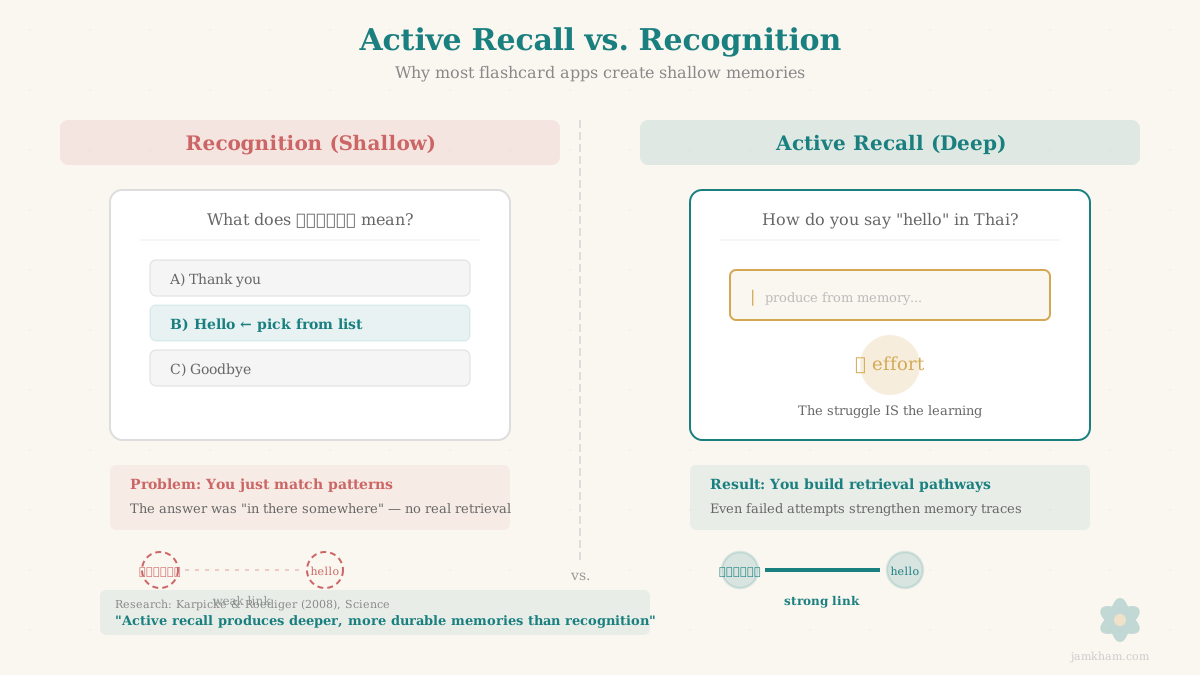
You’re using a language app. A Thai word appears. Four English translations are shown. You tap the correct one. “Correct!” says the app. You feel like you’re learning.
But are you?
That type of question—recognition—is fundamentally different from what you’ll need when speaking Thai. In conversation, you don’t see options. You have to produce the word yourself, from a blank mental canvas.
This distinction—recognition vs. active recall—is one of the most important in memory science. And most flashcard apps get it wrong.
The Four Levels of Vocabulary Knowledge
But first---what does “knowing a word” actually mean?
Level 1: Passive Recognition
- Test: See Thai, recognize meaning
- Example: You see สวัสดี and know it means “hello”
- Real-world use: Reading Thai text
Level 2: Active Recognition
- Test: Hear Thai, recognize meaning
- Example: Someone says “sawatdee” and you understand it
- Real-world use: Understanding spoken Thai
Level 3: Prompted Production
- Test: See English, produce Thai with hints
- Example: Shown “hello (sa___)”, you complete “sawatdee”
- Real-world use: Speaking with support (dictionary, translation app)
Level 4: Free Production
- Test: Want to say something, produce Thai from memory
- Example: You want to greet someone and say “sawatdee” without thinking
- Real-world use: Natural conversation
Most language apps test Level 1 heavily, Level 2 sometimes, Level 3 rarely, and Level 4 almost never.
What Research Shows
The testing effect—also called retrieval practice—is one of the most robust findings in cognitive psychology.
Roediger & Karpicke (2006) conducted a landmark study comparing study strategies. Students who practiced retrieving information (active recall) showed 50% better retention on a delayed test compared to students who simply re-studied the material.
The key insight: retrieval itself is a learning event, not just an assessment. When you successfully pull information from memory, you strengthen the neural pathways that store it. When you merely recognize information, those pathways get weaker reinforcement.
Dunlosky et al. (2013) reviewed 10 learning techniques in a comprehensive analysis. Their ranking:
| Technique | Effectiveness |
|---|---|
| Practice testing (active recall) | High |
| Distributed practice (spaced repetition) | High |
| Elaborative interrogation | Moderate |
| Self-explanation | Moderate |
| Re-reading | Low |
| Highlighting | Low |
| Summarization | Low |
The two highest-rated techniques are exactly what spaced repetition flashcards should do: active recall at spaced intervals.
The Recognition Trap
Why do most apps favor recognition? Several reasons:
- It’s easier to implement — Multiple choice questions are simple to generate
- Users feel successful — Recognition is easier, so accuracy is higher, so users feel good
- Engagement metrics look better — Happy users keep using the app (even if learning is shallow)
- Production is messy — Checking free-form Thai text for correctness is technically harder
The result: apps optimize for user satisfaction over learning outcomes.
Consider two approaches to learning สวัสดี (sawatdee, “hello”):
Recognition approach:
- Card 1: See สวัสดี, tap “hello” from 4 options
- Card 2: Hear audio, tap สวัสดี from 4 options
- Result: You pass both cards easily. You feel confident.
Production approach:
- Card 1: See “hello”, type/speak สวัสดี from memory
- Card 2: See สวัสดี, produce the tones correctly without audio
- Result: You struggle. You make mistakes. But each retrieval attempt strengthens memory.
The second approach is harder. It’s also dramatically more effective.
Why Production Matters for Thai
Thai adds complications that make production especially important:
1. Tones
Recognizing ม้า (horse) is different from producing it with the correct high tone. Recognition tests understanding. Production tests pronunciation. Both matter.
2. Classifiers
Thai uses classifiers for counting. You don’t say “three dogs”—you say “dog three classifier-for-animals” (หมาสามตัว, mǎa sǎam dtua). This requires producing the correct classifier, not just recognizing that classifiers exist.
3. Word Order
Thai places adjectives after nouns (“water cold” instead of “cold water”). Recognizing this pattern is one thing; producing it correctly in real time is another.
4. Romanization Crutch
If you only do recognition, you can mentally translate Thai to romanization without truly learning the script. Production from English forces you to produce Thai script or sounds directly.
The Input-Output Gap
Language learners often describe this frustrating experience: “I understand everything I hear, but I can’t speak.”
This is the input-output gap. Recognition (input processing) develops faster than production (output generation). They use different cognitive pathways.
Reading Thai and understanding someone speaking Thai exercises your recognition pathway. Speaking and writing Thai exercises your production pathway. Without explicit production practice, you develop a lopsided skill set.
Traditional flashcard apps worsen this problem. 90% recognition practice + 10% production practice = an input-heavy learner who struggles to speak.
How to Train Production
The good news: you can deliberately train production. Here’s how:
1. Flip Your Cards
Instead of Thai → English (recognition), use English → Thai (production). This simple change dramatically increases difficulty and learning.
2. Cover Before You Check
When doing Thai → English, cover the answer and try to produce something (a translation, a pronunciation, a sentence using the word) before revealing. This adds a production element to recognition cards.
3. Use Varied Card Types
Mix different formats:
- Audio → meaning (listening recognition)
- Meaning → Thai script (writing production)
- Meaning → pronunciation (speaking production)
- Sentence with blank → fill the word (contextual production)
4. Record Yourself
Speaking aloud when you produce answers helps. Recording yourself and playing it back (even occasionally) reveals pronunciation gaps you might miss.
5. Write, Don’t Type
For script production, physically writing Thai characters engages more motor memory than typing. Even on a touchscreen, tracing letters is better than tapping.
8 Card Types in Jam Kham
We designed Jam Kham around the production principle. Here’s how our card types balance recognition and production:
| Card Type | Direction | Skill Tested |
|---|---|---|
| Recognition | Thai → meaning | Reading comprehension |
| Production | Meaning → Thai | Speaking/writing |
| Listening | Audio → meaning | Listening comprehension |
| Audio Production | Meaning → audio selection | Pronunciation |
| Tone ID | Thai → tone | Tone recognition |
| Tone Production | Word → correct tone | Tone accuracy |
| Classifier | Noun → classifier | Grammatical production |
| Sentence Fill | Context → word | Contextual use |
By rotating through card types, you build all four levels of vocabulary knowledge—not just recognition.
Separate Tracking
We also track skills separately. You might recognize a word perfectly but produce its tone incorrectly. Our system identifies this gap and serves more tone production cards for that word specifically.
This targeted practice addresses your actual weaknesses, not just your overall accuracy.
The Desirable Difficulty Principle
Production is harder than recognition. That difficulty is the point.
Psychologist Robert Bjork coined the term desirable difficulty to describe learning conditions that:
- Slow down initial performance
- Feel more challenging
- Produce superior long-term retention
Active recall is a desirable difficulty. It feels harder because you’re doing more cognitive work. That work is exactly what builds lasting memory.
Apps that make learning feel easy are often sacrificing long-term retention for short-term user satisfaction. The experience is pleasant, but the knowledge doesn’t stick.
Practical Recommendations
Based on the research:
- Weight production heavily — At least 40% of your flashcard practice should involve producing Thai from memory
- Don’t skip difficult cards — Cards you struggle with are doing the most learning work
- Reduce multiple choice — If you’re using multiple choice, challenge yourself to produce the answer mentally before looking at options
- Practice speaking — Even when alone, say words aloud during production cards
- Embrace mistakes — Production errors are learning opportunities, not failures
Breaking the Recognition Habit
If you’ve been using recognition-heavy apps, you might find production uncomfortable at first. Some tips:
- Start small — Add 2-3 production cards per session, not 20
- Accept lower accuracy — Production accuracy will be lower than recognition. That’s normal.
- Trust the process — The difficulty is building stronger memories, even when it doesn’t feel like it
- Track progress over weeks — Production skills improve slowly but substantially
For more on the science behind effective flashcards, see Why Spaced Repetition Works. For vocabulary-specific advice, see our Vocabulary Learning Guide.