
Bangkok First-Timer's Language Guide
The Thai phrases that actually matter in Bangkok: taxi meter requests, market bargaining, street food ordering, and the local slang nobody teaches tourists.
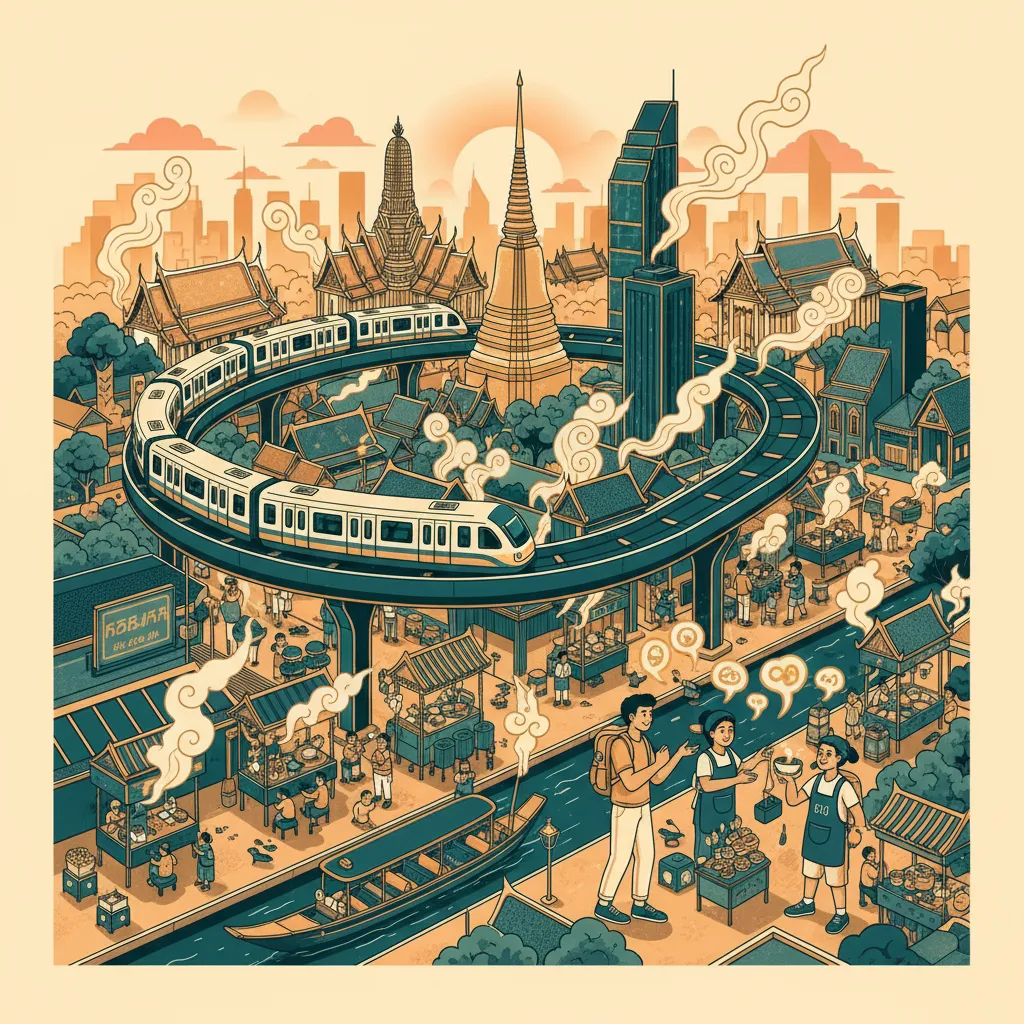
Bangkok is more forgiving for English speakers than almost anywhere else in Thailand. The BTS Skytrain has bilingual signage. Major malls have English-speaking staff. Sukhumvit Road’s tourist strip operates almost entirely in English.
But the Bangkok worth visiting — the street food stalls in Chinatown, the canal-side communities of Thonburi, the back-soi noodle shops in Ari, the fabric markets of Pahurat — is the Bangkok where English becomes unreliable. The old city, the real neighborhoods, the places where locals actually eat and shop: these run on Thai.
This guide covers the specific language situations you will encounter in Bangkok, not Thailand in general. The phrases overlap with broader Thai travel vocabulary, but the context — how and when you use them — is distinctly Bangkok.
Bangkok Runs on Five Interactions
Most of your language needs in Bangkok fall into five categories, in roughly this order of frequency:
- Transport — Getting from A to B in a city with 10 million people and legendary traffic
- Food — Street stalls, food courts, sit-down restaurants, convenience stores
- Shopping — Markets, malls, night bazaars, and the eternal “how much?”
- Accommodation — Hotels, hostels, and the phrases that make stays smoother
- Emergencies — Rare, but when you need language here, you really need it
Bangkok is not a city where you wander and stumble upon things. It is a city where you choose a destination, figure out how to get there, and navigate the interactions at the other end. Transport Thai is where it starts.
Transport Thai: Taxis, Tuk-Tuks, and the BTS
Taxis: The Two Phrases That Matter
Bangkok taxis are cheap, air-conditioned, and everywhere. They are also the interaction most likely to require Thai. Here are the two phrases you will use on every taxi ride.
bpai... khráp/khâไป...ครับ/ค่ะGo to... (destination)Simple. Say “bpai” followed by where you want to go. If you cannot pronounce the destination, show the address on your phone and say “bpai thîi-nîi” (go here):
bpai thîi-nîi khráp/khâไปที่นี่ครับ/ค่ะGo to here (showing address) bpə̀ət mí-dtə̂ə khráp/khâเปิดมิเตอร์ครับ/ค่ะTurn on the meterThis is the Bangkok taxi phrase. The meter. Some drivers, especially near tourist areas, will try to negotiate a flat fare. The flat fare is almost always more expensive than the meter. Say this phrase immediately after stating your destination. If the driver refuses, politely get out and take the next one. There is always a next one.
Other Transport Phrases
jɔ̀ɔt dtrong-níi khráp/khâจอดตรงนี้ครับ/ค่ะStop hereWhen you see your destination or want to get out. Works for taxis, tuk-tuks, and songthaews.
líao sáaiเลี้ยวซ้ายTurn left líao khwǎaเลี้ยวขวาTurn right dtrong bpaiตรงไปGo straightYou will use these less than you think — most drivers know where major destinations are or use GPS — but they are useful for the last few hundred meters.
(Thinking of relying on Google Translate in a Bangkok taxi? Here’s why that doesn’t work.)
Tuk-Tuks: Negotiate First
Tuk-tuks do not have meters. The price is agreed before you get in. This is a negotiation, and it follows a script:
You: ไป...เท่าไหร่ครับ/ค่ะ(bpai... thâo-rài khráp/khâ)
They name a price (usually high).
You: แพงไป(phaeng bpai) with a slight shake of the head.
They lower it, or you counter, or you walk to the next tuk-tuk. The walk-away is the most powerful negotiating tool. There is always another tuk-tuk.
A fair tuk-tuk price in Bangkok for a short trip (2-3 km) is 60-100 baht in 2026. If quoted 200+, negotiate or take a taxi — it will be cheaper with the meter.
BTS / MRT
Good news: the Skytrain and subway require almost no Thai. Signage is bilingual. Ticket machines have English. Staff at stations typically speak some English.
The one phrase you might need is for asking directions to the station:
sà-thǎa-nii rót-fai-fáa yùu thîi nǎi khráp/khâสถานีรถไฟฟ้าอยู่ที่ไหนครับ/ค่ะWhere is the Skytrain station?Or more simply, just the station name + ไปยังไง(bpai yang-ngai).
Grab and Bolt
Ride-hailing apps handle most of the communication for you — destination, price, and route are all in the app. But drivers sometimes call to confirm pickup location. The phrase you need:
yùu dtrong-níi khráp/khâอยู่ตรงนี้ครับ/ค่ะI'm right hereIf they cannot find you, describe what is near you or send a pin. The app’s chat function with auto-translate also works in a pinch.
For a comprehensive guide to all transport phrases, see our getting around guide.
These five interactions happen every day in Bangkok. Practice them before you arrive — Travel Thai paces your learning to your departure date.
Market Thai: Chatuchak, Pratunam, and Night Markets
Chatuchak Weekend Market has over 15,000 stalls. Pratunam is one of the largest clothing markets in Southeast Asia. Rot Fai night market stretches for what feels like kilometers. Bangkok is a shopping city, and its markets operate on Thai.
Essential Market Phrases
thâo-rài khráp/khâเท่าไหร่ครับ/ค่ะHow much?You will say this fifty times a day at markets. It is the most-used phrase in any Bangkok shopping context.
lót nɔ̀i dâi mái khráp/khâลดหน่อยได้ไหมครับ/ค่ะCan you reduce a bit?The polite opening of any negotiation. It works better than aggressive haggling. The “noi” (a little) signals that you are not trying to insult the price — just nudging it.
phaeng bpaiแพงไปToo expensiveIf the initial price is clearly inflated. Say it with a smile and a slight head shake. Usually followed by a counter-offer.
sʉ́ʉ sɔ̌ɔng an lót dâi máiซื้อสองอัน ลดได้ไหมBuy two, can you discount?Buying multiple items almost always unlocks a better price. This phrase makes the offer explicit.
Sizing and Trying On
mii sai yài gwàa níi máiมีไซส์ใหญ่กว่านี้ไหมDo you have a bigger size? lɔɔng dâi máiลองได้ไหมCan I try it on?At clothing markets, trying before buying is normal. Not all stalls have fitting rooms, but many do. Just ask.
Food Thai: From Yaowarat to Sukhumvit
Bangkok’s food scene deserves its own article (and we wrote one — see how to order food in Thai). Here is the Bangkok-specific context.
Yaowarat (Chinatown)
Bangkok’s Chinatown is one of the great street food destinations on earth. It operates differently from the rest of the city. Stalls are packed tight, vendors move fast, and the food is a mix of Thai and Chinese traditions.
Key differences from other Bangkok food areas:
- Portions are often smaller and cheaper — the expectation is that you graze across multiple stalls
- Some vendors speak Teochew (Chinese dialect) among themselves but communicate with customers in Thai
- Pointing is even more acceptable here than elsewhere — the stalls are visual and the food is on display
The phrases are the same as other street food situations: เอาอันนี้(ao an-níi), เท่าไหร่(thâo-rài), อร่อย(à-rɔ̂i). But the speed is faster and the crowds are thicker.
Sukhumvit and Tourist Areas
Restaurants along Sukhumvit, Silom, and Khao San Road typically have English menus. You can get by entirely in English here. But ordering in Thai — even at a tourist restaurant — changes the interaction. Faster service, warmer treatment, and occasionally dishes or specials not on the English menu.
Food Courts
Bangkok’s mall food courts (MBK, Terminal 21, Siam Paragon) use a coupon system. You buy a coupon card at a counter first, then use it to pay at individual stalls. Any remaining balance is refunded.
sʉ́ʉ kuu-bpɔɔng thîi nǎi khráp/khâซื้อคูปองที่ไหนครับ/ค่ะWhere do I buy coupons?This is the one phrase food courts require that other food situations do not. After that, ordering works the same as any stall.
Bangkok Food Quick Reference
| Situation | Thai | Meaning |
|---|---|---|
| Order this | เอาอันนี้ | I’ll have this one |
| Not spicy | ไม่เผ็ด | Not spicy |
| A little spicy | เผ็ดนิดหน่อย | A little spicy |
| To go | ใส่ถุง | Put in a bag |
| Eat here | กินที่นี่ | Eat here |
| How much | เท่าไหร่ | How much? |
| Delicious | อร่อย | Delicious |
| The bill | เช็คบิล | Check bill |
| Buy coupons | ซื้อคูปอง | Buy coupons |
| Plain water | น้ำเปล่า | Plain water |
The Phrases Nobody Tells You About
Every phrasebook covers hello, thank you, and how much. Here are the Bangkok-specific phrases that phrasebooks skip but that you will actually use.
The bathroom question
hɔ̂ng-náam yùu thîi nǎi khráp/khâห้องน้ำอยู่ที่ไหนครับ/ค่ะWhere is the bathroom?You will use this more than you expect. Bangkok has relatively few public restrooms. Most are in malls, hotels, and gas stations. Restaurants and cafes generally allow non-customers to use theirs if you ask politely.
The WiFi question
rá-hàt wai-fai à-rai khráp/khâรหัสไวไฟอะไรครับ/ค่ะWhat's the WiFi password?Essential for the modern traveler. Cafes, restaurants, and hostels almost always have WiFi. The password is sometimes posted, but often you need to ask.
Polite refusal
mâi ao khráp/khâไม่เอาครับ/ค่ะI don't want itFor persistent tuk-tuk drivers near tourist areas, tailors who approach you on the street, and anyone offering something you do not want. Polite, firm, and final. Add a smile and a slight wai (hands together) to soften it further.
Simple yes and no
châiใช่Yes / That's right mâi châiไม่ใช่No / That's not rightDifferent from the polite ครับ/ค่ะ(khráp/khâ) — these mean “correct” and “not correct.” When a taxi driver asks if you want to go to a specific place, or a vendor confirms your order, “chai” and “mai chai” are what you need.
”Can I take a photo?”
thàai rûup dâi mái khráp/khâถ่ายรูปได้ไหมครับ/ค่ะCan I take a photo?At temples, markets, and some shops, asking before photographing is respectful. Most people will say yes. The act of asking matters more than the answer — it shows awareness and politeness. This is especially important at temples and cultural sites.
Bangkok-Specific Slang Worth Knowing
These are not phrases you will actively use. They are words you will hear, see on signs, or encounter in conversation. Knowing them makes Bangkok more legible.
Rot dtit (Traffic jam)
rót dtìtรถติดTraffic jamYou will hear this constantly. Bangkok traffic is a defining feature of the city. When your taxi driver says “rot dtit” and gestures ahead, they are telling you why you are not moving. When someone is late to a meeting, “rot dtit” is the default explanation. It is less an excuse and more a shared reality.
Your taxi driver may ask: ไปทางไหนดี(bpai thaang nǎi dii) — asking you to choose a route. If you do not know, แล้วแต่คุณ(láaeo-dtàe khun) puts the decision back in their (more experienced) hands.
Soi (Side street / lane)
sɔɔiซอยSide street / laneBangkok’s address system revolves around sois. A major road like Sukhumvit has numbered sois branching off it. “Soi 11” is not just a number — it is a neighborhood, with its own restaurants, bars, and character. Soi 38 was famous for street food. Soi Cowboy has its own reputation.
When giving directions, soi is the key unit: ซอยอะไรครับ(sɔɔi à-rai khráp) is something taxi drivers ask when you name a main road but not a specific address.
Khlong (Canal)
khlɔɔngคลองCanalBangkok was once called the “Venice of the East” for its network of canals. Many survive, and the Khlong Saen Saep boat is a surprisingly fast way to cross the city. Knowing the word “khlong” helps you navigate references to canal-side communities, boat routes, and older parts of the city.
Farang (Foreigner / Western person)
fà-ràngฝรั่งForeigner / WesternerYou will hear this. It refers to Western foreigners and is not inherently rude — it is descriptive, the same way “Thai” describes Thai people. ราคาฝรั่ง(raa-khaa fà-ràng) (farang price) is the inflated price some vendors quote to tourists. Knowing the word helps you recognize when it is being used around you.
Putting It Together
Bangkok is a city that rewards language effort disproportionately. You do not need fluency. You do not even need particularly good pronunciation. What you need is a handful of phrases used at the right moments: the meter request in the taxi, the “how much” at the market, the “delicious” at the food stall, and the “mai ao khrap” to the persistent vendor.
The gap between a tourist who speaks zero Thai and one who speaks thirty phrases is not measured in language skill. It is measured in the quality of the trip. Better prices, better food, warmer interactions, and access to parts of the city that the English-only experience misses entirely.
Your Bangkok trip has a date. Set it in Jam Kham and we will pace your learning so these phrases are ready when you land. Start free.
Related reading: 30 Thai Phrases Every Tourist Needs | How to Order Food in Thai | Getting Around Phrases | Shopping and Market Phrases