
Chiang Mai Language Essentials: Thai Phrases for the North
A Chiang Mai language guide: red-truck songthaew fares, old city navigation, walking street markets, cooking classes, and northern Thai phrases.
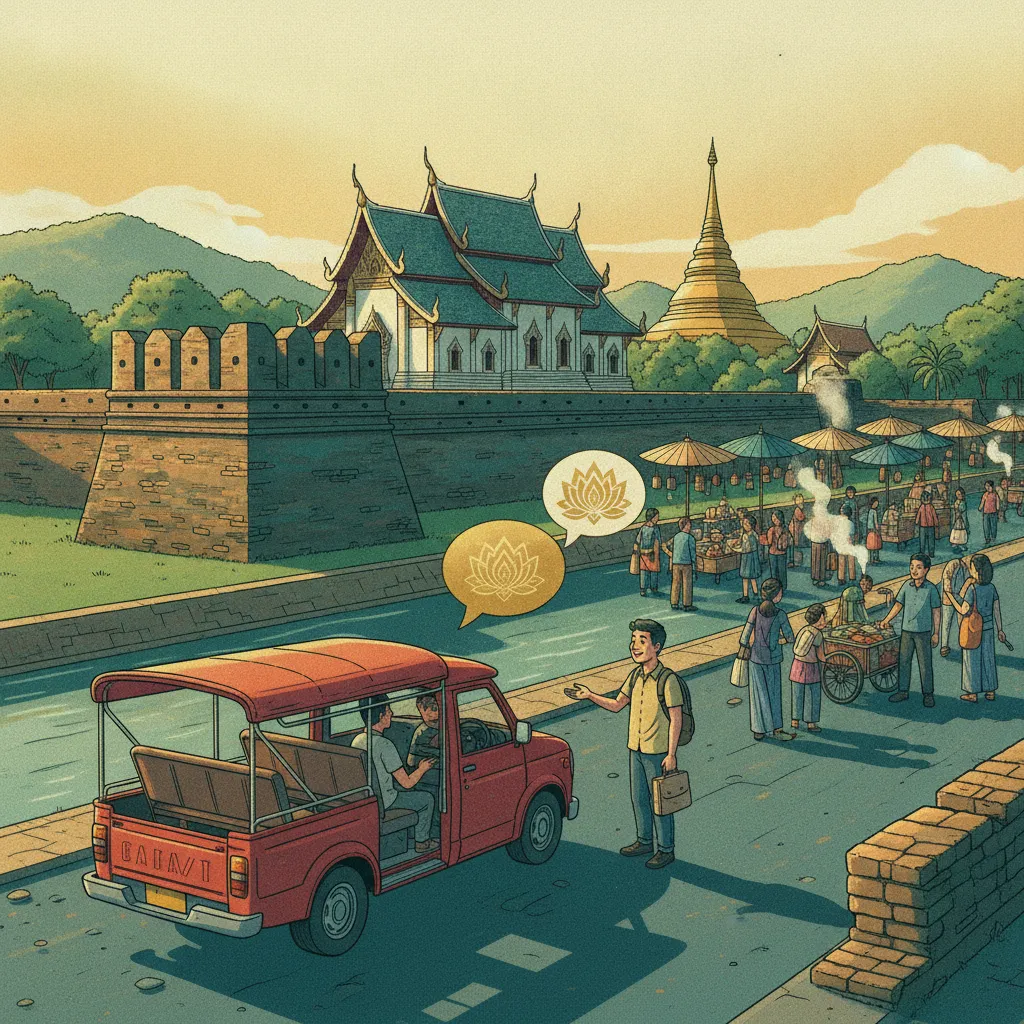
This is the third stop in our destination series. We covered the capital in the Bangkok first-timer’s language guide and the islands in the Phuket language essentials guide. Chiang Mai is a different beast again: slower than Bangkok, cooler than Phuket, and built around a compact old city you can cross on foot in twenty minutes. This Chiang Mai language guide covers the Thai you’ll actually use here — the red-truck fares, the temple-dense navigation, the walking-street markets, the cooking classes, and the cafe culture that’s turned Nimman into a digital-nomad hub.
The phrases overlap with general Thai travel vocabulary, but Chiang Mai changes when and how you use them. If you haven’t worked through the 30 core phrases every tourist needs yet, start there — everything below assumes those basics.
Getting Around: The Red Trucks
Chiang Mai has no Skytrain and no subway. The backbone of local transport is the songthaew — a converted pickup with two bench seats in the back. In Chiang Mai they’re red, so everyone calls them รถแดง(rót daeng). They run shared, hail-anywhere, drop-anywhere routes rather than fixed lines.
bpai... thâo-ràiไป...เท่าไหร่How much to go to...?The phrase you’ll use most. Name your destination, ask the price before you climb in. Inside the old city, the standard fare is a flat 30 baht per person. Out to Nimman or the night bazaar runs about 50 baht, and longer trips top out around 100. If a driver quotes far above that, it’s a tourist markup — wave the next one down.
long dtrong-níiลงตรงนี้I'll get off hereSongthaews stop on request. When you near your spot, say this or press the buzzer on the cabin roof.
Getting-Around Phrases
| Thai | Romanization | Meaning |
|---|---|---|
| ไปเมืองเก่า | bpai meuang gào | Go to the old city |
| ไปนิมมาน | bpai nim-maan | Go to Nimman |
| ไปดอยสุเทพเท่าไหร่ | bpai dawi sù-thêep thâo-rài | How much to Doi Suthep? |
| รอได้ไหม | raw dâi mái | Can you wait? |
| ลงตรงนี้ | long dtrong-níi | Stop here / I’ll get off here |
| เหมาเท่าไหร่ | mǎo thâo-rài | How much to charter (the whole truck)? |
For the trip up to Doi Suthep, the mountain temple, drivers usually quote a charter price rather than the shared fare. เหมา(mǎo) is the key word — it means hiring the truck just for you, round trip, with the driver waiting. Grab and Bolt also work in Chiang Mai and handle the language for you, though coverage thins out once you leave the city center.
Navigating the Old City
Here’s what makes Chiang Mai different from Bangkok and Phuket: you’ll spend most of your time on foot inside a square-kilometer grid ringed by a moat and old brick walls. That means you ask for directions far more than you negotiate rides. Knowing the landmarks by their Thai names makes every direction-asking conversation smoother.
bprà-dtuu thâa-phaeประตูท่าแพTha Phae Gate (the main east gate)Tha Phae Gate is the old city’s front door and the reference point everyone uses. ประตู(bprà-dtuu) is the word for the city gates, and there are four main ones plus corner bastions.
...yùu thîi nǎi...อยู่ที่ไหนWhere is...?The universal direction question. Plug in a temple or a gate: วัดพระสิงห์อยู่ที่ไหน(wát phrá-sǐng yùu thîi nǎi).
wátวัดtempleYou can’t go fifty meters in the old city without passing a wát. When you’re navigating, temples are the landmarks locals point to. Just remember that a temple is a place of worship first — if you step inside, the dress code and etiquette matter. We cover that in detail in the Chiang Mai temple etiquette phrases guide, and it’s worth reading before you visit Wat Phra Singh or Wat Chedi Luang.
Old City Navigation
| Thai | Romanization | Meaning |
|---|---|---|
| …อยู่ที่ไหน | …yùu thîi nǎi | Where is…? |
| ไกลไหม | glai mái | Is it far? |
| เดินไปได้ไหม | doen bpai dâi mái | Can I walk there? |
| ตรงไป | dtrong bpai | Go straight |
| เลี้ยวซ้าย / เลี้ยวขวา | líao sáai / líao khwǎa | Turn left / turn right |
| ใกล้ประตูท่าแพ | glâi bprà-dtuu thâa-phae | Near Tha Phae Gate |
In the old city, the answer is almost always yes. Distances that feel like they need a ride are usually a ten-minute stroll past three more temples.
Market and Walking Street Thai
Chiang Mai’s markets are an event. On Sundays, the Sunday Walking Street closes Ratchadamnoen Road from Tha Phae Gate all the way to Wat Phra Singh — over a kilometer of handicraft stalls and food, roughly 4pm to midnight. On Saturdays, the smaller, mellower Saturday Walking Street takes over Wualai Road, the old silversmith neighborhood. And the Night Bazaar on Chang Klan Road runs every night for the tourist crowd.
The phrases are your standard market kit, but you’ll lean on them hard.
thâo-ràiเท่าไหร่How much? lót nàwi dâi máiลดหน่อยได้ไหมCan you come down a little?The polite opener for any bargain. The หน่อย(nàwi) softens it — you’re nudging the price, not insulting it. Chiang Mai’s craft sellers are generally relaxed; a smile gets you further than hard haggling. For the full playbook, see how to bargain in Thai.
tham eeng rěu bplàoทำเองหรือเปล่าDid you make this yourself?A genuinely useful question at the walking streets, where a lot of the goods are handmade — silver from Wualai, woven textiles, woodcarving, paper umbrellas from nearby Bo Sang. Asking shows interest and often gets you the maker’s story, which is half the point of shopping here.
Eating Your Way Through the Market
The walking streets are as much food court as craft market. Northern food is its own cuisine — milder than southern Thai, with its own signatures.
khǎw an-níiขออันนี้I'll have this onePoint and say it. Works at every stall.
khâao sawiข้าวซอยkhao soi (northern curry noodle soup)Chiang Mai’s most famous dish: egg noodles in a coconut-curry broth, topped with crispy fried noodles. If you eat one thing in the north, eat this. Order it and you’ve instantly signaled you know the local food.
sâi ùaไส้อั่วsai ua (northern herb sausage) nám-phrík nùmน้ำพริกหนุ่มnam prik num (roasted green chili dip)Two more northern staples worth knowing by name. Order them by name at a market stall and watch the vendor’s reaction shift.
Market and Food Quick Reference
| Thai | Romanization | Meaning |
|---|---|---|
| เท่าไหร่ | thâo-rài | How much? |
| ลดหน่อยได้ไหม | lót nàwi dâi mái | Can you come down a little? |
| ขออันนี้ | khǎw an-níi | I’ll have this one |
| ไม่เผ็ด | mâi phèt | Not spicy |
| ใส่ถุง | sài thǔng | Put it in a bag (to go) |
| อร่อย | à-ràwi | Delicious |
| คิดเงิน | khít ngoen | The bill, please |
Cooking Class Thai
Chiang Mai is the cooking-class capital of Thailand. Most classes start with a market tour, so a little ingredient vocabulary turns you from passive tourist into someone who can actually follow along.
an-níi kheu à-raiอันนี้คืออะไรWhat is this?The single best question on a market tour. Point at an unfamiliar herb or paste and ask. Instructors love it — it’s literally the lesson.
phèt dâi nít-nàwiเผ็ดได้นิดหน่อยA little spicy is okayCooking your own food means controlling your own heat. This phrase lets you tune the spice to your tolerance without going full ไม่เผ็ด(mâi phèt).
Cooking Class Vocabulary
| Thai | Romanization | Meaning |
|---|---|---|
| อันนี้คืออะไร | an-níi kheu à-rai | What is this? |
| เผ็ด | phèt | Spicy |
| หวาน | wǎan | Sweet |
| เปรี้ยว | bprîao | Sour |
| เค็ม | khem | Salty |
| ผัก | phàk | Vegetable |
| น้ำปลา | nám-bplaa | Fish sauce |
Cafe and Nomad Culture
Chiang Mai, and Nimmanhaemin (Nimman) in particular, is one of Asia’s biggest remote-work hubs. The cafe scene is world-class, and if you’re staying weeks rather than days, the language need shifts from transactions to small repeated interactions. If that’s you, our guide to Thai for digital nomads goes deeper than this section.
mii bplák-fai máiมีปลั๊กไฟไหมAre there power outlets?The remote worker’s first question. Most Nimman cafes are laptop-friendly, but seats near outlets go fast.
rá-hàt wai-fai à-raiรหัสไวไฟอะไรWhat's the WiFi password? nâng tham-ngaan dâi máiนั่งทำงานได้ไหมIs it okay to sit and work here?Worth asking at smaller or busier cafes, some of which limit laptop hours during peak times. Asking first is the courteous move.
A Note on Northern Thai (Kam Meuang)
Locals around Chiang Mai grew up speaking คำเมือง(kam meuang), also called Lanna or Tai Yuan. It’s a distinct northern language, not just an accent. Exactly as in Phuket, you don’t need to learn it. Central (Bangkok) Thai is understood by everyone — shop staff, drivers, instructors, market vendors. Northern words just earn you a delighted double-take.
A few you’ll hear, and might sprinkle in:
sà-wàt-dii jâoสวัสดีเจ้าhello (with the northern polite particle)In the north, เจ้า(jâo) often replaces the Central ครับ/ค่ะ(khráp/khâ). You’ll hear “sà-wàt-dii jâo” from a shopkeeper or a 7-Eleven cashier. Echo it back and you’ve just made someone’s morning.
ûu kam meuangอู้กำเมืองto speak northern ThaiIf you want to ask whether someone speaks northern Thai, or comment that you’re trying to, this is the phrase. อู้(ûu) is the northern word for “speak,” where Central Thai uses พูด(phûut).
bpai àeoไปแอ่วto go out / go traveling (northern)A wonderfully northern word. แอ่ว(àeo) covers visiting, sightseeing, and just hanging out. “bpai àeo Chiang Mai” — come hang out in Chiang Mai — is the spirit of the place in two words.
A Seasonal Heads-Up
One Chiang Mai reality no language guide should skip: the burning season. Roughly late February through April, agricultural burning and regional haze push air quality to some of the worst readings on the planet, and the city can disappear into smoke. If you’re planning around the cool, clear months, aim for November to February. If you do come in the smoky season, the phrase you’ll want is มีหน้ากากไหม(mii nâa-gàak mái) — pharmacies (ร้านขายยา(ráan khǎai yaa)) stock N95s when the haze rolls in.
Putting It Together
Chiang Mai rewards a different language toolkit than the rest of Thailand. You won’t fight over taxi meters or seafood-by-the-kilo here. You’ll ask the way to one more temple, agree a 30-baht red-truck fare, bargain gently for a paper umbrella, ask a cooking instructor what an herb is, and — if you’re lucky — catch a “sà-wàt-dii jâo” and hand one right back.
None of it requires fluency. It requires a handful of phrases used at the right moment, with a smile. The gap between the traveler who speaks zero Thai and the one who speaks thirty phrases isn’t measured in grammar — it’s measured in warmer markets, fairer prices, and a north that opens up a little wider.
Frequently Asked Questions
Do I need to speak Thai in Chiang Mai?
Not strictly. The old city, Nimman, and the main markets all have enough English to get by. But Chiang Mai is a slower, friendlier place than Bangkok or Phuket, and even a little Thai goes a long way here — a price question at a market stall or a greeting at your guesthouse earns warmer treatment and better prices. The effort-to-payoff ratio is unusually high in the north.
How much should a red-truck songthaew cost in Chiang Mai?
Inside the old city, the standard shared fare is a flat 30 baht per person. Out to Nimman or the night bazaar is around 50 baht, and longer trips top out near 100 baht. For Doi Suthep or out-of-town runs, drivers quote a charter price (mǎo) rather than the shared fare — agree on the number before you get in.
Do people in Chiang Mai speak a different language?
Locals speak kam meuang (northern Thai, also called Lanna), which is a distinct northern language rather than just an accent. But everyone also speaks and understands Central Thai — the standard Bangkok dialect — so anything you’ve practiced works fine. A few northern words, like the polite particle “jâo,” are a nice bonus, not a requirement.
When is the best time to visit Chiang Mai?
November to February is the sweet spot: cool, dry, and clear. Avoid late February through April if you can — that’s the burning season, when agricultural fires and haze push air quality to hazardous levels and the mountains vanish into smoke. The green season (roughly June to October) is humid with afternoon rain but lush and far less crowded.
What food should I order by name in Chiang Mai?
Start with khao soi (egg noodles in coconut curry broth), then try sai ua (northern herb sausage) and nam prik num (roasted green chili dip). Ordering these by name at a market stall signals you know the local cuisine, and it almost always gets a warm reaction from the vendor.
Practice Before You Go
Reading a phrase on a screen and saying it to a Chiang Mai red-truck driver are two different skills. Jam Kham’s Speak Thai track paces your daily practice to your trip date, with clear audio on every phrase so the north sounds familiar before you arrive.
Speak Thai is coming soon — join the waitlist for founding pricing.
Related reading: Bangkok First-Timer’s Language Guide · Phuket Language Essentials · Chiang Mai Temple Etiquette Phrases · Thai for Digital Nomads