
Chiang Mai Temple Etiquette: Thai Phrases
300+ temples, specific dress codes, monk interaction rules, and the Thai phrases that transform temple visits from sightseeing to genuine cultural exchange.
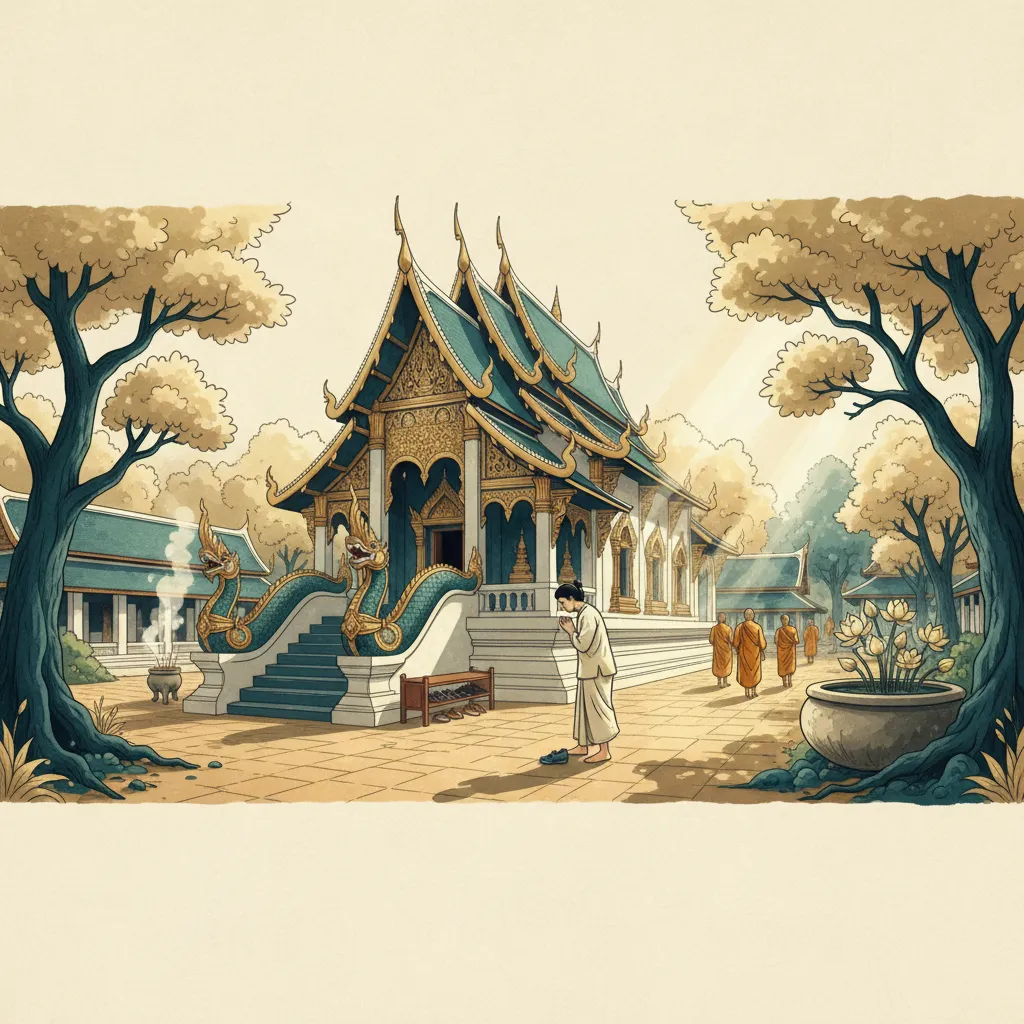
You can’t walk ten minutes in Chiang Mai’s Old City without passing a temple. The city has over 300 of them—more per square kilometer than anywhere else in Thailand. Some are major tourist draws with tour buses parked outside. Others are neighborhood temples where monks go about morning routines while locals make offerings before work.
Most visitors treat temples like museums: enter, photograph, leave. The interactions stay transactional. A few Thai phrases change that dynamic entirely. Not because the phrases are complex, but because they signal something specific—you’ve taken the time to understand what this space means to the people who use it daily.
This guide covers the phrases, the etiquette, and the cultural context that transforms a Chiang Mai temple visit from sightseeing into something more substantial.
Chiang Mai Has 300+ Temples. Here’s What to Know Before Entering Any of Them
The rules aren’t complicated, but they’re non-negotiable.
Dress code: Cover your shoulders. Cover your knees. This applies to everyone, regardless of gender. Many major temples have wrap-around cloths available at the entrance for visitors who arrive underprepared—but relying on that signals a lack of preparation. Wear lightweight long pants or a skirt that covers the knees, and a top with sleeves.
Shoes: Remove them before entering any building. You’ll see rows of shoes outside every temple hall. This isn’t a suggestion. Look for the threshold—usually a raised step at the entrance—and leave your shoes before crossing it.
Feet: Never point your feet toward a Buddha image or a monk. When sitting inside a temple hall, tuck your feet behind you or sit cross-legged. This connects to the Thai cultural concept that feet are the lowest part of the body, both physically and spiritually.
Head: Don’t touch anyone’s head, especially not a child’s. The head is the highest, most sacred part of the body. This applies everywhere in Thailand, but it’s especially relevant in temple contexts.
The language dimension adds something that dress codes alone can’t. A visitor who follows all the physical rules but speaks only English still reads as a tourist observing from outside. A visitor who adds สวัสดีครับ/ค่ะ(sà-wàt-dii khráp/khá) with a proper wai reads as someone engaging with the culture on its own terms.
(Cultural phrases are exactly where translation apps fail hardest — they miss register and context entirely.)
For deeper cultural context beyond temples, see our Thai cultural guide.
Phrases for Temple Visits
You don’t need dozens of phrases. Five or six, used at the right moment with the right tone, accomplish more than a full phrasebook.
khɔ̌ɔ thôot khráp/kháขอโทษครับ/ค่ะExcuse me / I'm sorry (polite)This is the single most useful temple phrase. You will make small mistakes—stepping somewhere you shouldn’t, accidentally blocking someone’s path to a shrine, fumbling with shoes at the entrance. ขอโทษ(khɔ̌ɔ thôot) delivered with a slight bow acknowledges the error without drama. Thai culture values smooth social surfaces. A quick, sincere apology maintains them.
sǎa-thúสาธุBuddhist acknowledgment / amenYou’ll hear this word constantly at temples. It’s spoken after prayers, after a monk’s blessing, after merit-making. The closest English equivalent might be “amen,” but it carries a broader meaning—acknowledgment, agreement, reverence. When you hear others say it, joining in is appropriate and appreciated. Hands in a wai position, a quiet สาธุ(sǎa-thú).
thàai rûup dâi máiถ่ายรูปได้ไหมCan I take a photo?Always ask before photographing monks, ceremonies, or people praying. Some temple halls prohibit photography entirely—look for signs. But in open areas and courtyards, asking first is the respectful approach. A monk who says yes will often pose patiently. A monk who says no will appreciate that you asked.
The wai: Not a phrase, but inseparable from every verbal exchange at a temple. Press your palms together, fingers pointing upward, and bow slightly. The height matters. For monks, raise your hands so your thumbs touch your forehead—this is the highest wai, reserved for monks and the King. For laypeople, thumbs at nose level. For casual greetings, thumbs at chest level.
For more on the formal language registers used at temples, see our guide on Thai politeness levels.
Interacting with Monks: What’s Appropriate and What Isn’t
Many visitors are surprised to learn that monks in Chiang Mai frequently welcome conversation with foreigners. Several temples run formal “monk chat” programs specifically designed for cultural exchange. Monks who participate are often studying English and value the practice as much as visitors value the cultural insight.
What’s appropriate:
- Sitting and talking when a monk initiates or when a monk chat program is in session
- Asking respectful questions about Buddhism, temple life, or Thai culture
- Sharing information about your own country or background when asked
What isn’t:
- Approaching a monk in meditation
- Physical contact of any kind
- Photographing without asking
- Using casual or street-level Thai
That last point matters. The language you’d use ordering food at a night market is not the language you’d use speaking with a monk. Thai has distinct registers, and temple contexts call for formal speech.
Casual vs. Formal Register at Temples
| Context | Casual Thai | Formal Thai |
|---|---|---|
| Hello | สวัสดี (sà-wàt-dii) | สวัสดีครับ/ค่ะ (sà-wàt-dii khráp/khá) |
| Eat | กิน (gin) | ทาน (thaan) or รับประทาน (ráp-prá-thaan) |
| Yes | ครับ/ค่ะ (khráp/khá) | ครับผม/เจ้าค่ะ (khráp phǒm/jâo khá) |
| Thank you | ขอบคุณ (khɔ̀ɔp-khun) | ขอบพระคุณ (khɔ̀ɔp phrá-khun) |
Note: When speaking with monks, always use formal register. The polite particles (khráp for men, khá for women) should end every sentence.
If you address a monk directly, พระอาจารย์(phrá aa-jaan) is the respectful form. You’ll hear Thai visitors use it, and using it yourself signals that you understand the social dynamic of the space.
At Wat Chedi Luang, the monk chat program runs Wednesday afternoons—an ideal setting if you’re uncertain about protocol. The monks who participate expect foreign visitors and will gently guide the interaction.
Five Temples Worth the Language Effort
Chiang Mai’s temples aren’t interchangeable. Each has a distinct character, and the language context varies. Here are five where knowing some Thai meaningfully changes the experience.
1. Wat Phra That Doi Suthep
The mountain temple. Chiang Mai’s most famous, perched at 1,000 meters with views across the city. The 306-step naga staircase is the traditional entrance, though a tram exists for those who prefer it.
Language context: Monks here are accustomed to foreign visitors and many speak some English. But opening in Thai—even just a greeting and สาธุ(sǎa-thú) during the evening prayer chanting—earns a different quality of acknowledgment. The temple is crowded enough that most tourists never speak to anyone. You’ll stand out.
2. Wat Chedi Luang
Home to Chiang Mai’s most accessible monk chat program. The massive central chedi, partially destroyed by a 16th-century earthquake, anchors a complex where monks study and live.
Language context: The monk chat program is the draw here. Monks studying English sit at designated tables and welcome conversation. Starting in Thai before switching to English shows respect and often leads to longer, more candid exchanges. Ask about temple life, Buddhism, or Chiang Mai—they’ll ask about your country in return.
3. Wat Phra Singh
One of Chiang Mai’s most important temples, housing the Phra Singh Buddha image. Ceremonial Thai is used during prayers and rituals you can observe from designated areas.
Language context: This temple hosts frequent ceremonies. If you visit during one, silence and observation are appropriate. The prayers use Pali, the liturgical language of Theravada Buddhism, mixed with formal Thai. You won’t understand the words, but understanding that this is a living religious practice—not a performance—shapes how you behave.
4. Wat Umong
A forest temple on the western edge of the city. Tunnels beneath the main structure give it its name. Quieter than the Old City temples, with monks often in meditation.
Language context: This is not a talking temple. The atmosphere is contemplative. Silence is valued. If you do interact with a monk here, keep it brief and quiet. The best Thai for Wat Umong is no Thai at all—respectful presence says enough.
5. Wat Suan Dok
A monastery complex that hosts international meditation retreats. The white-washed chedi field at sunset is one of Chiang Mai’s most photographed scenes.
Language context: The meditation retreats are conducted partly in English, but the monastery itself operates in Thai. If you attend a retreat, you’ll learn basic Thai meditation vocabulary: นั่งสมาธิ(nâng sà-maa-thí), หายใจเข้า(hǎai-jai khâo), หายใจออก(hǎai-jai ɔ̀ɔk).
For more destination-specific guidance, see our Thai destinations guide.
Beyond Temples: Chiang Mai Thai Is Different
You’ll notice something within your first day in Chiang Mai: the Thai sounds different from what you studied. That’s because Northern Thai—known as คำเมือง(kham mʉeang)—exists alongside Central Thai throughout the region.
You don’t need to learn Kham Mueang. Central Thai works everywhere in Chiang Mai, and locals will use it with you by default. But knowing that Northern Thai exists prevents confusion when you hear unfamiliar words or greetings in contexts where you expected to understand.
Central Thai vs. Northern Thai
| Meaning | Central Thai | Northern Thai |
|---|---|---|
| Thank you | ขอบคุณ (khɔ̀ɔp-khun) | ขอบใจ๋ (khɔ̀ɔp-jai) |
| Hello | สวัสดี (sà-wàt-dii) | สบายดีก่อ (sà-baai dii gɔ̀ɔ) |
| Delicious | อร่อย (à-rɔ̂i) | ลำ (lam) |
| Fun / Good time | สนุก (sà-nùk) | ม่วน (mûan) |
Note: You’ll hear both Central and Northern Thai in Chiang Mai. Use Central Thai—locals will understand perfectly—but recognize Northern Thai when you hear it.
Northern Thai has its own script, its own tonal patterns, and vocabulary that doesn’t appear in Central Thai at all. At markets, you might hear vendors using Kham Mueang among themselves before switching to Central Thai with you. At temples, older monks may use Northern Thai in conversations with local visitors.
The practical takeaway: if a word sounds completely unfamiliar even though you’ve been studying, it might be Northern Thai rather than a gap in your knowledge.
For a deeper look at regional language differences across Thailand, see our post on Thai dialects and regional variations.
The “Tam Bun” Concept: Merit-Making for Visitors
tam bunทำบุญMake meritMerit-making sits at the center of Thai Buddhist life. The concept is straightforward: good actions generate merit (bun), which shapes this life and future ones. Thai people make merit regularly—daily for many—through specific acts at temples and in daily life.
Tourists can participate, and doing so respectfully represents the deepest form of cultural engagement available at a temple. This isn’t performance or spectacle. It’s joining, briefly, in a practice that structures how millions of people relate to the world.
Common merit-making activities visitors can join:
-
Offering food to monks: During morning alms rounds (typically 6-7 AM), monks walk through neighborhoods collecting food. You can purchase prepared offerings near temples and present them as monks pass. Kneel as the monk approaches, place the food in the offering bowl without touching the monk.
-
Lighting incense and candles: At temple shrines, sets of incense, candles, and gold leaf are available for a small donation. Light the incense, place it in the sand-filled tray, and make a wish or prayer.
-
Releasing fish or birds: Some temples offer this practice as merit-making, though its ethics are debated. The intention is to give life and freedom.
-
Donating to temple maintenance: Many temples have donation boxes. Even small contributions are merit-making.
The phrase for participation:
khɔ̌ɔ tam bun khráp/kháขอทำบุญครับ/ค่ะI'd like to make merit (polite)Say this to a temple attendant or vendor near a shrine, and they’ll guide you through the process. You don’t need to be Buddhist. The act is about intention and respect, and Thai people welcome sincere participation from visitors of any background.
The cultural depth here is real. A visitor who makes merit at a Chiang Mai temple—even once, even imperfectly—has experienced something that temple photography alone never captures. The phrases are simple. The etiquette is learnable. The interaction stays with you.
Prepare for Your Chiang Mai Trip
Chiang Mai rewards visitors who engage with the culture. A few well-placed Thai phrases at a temple earn a quality of interaction that photos alone never capture.
The phrases in this guide work because they’re the right words in the right context—formal register where formality matters, sincere participation where sincerity matters.
If you’re preparing for a Chiang Mai trip and want to practice these phrases with native audio and tone guidance, Jam Kham’s travel packs include temple vocabulary, register guidance, and cultural context for every phrase. Prepare for your Chiang Mai trip.
Related reading: Thai Phrases Locals Love | Thai Politeness Levels | Thai Dialects & Regional Variations | Thai Cultural Guide