
How Many Thai Words Should You Learn Per Day?
The optimal number of new vocabulary words per day—backed by research. Why learning too many creates review backlogs, and how to find your sustainable pace.
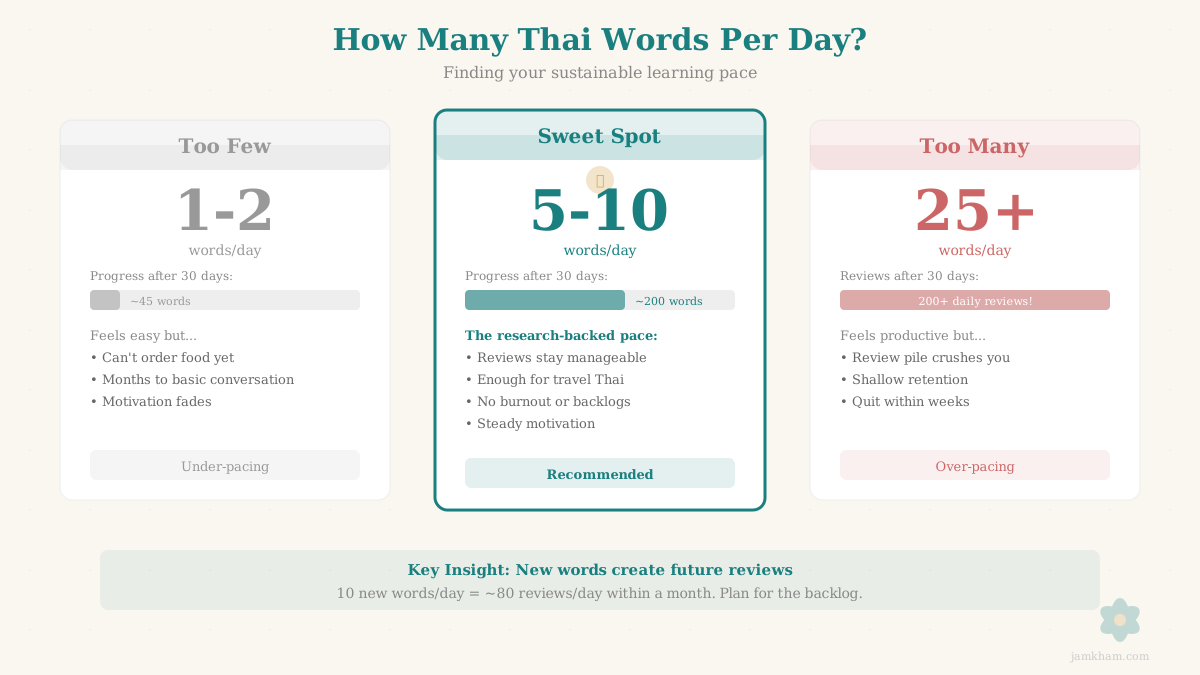
“Learn 50 new Thai words today!” says the enthusiastic app notification. You spend an hour cramming through flashcards, feeling productive. A week later, you have 350 words in your review queue. The next session takes 2 hours. You skip a day. Then another. Eventually, you delete the app.
This pattern is so common it has a name: review burnout. The problem isn’t lack of willpower—it’s the math of spaced repetition.
The Review Bottleneck
Every new word you learn today becomes a review for tomorrow. And the day after. And next week. And next month.
Here’s how it compounds:
| Day | New Words | Reviews Due | Total Cards |
|---|---|---|---|
| 1 | 20 | 0 | 20 |
| 2 | 20 | 20 | 40 |
| 3 | 20 | 35 | 55 |
| 7 | 20 | 80 | 100 |
| 14 | 20 | 150 | 170 |
| 30 | 20 | 250+ | 270+ |
At 20 new words per day, you’re looking at 250+ reviews daily by the end of month one. Each review takes 5-15 seconds on average. That’s 20-60 minutes just for reviews—before learning anything new.
What Research Suggests
Studies on vocabulary acquisition and spaced repetition converge on a similar range:
10-15 new items per day is sustainable for most adult learners.
This number comes from several sources:
-
Pimsleur’s research (1967) on graduated interval recall suggested 25-30 items per hour of instruction, with sessions not exceeding 30 minutes daily.
-
Nation’s vocabulary learning research indicates that for true acquisition (not just recognition), learners need 5-16 meaningful encounters with a word. At 10 words/day, this is achievable.
-
SRS user data from apps like Anki shows that users who maintain long-term streaks typically learn 10-20 new cards daily, with higher numbers correlating with eventual abandonment.
The 10-15 range works because:
- Reviews stay manageable (50-100 per day after a month)
- Each word gets adequate attention
- Sessions remain under 30 minutes
- Motivation doesn’t tank from overwhelm
Finding Your Number
The “right” number depends on your schedule, goals, and current level:
Beginners: Start Lower
If you’re new to Thai, your reviews will take longer because everything is unfamiliar. Consider:
- Week 1-2: 5-10 new words/day
- Week 3-4: 8-12 new words/day
- Month 2+: 12-15 new words/day
You’re also building foundational skills (tones, script basics) that require extra attention. Don’t rush.
Intermediate Learners: Find Your Ceiling
Once you’ve internalized Thai phonology and basic grammar, you can push higher:
- 15-20 new words/day is sustainable for committed learners
- Watch your review time—if it exceeds 45 minutes daily, slow down
- Quality still matters more than quantity
Busy Professionals: Consistency Over Volume
If you only have 15 minutes per day:
- 5-10 new words is realistic
- Prioritize completing reviews over adding new words
- A smaller consistent habit beats sporadic intense sessions
The Quality Question
Word count isn’t the only factor. Learning quality matters too.
Consider what “learning a Thai word” actually means:
- Recognize the Thai script
- Produce the correct pronunciation
- Know the correct tone
- Understand the meaning
- Use it in appropriate context
- Handle related classifiers (for nouns)
A single Thai word might require 4-5 distinct “knowledge pieces.” A vocabulary card that only tests recognition (Thai → English) leaves production untested.
Jam Kham addresses this with 8 card types that test different knowledge dimensions:
- Recognition (Thai → meaning)
- Production (meaning → Thai)
- Listening (audio → meaning)
- Tone identification (isolating the tone skill)
- And more…
This means each vocabulary item might generate 2-3 cards in your review queue. Factor this into your daily new word count.
Signs You’re Learning Too Many
Watch for these warning signs:
- Review queue keeps growing — You can’t clear yesterday’s reviews before adding today’s words
- Accuracy drops below 75% — You’re seeing words before they’ve consolidated
- Sessions exceed 1 hour — Fatigue reduces learning quality
- You skip days — The queue feels overwhelming, so you avoid it entirely
- Words don’t stick — You “know” them during reviews but can’t use them in context
If you notice these patterns, reduce new words immediately. It’s better to learn 500 words solidly than 1,000 words poorly.
The Consistency Principle
Research on learning repeatedly shows: distributed practice beats massed practice.
15 minutes every day is more effective than 2 hours every Sunday. Why?
- Memory consolidation happens during sleep. Daily study means daily consolidation.
- Spacing effect — Reviews spaced over time produce stronger memories than reviews crammed together.
- Habit formation — Short daily sessions become automatic. Long weekly sessions require willpower.
A sustainable daily habit builds more vocabulary over a year than intense bursts that lead to burnout.
| Approach | Daily Time | Days/Week | Monthly Words | Words After 1 Year |
|---|---|---|---|---|
| Intense weekend | 3 hours | 2 | 200 | 600 (with burnout) |
| Daily moderate | 20 min | 7 | 350 | 4,200 |
| Daily light | 10 min | 7 | 175 | 2,100 |
The daily moderate approach wins—even though each session is shorter—because consistency compounds.
How Many Words Do You Need?
Context helps in setting goals:
| Level | Approximate Vocabulary | Capabilities |
|---|---|---|
| Tourist basics | 100-300 | Greetings, ordering food, directions |
| Conversational | 1,000-2,000 | Basic conversations, daily topics |
| Intermediate | 3,000-5,000 | Most conversations, reading simple texts |
| Advanced | 8,000-10,000 | News, literature, nuanced expression |
| Native-like | 20,000+ | Full fluency, idioms, formal/informal registers |
At 10 words/day consistently:
- 100 days = tourist basics
- 200 days = conversational
- 1 year = intermediate
- 2-3 years = advanced
This is achievable. It requires patience, not superhuman effort.
Practical Recommendations
Based on research and real user patterns:
Daily New Words
- Beginners: 5-10
- Intermediate: 10-15
- Advanced: 15-20 (if reviews stay manageable)
Session Length
- Minimum viable: 10-15 minutes
- Optimal: 20-30 minutes
- Maximum: 45-60 minutes (beyond this, fatigue sets in)
Review-to-New Ratio
- Prioritize reviews over new words
- If reviews exceed 30 minutes, skip new words for the day
- Never let review queue exceed 2-3 days of backlog
Weekly Rhythm
- 5-6 days with new words
- 1-2 “review only” days to catch up
- One full day off is fine—the algorithm accounts for it
How Jam Kham Helps
Our system is designed around sustainable learning:
- Smart new word limits — The app suggests how many new words you can handle based on your current review load
- Review-first sessions — You complete reviews before new words are introduced
- Session time tracking — See how long you’re spending, adjust accordingly
- 8 card types — Deeper learning per word means fewer words needed for real acquisition
- Streak-friendly design — Short sessions count. Consistency is rewarded over intensity.
For more on the science behind our learning system, see Why Spaced Repetition Works and our Vocabulary Learning Guide.