
How to Bargain in Thai: A Step-by-Step Market Guide
The 7 Thai phrases that run every market negotiation, the step-by-step bargaining dance, and three mistakes that cost you money and respect.
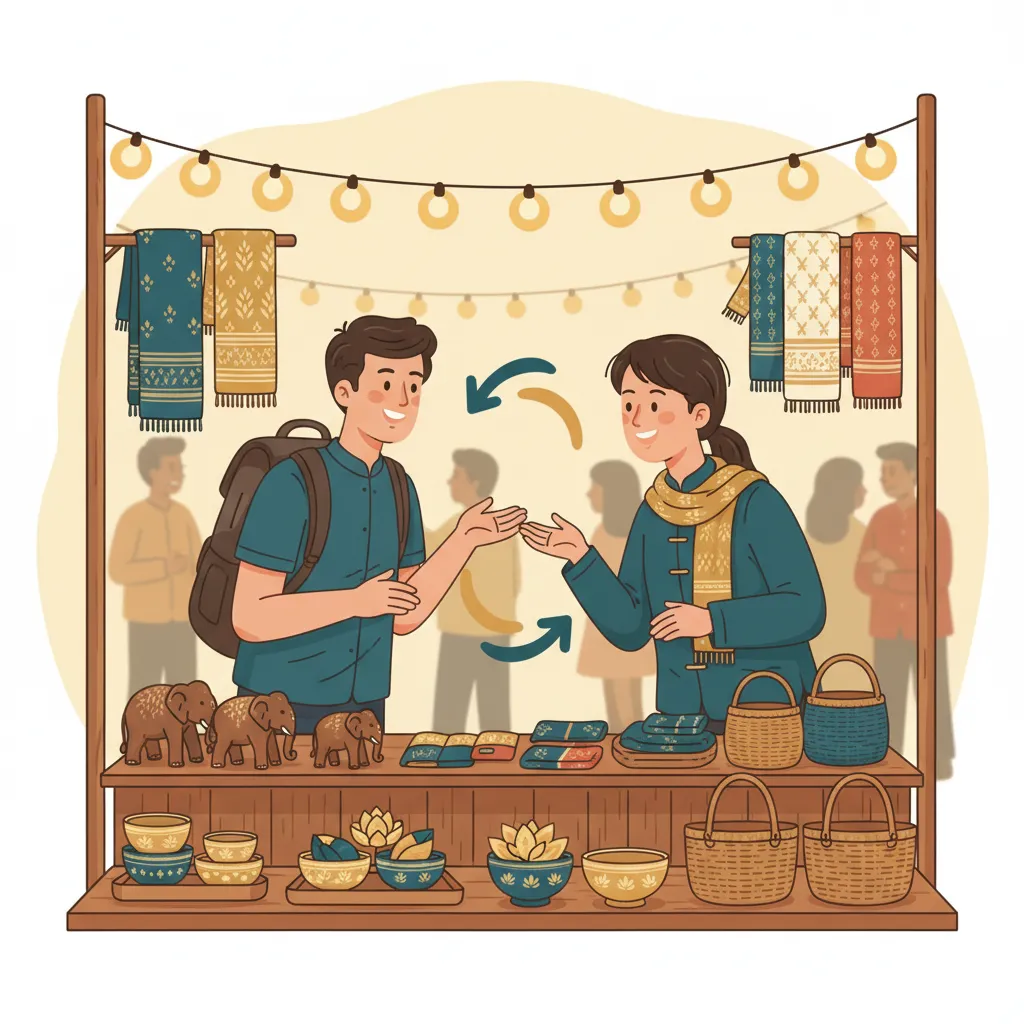
Bargaining in Thailand is not about winning. It’s not about squeezing the lowest price out of a vendor who earns less in a day than your hotel costs per night. It’s a social dance with choreography that both sides understand, and learning the steps — in Thai — makes it more enjoyable for everyone involved.
The difference between tourists who overpay and those who get fair prices usually comes down to knowing about seven phrases and understanding when to deploy them. You don’t need to be fluent. You need to be prepared.
(Thinking of using your phone to bargain? Here’s why that breaks the flow.)
For a comprehensive list of shopping vocabulary, see our Thai phrases for shopping and markets guide.
Where Bargaining Is Expected (And Where It Isn’t)
Not everything in Thailand is negotiable. Knowing the distinction prevents you from either overpaying or embarrassing yourself.
Bargain here:
- Open-air markets (Chatuchak, night markets, floating markets)
- Street stalls selling clothes, souvenirs, or accessories
- Tuk-tuk and songthaew rides (negotiate before you get in)
- Some independent shops without price tags
- Tailor shops (especially for multiple items)
Don’t bargain here:
- Anything with a barcode or printed price tag
- 7-Eleven, Family Mart, or any chain store
- Supermarkets and malls (fixed prices)
- Restaurants (the price is the price)
- BTS/MRT tickets and metered taxis
Sometimes negotiable:
- Hotels (direct bookings, longer stays, off-season)
- Tour operators (especially for group bookings)
- Large purchases at jewelry or craft shops
The cultural frame matters: bargaining in Thailand is not adversarial. It’s a social interaction with expected give-and-take. The vendor expects you to negotiate. The asking price already accounts for this. Walking up and paying full price is fine — you won’t be cheated — but you’re skipping a ritual that most vendors enjoy.
The 7 Phrases That Run Every Negotiation
Every market bargaining exchange in Thailand runs on a small set of phrases. Learn these seven and you can handle any negotiation.
1. How much?
thâo ràiเท่าไหร่How much?Always start here. Even if the price is displayed, asking in Thai signals that you’re not a completely uninformed tourist. Wait for the answer — vendors often quote a lower price verbally than what’s written.
2. Too expensive
phaaeng paiแพงไปToo expensiveDelivered with a smile, not with anger. This is your signal that the negotiation has begun. Think of it as an opening move, not a complaint. Shake your head gently, say it warmly, and watch the vendor’s reaction.
3. Can you reduce a little?
lót nɔ̀i dâi máiลดหน่อยได้ไหมCan you reduce a little?The polite request. This is the phrase that separates you from tourists who just say “too expensive” and walk away. You’re asking, not demanding. The ได้ไหม(dâi mái) at the end makes it a question, not a command.
4. Give a discount
lót hâi nɔ̀i sìลดให้หน่อยสิGive a discount, come onSlightly more direct than phrase 3. The สิ(sì) at the end adds a friendly push — like saying “come on” in English. Use this after you’ve already asked politely and want to nudge things along.
5. Can you do [X] baht?
[number] bàat dâi mái___บาทได้ไหมCan you do [X] baht?This is where you name your price. Fill in the number. “Song roi baat dai mai?” (Can you do 200 baht?). Naming a specific number shows you’ve thought about what the item is worth. See the numbers section below for how to say prices.
6. I don’t want it
mâi aoไม่เอาI don't want it / No thanksThe walk-away phrase. Said politely, with a smile, as you start to move away. This isn’t rude — it’s part of the dance. Often triggers the vendor’s final offer. If it doesn’t, the price wasn’t going to drop further.
7. Thank you
khɔ̀ɔp khun khráp/khâขอบคุณครับ/ค่ะThank youWhether you buy or not. Always. This is non-negotiable. Ending an interaction without thanks — even one where you walked away — is poor form. Use ครับ(khráp) if you’re male, ค่ะ(khâ) if you’re female.
The Negotiation Dance (Step by Step)
Here’s how a typical market negotiation unfolds. Think of it as choreography — both sides know the steps.
Step 1: Browse without commitment. Walk around the stall. Pick things up, put them down. Ask the price of multiple items, not just the one you want. This gives you a sense of the vendor’s pricing and prevents them from knowing which item you’re focused on.
Step 2: Show interest and ask the price. Point to your item. อันนี้เท่าไหร่(an níi thâo rài) The vendor names a price. React with mild surprise — a raised eyebrow, a slight head tilt. Not offense. Not outrage. Just “hmm, that’s more than I expected.”
Step 3: Counter at 50-60% of the asking price. This is your opening offer. It’s deliberately low. The vendor knows it’s low. You know it’s low. But it establishes the negotiation range. If they ask 500 baht, counter with 250-300.
Step 4: Meet in the middle. They’ll counter your counter. You’ll come up slightly. They’ll come down slightly. The natural landing zone is 70-75% of the original asking price. At a well-touristed market, paying 70% of the first price quoted is a fair deal for both sides.
Step 5: Walk away if needed. If you’re stuck above your target, say ไม่เอา ขอบคุณ(mâi ao, khɔ̀ɔp khun) and start walking. Slowly. This often triggers a “okay, okay” and their final price. If they let you walk, their price was already near their bottom.
Step 6: Close with warmth. Whether you buy or not, smile and say thank you. If you buy, a genuine ขอบคุณมาก(khɔ̀ɔp khun mâak) goes a long way. Many vendors remember friendly customers and offer better prices on return visits.
Numbers You’ll Need
You can’t negotiate prices if you can’t say prices. Here are the numbers that matter for bargaining.
Thai Numbers for Bargaining
| Number | Thai | Romanization |
|---|---|---|
| 1 | หนึ่ง | nʉ̀ng |
| 2 | สอง | sɔ̌ɔng |
| 3 | สาม | sǎam |
| 4 | สี่ | sìi |
| 5 | ห้า | hâa |
| 10 | สิบ | sìp |
| 20 | ยี่สิบ | yîi sìp |
| 50 | ห้าสิบ | hâa sìp |
| 100 | ร้อย | rɔ́ɔi |
| 200 | สองร้อย | sɔ̌ɔng rɔ́ɔi |
| 500 | ห้าร้อย | hâa rɔ́ɔi |
| 1,000 | พัน | phan |
Currency: บาท(bàat) (baht). Say the number + bàat: “hâa rɔ́ɔi bàat” = 500 baht.
How prices work in Thai:
- 150 baht = ร้อยห้าสิบบาท(rɔ́ɔi hâa sìp bàat)
- 250 baht = สองร้อยห้าสิบบาท(sɔ̌ɔng rɔ́ɔi hâa sìp bàat)
- 800 baht = แปดร้อยบาท(bpàaet rɔ́ɔi bàat)
The structure is straightforward: hundreds + tens + ones + bàat. No irregular forms, no surprises. If you know the digits, you can construct any price.
For a complete guide to Thai numbers including how to count and handle change, see our Thai numbers for travelers page.
Practice these until the numbers come automatically. Fumbling with a phrase while a vendor waits kills your negotiating position. When you can say “sɔ̌ɔng rɔ́ɔi hâa sìp bàat dâi mái” without hesitation, you’re playing the game at a different level.
Three Mistakes That Cost You Money (And Respect)
Mistake 1: Getting Angry or Aggressive
This is the single biggest error foreigners make in Thai markets. Raised voices, aggressive body language, slamming items down — all of it violates Thai social norms around ใจเย็น(jai yen).
Thai vendors will not negotiate with angry customers. They’ll quote you the full tourist price, stop smiling, and wait for you to leave. Getting angry in Thailand doesn’t get you a better price. It gets you no price at all.
The cultural logic: losing your temper means losing face, and in Thai culture, causing someone else to lose face is the greater social crime. An aggressive bargainer forces the vendor into an uncomfortable position, and the interaction shuts down.
Mistake 2: Bargaining Too Hard on Small Amounts
Fighting over 20 baht (about $0.55 USD) for fifteen minutes is not skilled negotiation. It’s disrespectful. The vendor knows what the item costs. You know what the item costs. Grinding someone down on a 60-baht souvenir to save a fraction of a dollar damages the interaction and your own experience.
A useful rule: if the difference between your price and the vendor’s price is less than what you’d pay for a cup of coffee at home, accept their price. The goodwill you generate is worth more than the savings.
Mistake 3: Walking Away After Agreeing on a Price
Once you’ve said “dai” (okay) or nodded to a price, the deal is made. Walking away after agreeing — to check other stalls, to “think about it,” to see if you can find it cheaper — is genuinely rude in Thai market culture.
The negotiation is a verbal contract. The vendor may have turned away other customers during your negotiation. Backing out after agreement is a breach of trust that reflects badly on you and, by extension, on other foreign visitors.
If you’re not sure you want it, don’t start negotiating. If you want to compare prices, do that first, then come back and negotiate when you’re ready to buy.
The Numbers Come Fast
You say lot noi dai mai confidently. The vendor fires back saam roi (300) or song roi haa sip (250). Can you catch that at market speed? Bargaining requires real-time number comprehension — the one skill that’s hardest to get from a phrase list.
Travel Thai includes number drills designed specifically for market situations — hearing and recognizing prices at conversational speed.
Bargaining as Connection, Not Combat
The best bargaining interactions end in laughter. That’s not a platitude — it’s a practical observation about how Thai markets work.
The reframe that transforms your market experience: you’re not trying to “win.” You’re participating in a social ritual that has rules, rhythm, and mutual respect built into it. The vendor is not your opponent. They’re your partner in a brief, structured interaction that both of you are supposed to enjoy.
Regular customers get better prices naturally. Showing your face at the same stall multiple times matters more than aggressive negotiation. The vendor at the morning market who sees you three days in a row will give you a better price on day three than any amount of haggling would achieve on day one. Relationships outperform tactics, every time.
Think about it from the vendor’s side: they do this interaction fifty times a day. The customers they remember — and treat well on return visits — are the ones who smiled, tried some Thai, and treated the negotiation as a conversation rather than a battle.
One phrase captures this entire philosophy. When a deal is done and both sides are satisfied, you’ll sometimes hear: พอใจ(phɔɔ jai). Literally “enough heart.” Both hearts are full. That’s the goal.
Practice These Phrases Before You Go
Reading about bargaining is useful. Practicing the phrases until they come out naturally is what actually changes your market experience. The difference between checking your phone for “lot noi dai mai” and saying it without thinking is the difference between an awkward transaction and a genuine interaction.
Jam Kham’s Shopping & Markets pack covers all negotiation phrases with native speaker audio. Practice until ลดหน่อยได้ไหม(lót nɔ̀i dâi mái) feels as natural as “how much.”
Start with free essentials — the phrases you’ll use most at Thai markets, with audio and spaced repetition to make them stick.
Related reading: Thai Phrases Every Tourist Needs | Thai Numbers for Travelers | Complete Bargaining Guide