
Jam Kham vs Duolingo vs Anki for Thai
An honest comparison of three popular approaches to learning Thai. Which app fits your goals, timeline, and learning style?
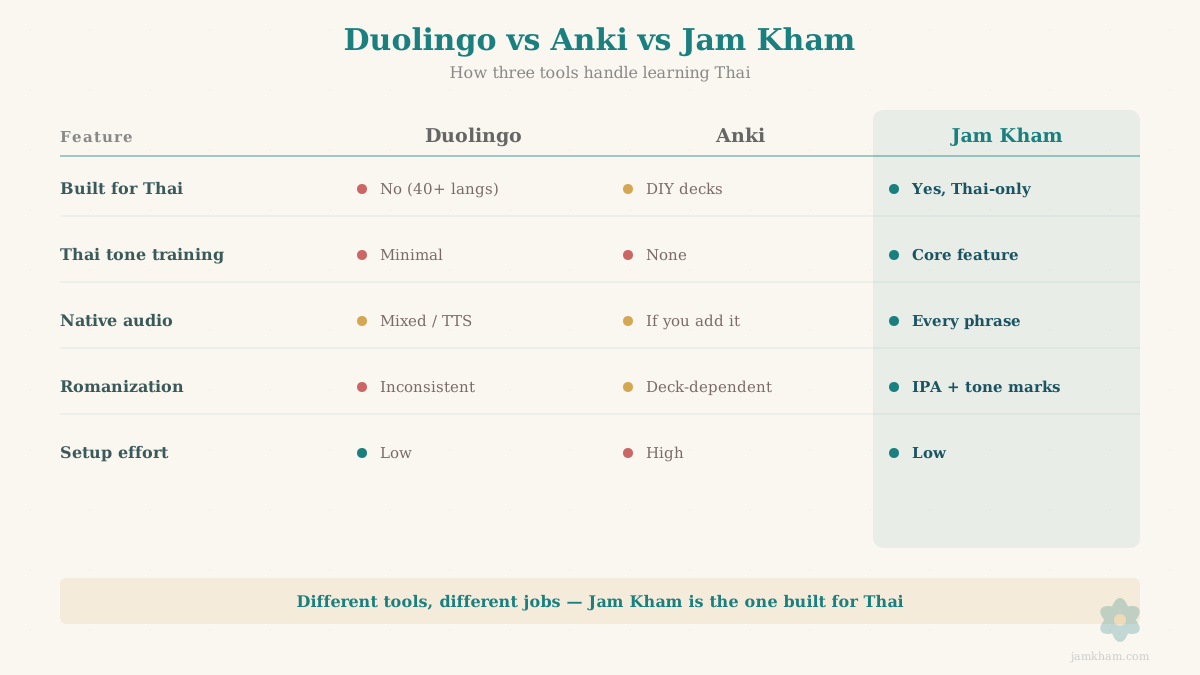
Three apps, three philosophies. For Thai specifically, the differences matter more than they do for European languages.
Thai isn’t Spanish. It has five tones that change word meaning, a script with 44 consonants, no spaces between words, and sounds that don’t exist in English. A language app built for Romance languages struggles with all of this in ways that don’t show up in its marketing copy.
This comparison is as honest as we can make it. We built Jam Kham, so we have a bias. But we also know where Duolingo and Anki outperform us, and we’ll say so.
The Thai-Specific Problem
Before comparing apps, it helps to understand what makes Thai different from the languages most apps were designed around.
Tones change meaning. The syllable “mai” can mean “new” (low tone), “not” (falling tone), or signal a question (rising tone) — three tones, three meanings: ใหม่(mài), ไม่(mâi), ไหม(mǎi). Any app that teaches Thai vocabulary without drilling tones is teaching you to say the wrong word confidently.
No spaces between words. Thai script runs words together: ฉันไปกินข้าว is four words with no visual boundaries. Learning to read Thai requires word segmentation skills that no European language demands.
Romanization varies wildly. There’s no single standard. The same word might be spelled “sawatdee,” “sawasdee,” or “sà-wàt-dii” depending on the source. Without a consistent system, learners build conflicting mental models.
These aren’t minor issues. They’re the reason most learners plateau after a few weeks with a generic app.
Duolingo for Thai
What it does well:
Duolingo is the best habit-building app in the industry. The streak system, the gamification, the five-minutes-a-day pitch — it works. Millions of people who would never open a textbook will open Duolingo on the bus. That’s exactly why it’s the first thing most people try for Thai, too.
There’s just one problem: Duolingo doesn’t offer a Thai course. Not a thin one, not a beta one — none. The habit-building engine that makes Duolingo Duolingo has nothing to run on for Thai specifically.
Where it falls short for Thai:
There’s no Thai course to fall short — that’s the real gap, and it’s bigger than any content critique. Search “Duolingo Thai” and you’ll find years of user requests in Duolingo’s own forums, not a course tree. More importantly, even the gamified format that works well for Duolingo’s other languages has structural problems for Thai that a future course would still have to solve:
- Tone training doesn’t fit the format. Tap-the-answer apps teach vocabulary as flat text, not tonal patterns. For a language where tone changes meaning, that’s a structural gap, not a content gap.
- Romanization needs a fixed system with tone markers. Without one, written prompts and correct pronunciation drift apart — a problem for any app, Duolingo included, that treats Thai the way it treats Spanish.
- Thai-specific skills go untaught by default. Word segmentation, consonant class explanation, aspiration drills — the skills that separate tourists who are understood from those who aren’t don’t show up in a generic vocabulary app.
- Native audio isn’t guaranteed. Where gamified Thai content exists at all (browser extensions, community add-ons), it’s often text-to-speech rather than native speakers, which matters more for a tonal language than for, say, Italian.
None of that is a knock on Duolingo specifically — it’s what happens to any habit-building app that hasn’t built for Thai. Duolingo just hasn’t built for Thai at all.
Anki for Thai
What it does well:
Anki is the most powerful spaced repetition engine available. It’s free (on desktop and Android), endlessly customizable, and backed by 15+ years of spaced repetition research. The community has created thousands of Thai decks covering everything from travel phrases to advanced vocabulary.
For disciplined, self-directed learners, Anki is unmatched:
- Total control. You decide exactly what to learn, in what order, with what intervals.
- Community decks. Thousands of pre-made Thai decks are available for free. Some are excellent.
- Proven algorithm. Anki’s spaced repetition scheduling is battle-tested over 15+ years.
- Free (mostly). Desktop and Android are free. iOS is $24.99 one-time.
Where it falls short for Thai:
Anki’s strength is also its weakness: it gives you a blank canvas and expects you to be the artist.
- Setup burden is real. Finding a good Thai deck, verifying its accuracy, adding audio, configuring settings — this takes hours before you learn your first word. Many learners spend more time configuring Anki than using it.
- No native audio by default. Unless someone recorded audio for the deck you downloaded, you’re learning Thai from text. For a tonal language, silent flashcards teach you to recognize characters without knowing how they sound.
- No tone training. Anki doesn’t know what a tone is. It shows you a card and asks if you know it. Whether you’re producing the right tone is entirely on you.
- No structure. Anki doesn’t tell you what to learn first. A beginner staring at a 3,000-card Thai deck has no guidance on which 50 words matter for their trip next month.
- Quality varies wildly. Community decks range from expertly curated to riddled with errors. A beginner can’t tell the difference.
Anki rewards expertise. If you already know what you need to learn and can verify the material, it’s the best tool for drilling it into memory. If you’re starting from zero, the setup cost is a real barrier.
Jam Kham for Thai
What it does well:
Jam Kham is built for one language. Every feature exists because Thai requires it.
- Tone training is core. Every phrase includes tone indicators, and the spaced repetition system tests tone production, not just vocabulary recognition.
- IPA-based romanization. A consistent romanization system with tone marks (à, â, á, ǎ) so you build one accurate mental model instead of three conflicting ones.
- Native speaker audio on every phrase. Recorded by Thai speakers, not generated by software.
- Trip-paced learning. Set your departure date and the system paces your daily practice so you’re ready by day one. No guessing what to prioritize.
- Response comprehension. We train you to understand what locals say back, not just what to say. Ordering food is half the conversation; understanding the vendor’s follow-up question is the other half.
- Word segmentation. Thai script practice that teaches you to see word boundaries where there are none.
Where it’s limited:
- Thai only. If you’re learning multiple languages, Jam Kham covers one of them. Duolingo covers 40+.
- Smaller and newer. The community is smaller than Duolingo’s or Anki’s. Fewer user reviews, less social proof.
- Less customizable than Anki. You can’t build your own cards from scratch or import arbitrary content. The trade-off is that you don’t have to — everything is pre-built and verified.
- Paid tiers, waitlist launch. The full phrase packs are part of Travel Thai, a coming-soon one-time pass — join early for founding pricing.
Comparison Table
| Feature | Duolingo | Anki | Jam Kham |
|---|---|---|---|
| Price | Free (ads) / $7.99/mo | Free (desktop/Android) / $24.99 iOS | Free tier / paid plans on waitlist |
| Thai tone training | N/A — no Thai course | None (unless self-built) | Core feature |
| Native audio | N/A — no Thai course | Only if deck includes it | Every phrase |
| Romanization | N/A — no Thai course | Deck-dependent | IPA-based with tone marks |
| Word segmentation | N/A — no Thai course | No | Yes |
| Setup time | 2 minutes | 2-4 hours | 5 minutes |
| Trip pacing | No | Manual scheduling | Set departure date |
| Customization | Low | Very high | Moderate |
| Languages | 40+ | Any | Thai only |
| Habit building | Excellent (streaks, XP) | Minimal | Good (daily goals) |
Which Tool for Which Learner?
You’re traveling to Thailand in 2-4 weeks: Jam Kham’s trip-paced Travel Thai track is built for this. Set your departure date, get daily practice sized to your timeline, arrive with phrases you can actually pronounce. Duolingo isn’t an option here — it doesn’t teach Thai. Anki requires too much setup time for a short runway.
You want casual, low-commitment exposure: Not Duolingo — it’s the app most people reach for first, but it has no Thai course to open. The closest match for that five-minutes-a-day, no-setup feel is Jam Kham’s free tier. It won’t make you conversational either, but at least it’s teaching actual Thai instead of nothing.
You’re a serious student planning months of study: Start with Jam Kham or a structured resource for the first 30 days to build a foundation with correct tones. Then add Anki for long-term vocabulary expansion once you know enough to evaluate deck quality and build your own cards. This combination — structured foundation plus flexible expansion — is what experienced Thai learners consistently recommend.
You already use Anki for other languages: Keep using it. Add a verified Thai deck with audio. Consider supplementing with Jam Kham specifically for tone training and native audio, since those are the gaps Anki can’t fill on its own.
Frequently Asked Questions
Is Duolingo good for learning Thai?
Duolingo doesn’t offer a Thai course, so there’s nothing to evaluate — it’s not a matter of quality, it’s just not there. It’s an excellent habit-building app for the 40+ languages it does teach, and that reputation is exactly why so many people search for it when they start learning Thai. If you want that same low-friction, five-minutes-a-day approach applied to Thai, you need an app that’s actually built for it.
Can you learn Thai with Anki?
Yes, if you’re self-directed and willing to invest time in setup. Anki’s spaced repetition algorithm is proven, and the community has created thousands of Thai decks. The catch: you need to find decks with native audio (silent flashcards don’t teach tones), verify the content for accuracy, and build your own study sequence. Experienced learners get excellent results. Beginners often spend more time configuring than studying.
What is the best app for learning Thai?
It depends on your learning style and goals. Casual learners chasing a low-friction daily habit often think of Duolingo first, but it doesn’t teach Thai — Jam Kham’s free tier is the closest equivalent built for the language. Self-directed learners who want full control over their study material do well with Anki. Travelers who need trip-ready phrases with correct pronunciation will get the most from Jam Kham’s tone-focused approach. See the Which Tool for Which Learner section above for specific recommendations.
How much does Jam Kham cost?
Jam Kham’s Read Thai course starts free — the first three alphabet modules require no credit card. The full vocabulary app (Travel Thai and above) is currently waitlist-only; join early for founding pricing. Travel Thai brings trip-focused phrase packs with native audio, Study Thai is $7/month for deeper vocabulary and grammar, and All-Access is $10/month for the full library including advanced content. All paid tiers include tone training and IPA romanization.
Can I use Duolingo and Anki together for Thai?
Not for Thai specifically — Duolingo doesn’t have a Thai course, so there’s no Duolingo Thai study time to combine with anything. What does combine well is Anki and Jam Kham: Anki for long-term vocabulary drilling once you know enough to evaluate deck quality, Jam Kham for tone training and travel phrases from day one. If you already use Duolingo for another language, keep doing that — just don’t expect it to cover Thai.
The Bottom Line
Generic language apps treat Thai as another item on a menu of 40 languages. Thai-specific tools treat it as the complex tonal language it actually is. Both approaches have merit. The right choice depends on your goals, your timeline, and how seriously you take pronunciation.
If you want to test the Thai-specific approach, Read Thai starts free — the first three modules cover the full alphabet, no credit card. The full vocabulary app is waitlist-only for now; early supporters get founding pricing at launch.
And none of these tools teach you to actually read Thai. The Read Thai course takes you from the alphabet to reading signs and menus on your own — see if Thai script clicks.
Start reading Thai today
All three drill words. None of them break you free of romanization. Read Thai walks every character in the order you'll meet it, with the tone rule behind it, until signs and menus read themselves. First three modules free — no card.
Start the reading course →First 3 modules free — no card, and they don't expire.
Related reading: Best Method to Learn Thai · Why Spaced Repetition Works · Thai Tones: The Complete Guide