
Nam Jai: How Thai Culture Shapes Healthcare
How น้ำใจ, เกรงใจ, and Buddhist values shape the Thai healthcare experience — from family at the bedside to the 30-baht universal coverage scheme.
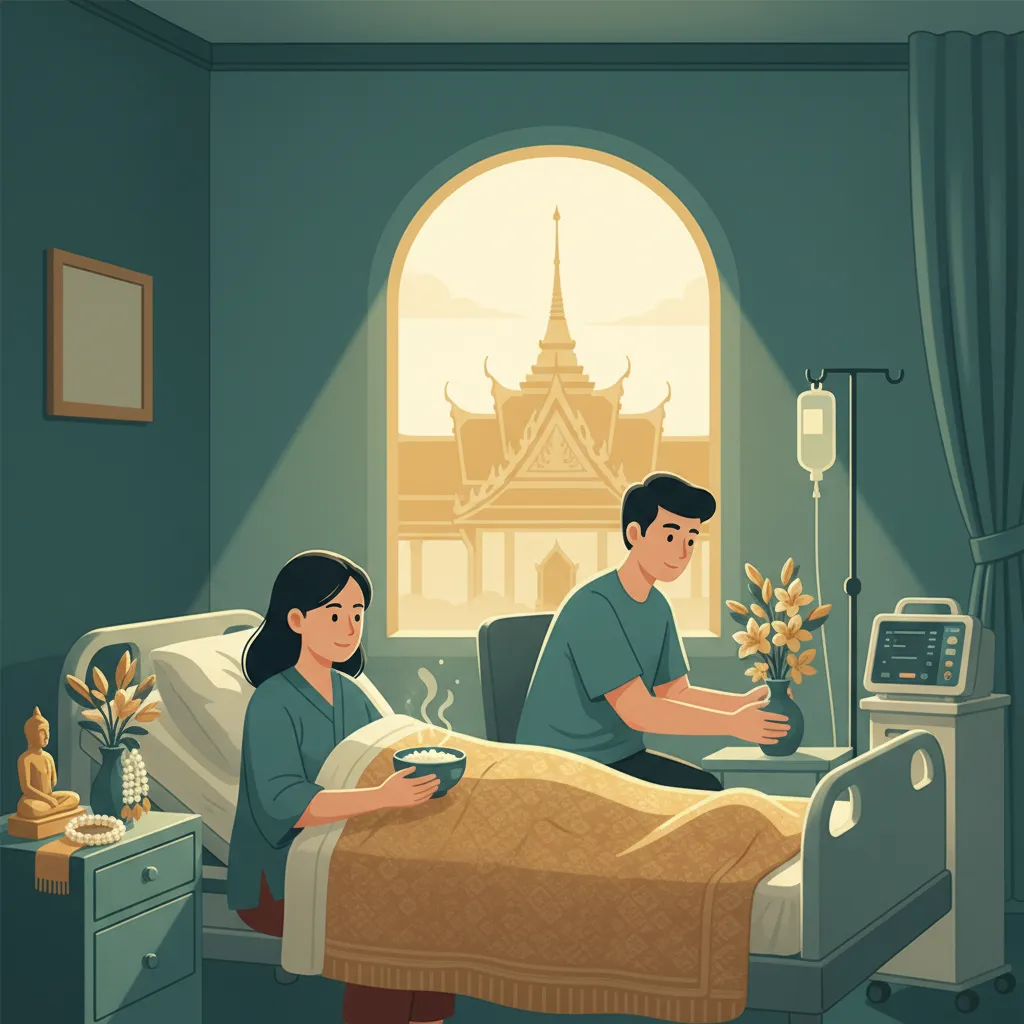
If you’ve spent time in a Thai hospital — as a patient, a visitor, or just someone accompanying a friend — you’ve seen things that don’t match Western healthcare assumptions. A woman sleeping on the floor beside her husband’s bed. A nurse staying 45 minutes past her shift because a patient’s daughter hadn’t arrived yet. Three generations of a family crowded around a single bed in a government hospital ward, unpacking containers of ข้าวต้ม(khâao dtôm) at 6 AM.
None of this is accidental. Thai healthcare operates inside a cultural framework built on Theravada Buddhist values, social obligations that predate modern medicine, and a concept of selfhood that puts relationships before individual autonomy. Understanding that framework changes how you experience the system — whether you’re getting stitches at a Chiang Mai clinic or navigating a three-day stay at Siriraj Hospital in Bangkok.
Family at the Bedside
In most Western hospitals, visiting hours are a privilege. Strict windows. One or two guests at a time. Staff manage traffic like air traffic controllers. The patient is the unit of care. Family visits but doesn’t stay.
Thai hospitals invert this. Family isn’t visiting — family is part of the treatment.
At government hospitals like Ramathibodi or Siriraj, one family member is typically allowed to stay overnight with the patient. That person sleeps on the floor, on a thin mat, sometimes on flattened cardboard boxes. They’re not sneaking past security — they’re fulfilling a role the hospital expects them to fill. They help the patient eat. They assist with bathing. They communicate with nurses. They bring food from home or from the hospital canteen because the patient’s family knows what the patient will actually eat.
Visiting hours at most government hospitals typically include windows around midday and evening, though schedules vary by hospital and ward. Outside those hours, the designated overnight companion stays. During visiting hours, the room fills. Aunts, cousins, coworkers, neighbors — Thai social networks are wide, and showing up at a hospital is one of the clearest demonstrations of น้ำใจ(nâam jai).
Private hospitals — Bumrungrad, Bangkok Hospital, Samitivej — offer more space. Sofa beds for companions. More flexible visiting policies. But the underlying cultural pattern is the same: family stays.
For foreigners, this has practical implications. If you’re hospitalized in Thailand and you don’t have family nearby, the absence is conspicuous. Hospital staff may ask about your family. Thai friends may feel obligated to fill the gap — and they will, sometimes taking time off work to sit with you. If you’re the one visiting a Thai friend in the hospital, bring food. Fruit is standard. นม(nom) (boxed milk drinks) is common. Show up in person if you possibly can — a LINE message doesn’t carry the same weight.
น้ำใจ in Medical Contexts
We covered น้ำใจ(nâam jai) in depth in our post on Thai heart words. The short version: nam jai is generosity made visible. Not a feeling you hold privately — an action you perform where others can see it.
In healthcare settings, nam jai takes specific forms.
From strangers. A Thai person who sees you struggling to find the right building at a hospital complex won’t point and give directions. They’ll walk you there. This happens constantly. It happened to me at Chiang Mai Ram Hospital — a woman in the lobby noticed I was confused, abandoned whatever she was doing, and physically escorted me to the correct floor. She patted my arm when we got there, said เอาน่า ไม่เป็นไร(ao nâa, mâi bpen rai), and left. I never learned her name.
From medical staff. Nurses at Thai hospitals — especially government hospitals where pay is modest and patient loads are brutal — frequently demonstrate nam jai in ways their job descriptions don’t require. Staying late for a patient who’s anxious. Bringing a personal blanket for someone who’s cold. Calling a patient’s family member to give an update when the doctor hasn’t had time. These small acts aren’t random kindness — they’re expressions of a cultural value system where withholding help when you can see someone suffering marks you as ใจดำ(jai dam).
From taxi drivers and neighbors. A Bangkok taxi driver who takes a visibly sick passenger to the hospital may wait outside, unprompted, to make sure they get in safely. Neighbors who hear that someone on their soi is hospitalized will organize food deliveries and hospital visits without being asked. This isn’t extraordinary behavior in Thailand. It’s the baseline expectation of decent people.
เกรงใจ and Patient Advocacy
Here’s where Thai cultural values create a real tension with modern medical best practices.
kreng jaiเกรงใจreluctance to impose, consideration for others' comfort is one of the most important concepts in Thai social life — and one of the hardest for Westerners to fully grasp. As we discussed in our jai words post, kreng jai is the reluctance to cause inconvenience, burden, or discomfort to another person, even when that person has explicitly offered help.
In everyday life, kreng jai produces graceful social interactions. In healthcare, it can be dangerous.
Research on Thai patients and pain management has consistently identified kreng jai as a barrier to adequate pain relief. A 2014 qualitative study on postoperative pain in Thai patients found that participants delayed requesting analgesics because they didn’t want to bother nurses who appeared busy. They described feeling เกรงใจ(kreng jai) toward overworked staff — aware of their own pain, but unwilling to add to someone else’s burden.
This isn’t a minor communication gap. Thai patients may:
- Underreport pain because expressing discomfort too forcefully feels like complaining — a behavior that conflicts with ใจเย็น(jai yen), the culturally valued state of equanimity
- Avoid questioning doctors because the physician holds a higher social position, and challenging authority violates hierarchical norms reinforced by the Thai politeness register system
- Decline to ask for help from nurses, even when in significant discomfort, because they can see the nurses are overwhelmed and kreng jai overrides self-advocacy
- Agree to treatment plans they don’t fully understand rather than asking for clarification, because repeated questions might imply the doctor explained poorly — causing the doctor to lose face
A study published in Pediatric Nursing examining Thai parents’ experiences with their children’s cancer pain identified two major cultural themes: “Understanding my child’s pain: it’s karma” and “Maintaining Kreng Jai.” Parents described navigating between their desire for better pain control and their reluctance to be perceived as demanding or ungrateful toward medical staff.
The flip side: Thai medical culture’s emphasis on ความสุภาพ(khwaam sù-phâap) means that patient interactions are often warmer and less rushed than in many Western systems. Doctors may spend more time on social pleasantries. Nurses address patients with respectful terms. The bedside manner, shaped by Buddhist compassion and Thai social grace, is something many foreigners find genuinely comforting — even as the kreng jai dynamic requires awareness.
กรรม (Karma) and Illness
Some Thai patients and families understand illness partly through the lens of กรรม(kam). This is worth discussing honestly, without romanticizing or dismissing it.
In Theravada Buddhist thought, karma is not fate. It’s not “you did something bad, so you got cancer.” The Thai understanding is more nuanced than the pop-Western version of karma suggests. กรรม(kam) refers to the consequences of actions across lifetimes — a framework for making sense of suffering that coexists with, rather than replaces, medical treatment.
In practice, this means a Thai family facing a serious diagnosis may hold two frameworks simultaneously: “We will pursue every medical treatment available” and “This suffering has causes that extend beyond what medicine can explain.” These aren’t contradictory positions. A grandmother might describe her grandchild’s illness as partly karmic while also insisting on the best oncologist in Bangkok. A monk might visit a hospital ward to chant and offer blessings alongside a patient’s chemotherapy schedule.
The karmic framework provides something that Western biomedicine often struggles to offer: a coherent response to the question “why me?” When a Thai patient says เป็นกรรม(bpen kam), they’re not resigning themselves to suffering. They’re placing their experience within a larger moral and spiritual framework that provides meaning. Many Thai patients report that this framework reduces anxiety — it’s not randomness, it’s part of a comprehensible order.
Where this becomes clinically significant is when karmic framing delays treatment-seeking. Some research suggests that patients who attribute illness primarily to karma may be slower to pursue aggressive medical intervention. But the evidence here is mixed, and it’s a mistake to generalize. Thailand’s high healthcare utilization rates — driven partly by the universal coverage scheme discussed below — suggest that karmic beliefs don’t broadly prevent Thais from seeking medical care.
The more common pattern: karma as a complement to medicine, not a substitute. Both at once. A hospital room with an IV drip and a Buddha amulet on the bedside table.
Thailand’s Universal Coverage Scheme
Thai cultural values don’t just shape bedside behavior — they’ve influenced health policy.
In 2001, Thailand launched the Universal Coverage Scheme (UCS), initially called the “30-baht scheme” because patients paid a 30-baht copayment (roughly $0.70 USD at the time) per visit. That copayment was eliminated in 2006, making the scheme effectively free at the point of care.
The numbers matter. Before universal coverage, Thailand had three separate health insurance systems covering different populations, with roughly 30% of the population uninsured. The UCS closed that gap. Today, the scheme covers approximately 47 million Thais — about 71% of the population — with the remainder covered by the Social Security Scheme (private sector employees) or the Civil Servant Medical Benefit Scheme (government workers).
What the UCS covers:
- Outpatient and inpatient care at registered public hospitals
- Essential medications (from the National List of Essential Medicines)
- Preventive care, vaccinations, and health promotion
- Emergency care at any hospital, public or private
- Chronic disease management including dialysis (added 2008) and antiretroviral therapy for HIV
The WHO praised Thailand’s UCS as one of the most successful universal health coverage implementations in a middle-income country. Between 2000 and 2015, catastrophic health expenditure — families spending more than 10% of household income on healthcare — dropped substantially. Infant mortality gaps between the poorest and wealthiest provinces narrowed.
The system has real constraints. Government hospitals operating under the UCS are crowded. Wait times at major facilities like Siriraj can stretch hours. Patients may see a different doctor each visit. The per-capita budget is limited, which affects staffing and equipment. Many Thais who can afford it use the UCS for routine care but pay out of pocket for private hospitals when they want faster service or specific specialists.
The UCS reflects a national commitment to healthcare access that resonates with Buddhist and Thai cultural values. The Thai phrase ไม่ทิ้งกัน(mâi thíng kan) captures the sentiment. Universal coverage isn’t just policy — it’s policy that aligns with cultural identity.
Traditional Medicine and Modern Healthcare
Walk into many Thai public hospitals and you’ll find something unusual by Western standards: a การแพทย์แผนไทย(kaan phɛ̂ɛt phɛ̌ɛn thai) department operating alongside cardiology, orthopedics, and everything else.
Thai traditional medicine (TTM) isn’t fringe. It’s institutionally integrated into the public health system. The Department of Thai Traditional and Alternative Medicine (กรมการแพทย์แผนไทยและการแพทย์ทางเลือก), established in 2002 under the Ministry of Public Health, oversees this integration. Approximately 6,000 public hospitals and health facilities across the country include TTM services.
What this looks like in practice:
Herbal medicine. Thailand’s National List of Essential Medicines — the formulary that determines what the UCS covers — includes herbal preparations. The list has expanded over the years from 19 to 71 traditional herbal items. These aren’t unregulated supplements; they’re standardized preparations that have gone through efficacy review. ฟ้าทะลายโจร(fáa thá-laai joon), for example, is widely prescribed for upper respiratory symptoms and was used extensively during the COVID-19 pandemic.
Thai massage. นวดแผนไทย(nûat phɛ̌ɛn thai) — known internationally as “Nuad Thai” — received UNESCO Intangible Cultural Heritage recognition in 2019. But in Thai hospitals, it’s not a spa treatment. It’s a therapeutic modality used for musculoskeletal pain, rehabilitation, and chronic conditions. Practitioners in hospital settings have formal training and certification.
Postpartum care. The tradition of อยู่ไฟ(yùu fai) — a postpartum recovery period involving heat therapy, herbal compresses, and dietary restrictions — has been adapted into hospital-based postpartum programs. Many Thai hospitals offer a version that combines traditional practices with modern postnatal monitoring.
Herbal steam and compress treatments. ประคบสมุนไพร(bprà-khóp sà-mun-phrai) therapy — heated bundles of medicinal herbs applied to the body — is used in hospital physiotherapy departments for muscle pain and inflammation.
The relationship between TTM and biomedical practice isn’t seamless. Some physicians are skeptical. Quality control for herbal preparations varies. Patients sometimes use herbal remedies without telling their doctors, creating interaction risks. But the institutional commitment to integration is real and growing. Thailand’s 2017 National Drug Policy explicitly supports expanding the role of traditional herbal medicines in the public health system.
The Language of Comfort
When someone you know in Thailand is sick or hospitalized, the right words matter. Thai has specific phrases for offering comfort, and using them — even imperfectly — demonstrates the kind of น้ำใจ(nâam jai) that Thais value.
Phrases for Offering Comfort
| Thai | Romanization | Meaning | When to Use |
|---|---|---|---|
| ไม่เป็นไร | mâi bpen rai | it’s nothing / don’t worry | Reassuring someone who is anxious or apologetic |
| หายเร็วๆ นะ | hǎai rew rew ná | get well soon | Standard well-wish for anyone who is sick |
| เป็นห่วง | bpen hùang | I’m worried about you | Expressing genuine concern — stronger than casual |
| ดูแลตัวเองด้วยนะ | duu lɛɛ dtua eeng dûai ná | take care of yourself, okay? | Parting words after a visit or in a message |
| เป็นกำลังใจให้ | bpen kam-lang jai hâi | I’m giving you moral support | Encouragement during difficult treatment |
| ขอให้หายเร็วๆ | khɔ̌ɔ hâi hǎai rew rew | wishing you a quick recovery | Slightly more formal well-wish |
mâi bpen raiไม่เป็นไรit's nothing, don't worry, it's okay is the most versatile phrase in Thai — you’ll hear it a hundred times a day in every context. In a medical setting, it’s used to reassure. A patient apologizes for being difficult; the nurse says mâi bpen rai. Someone fumbles with their IV pole; a visitor says mâi bpen rai. It smooths over discomfort and embarrassment the way “don’t worry about it” does in English, but with more cultural weight. Saying mâi bpen rai is an act of nam jai — you’re actively reducing someone’s burden of guilt or anxiety.
hǎai rew rew náหายเร็วๆ นะget well soon is what you write in a LINE message or say at the end of a hospital visit. The นะ(ná) at the end is a softening particle that adds warmth — somewhere between “okay?” and a gentle nudge. Without it, the phrase sounds flat. With it, it sounds like you mean it.
bpen hùangเป็นห่วงI'm worried about you carries real emotional weight. This isn’t casual. Telling someone bpen hùang signals that you’ve been thinking about them, that their situation occupies space in your mind. In Thai culture, where emotional restraint is valued, openly expressing worry is a significant gesture. Use it with people you’re genuinely close to.
bpen kam-lang jai hâiเป็นกำลังใจให้I'm giving you moral support / encouragement is one of the most beautiful phrases in Thai. กำลังใจ(kam-lang jai) literally means “heart-strength” or “power of the heart.” When you tell someone you’re being their kam-lang jai, you’re saying your heart is lending strength to theirs. It’s commonly used for people facing serious illness, difficult surgery, or long recovery.
Two Systems, One Room
Thai healthcare sits at an intersection that most Western systems don’t have to manage: biomedical science and Buddhist cultural values operating in the same space, sometimes reinforcing each other, sometimes in tension.
The nam jai that fills hospital rooms with family and food and warmth? That’s a real resource for healing. Research consistently shows that social support improves patient outcomes. Thai hospitals didn’t need a study to know this — the culture built it in.
The kreng jai that prevents patients from speaking up about pain? That’s a concrete barrier to care. And it requires Thai medical professionals to be proactive — to ask, to observe, to offer — in ways that a system built on patient self-advocacy doesn’t.
The karmic framework that helps patients find meaning in suffering? That’s a psychological resource with measurable effects. And when it occasionally delays treatment-seeking, it requires public health messaging that respects the framework while encouraging timely medical action.
The universal coverage scheme that ensures a rice farmer in Isan gets the same essential medications as a Bangkok civil servant? That’s a policy achievement rooted in cultural values about collective responsibility — and it has measurably reduced health inequality.
Understanding these dynamics won’t just help you if you end up in a Thai hospital. It’ll help you understand Thailand.
Related reading: Sick in Thailand? Phrases and Numbers That Get You Help | Thai Medical Vocabulary: Body Parts and Symptoms | Thai Heart Words: How ใจ Built a Language of Emotion | Thai Politeness Levels
Thai cultural vocabulary like น้ำใจ and เกรงใจ isn’t in most phrasebooks. These are the words that explain why Thais behave the way they do — and knowing them transforms how you experience the country. Start free with Jam Kham and learn the Thai that actually matters.