
How Songkran Split Into Two Festivals
Songkran was a quiet family ritual until the mid-20th century. The language of water — รดน้ำ vs สาดน้ำ — reveals how one festival became two.
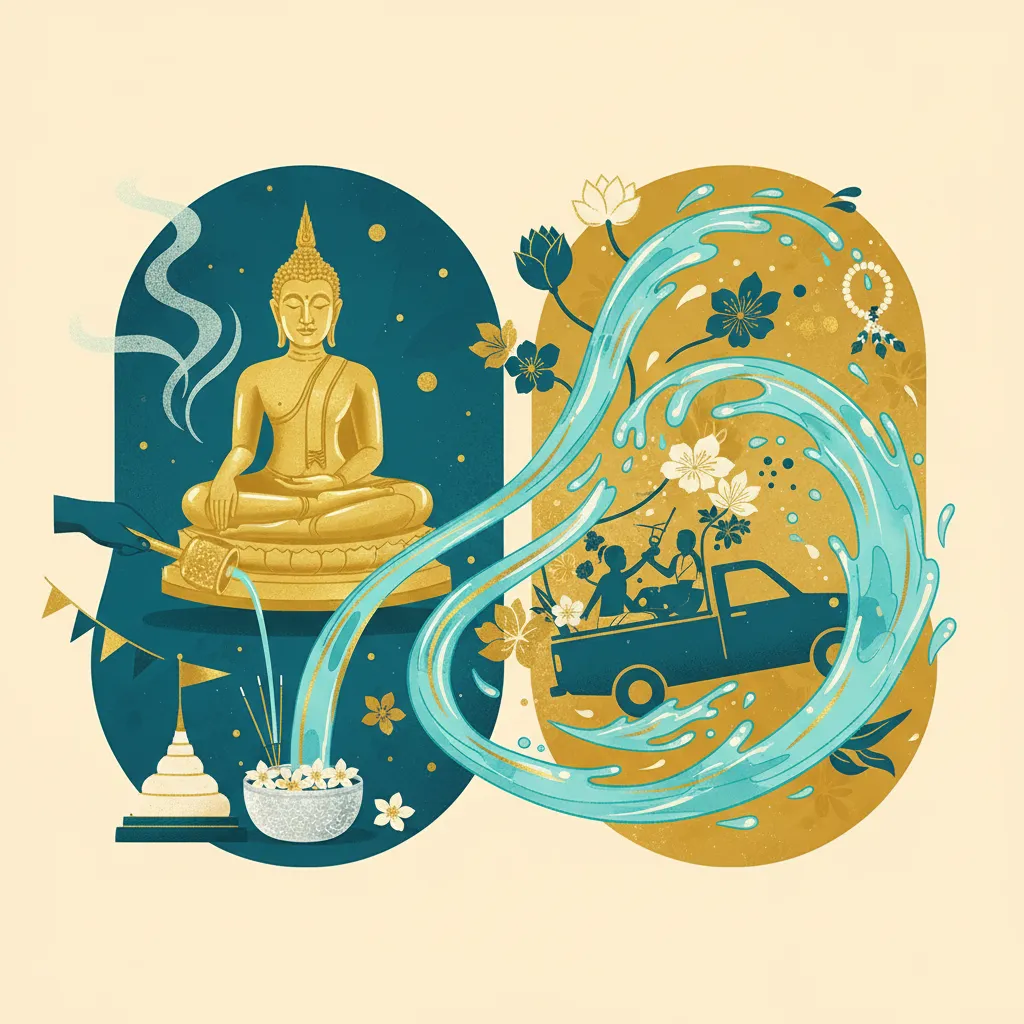
Every April, the same stretch of road in Chiang Mai hosts two completely different festivals at the same time. At 7 AM, families in pressed clothes carry jasmine garlands to Wat Phra Singh. They kneel before the abbot. They pour scented water over a Buddha image with both hands, slowly, the way their grandparents taught them. By 2 PM, that same road is a war zone---pickup trucks mounted with plastic barrels, children armed with pressurized water cannons, tourists in neon tank tops drenched and screaming.
Same city. Same holiday. Same afternoon. Two festivals wearing one name.
The word “Songkran” comes from the Sanskrit สงกรานต์(sǒng-kraan)---an astronomical event marking the sun’s transition into Aries. For centuries, it meant one thing: the turning of the year, observed through Buddhist merit-making and family obligation. How it also became the world’s largest water fight is a story about tourism, modernity, and the slippery relationship between tradition and spectacle.
The Thai language, as it often does, tells the story more honestly than any history book.
The Traditional Songkran: What the Holiday Actually Is
Before the water guns, before the foam parties, before Silom Road became a mosh pit with hoses---Songkran was quiet.
The traditional festival runs April 13—15. Each day has a name and a purpose. April 13 is วันมหาสงกรานต์(wan má-hǎa sǒng-kraan), the last day of the old year. April 14 is วันเนา(wan nao), a day of preparation---cleaning the house, cooking food for monks, getting ready. April 15 is วันเถลิงศก(wan thà-lǝǝng sòk), Thai New Year proper.
Morning starts at the temple. Families bring offerings, listen to chanting, and participate in สรงน้ำพระ(sǒng náam phrá)---pouring scented water, often infused with jasmine or rose petals, over a Buddha statue. This isn’t splashing. It’s deliberate. You pour a small ladle of fragrant water over the image’s shoulders, catching the runoff in a tray below. The water is considered blessed.
The day’s emotional center is รดน้ำดำหัว(rót náam dam hǔa). Younger family members visit parents, grandparents, and respected elders. They kneel. They pour scented water over the elder’s hands---sometimes just the palms, sometimes over the head. The elder blesses them in return, often tying a white cotton thread around their wrists. This is intimate. Voices are low. Children who haven’t visited their parents all year make the trip home.
The largest internal migration in Thailand happens during Songkran. Millions of people leave Bangkok---factory workers, office employees, students---and travel back to their home provinces. Bus stations overflow. Trains sell out weeks ahead. Highways become parking lots. The scale of this homeward movement reveals what Songkran still means at its root: you go home. You pay respect. You start the year right.
Another element that predates the water fights is ดินสอพอง(din sɔ̌ɔ phɔɔng), a chalky paste dabbed on faces and arms. The paste is made from calcium carbonate (limestone powder) mixed with water into a smooth, cool consistency. Originally medicinal---the paste was believed to cool the skin and protect against the fierce April heat---it became part of Songkran’s visual culture. You’ll still see it: white streaks on cheeks, dots on foreheads, sometimes playfully smeared on friends.
None of this involves getting blasted in the face by a stranger with a Super Soaker.
How the Water Fight Evolved
The transition happened gradually, then all at once.
In the 1950s and earlier, the water component of Songkran was modest. After the temple rituals and elder blessings, neighbors might sprinkle water on each other---a small, gentle act, an extension of the blessing ritual. You’d cup water in your hands and pour it lightly on a friend’s shoulder. A gesture of goodwill. A wish for prosperity in the new year.
By the 1960s, the splashing grew. Bowls replaced cupped hands. Children started chasing each other with buckets. The playful escalation was organic---April in Thailand is brutally hot, the hottest month of the year, with temperatures regularly hitting 40°C. Getting wet felt good. The blessing became a game.
Then the containers got bigger. Garden hoses entered the picture. Ice was added to the water---a particularly controversial development, since the original blessing water was meant to be scented and warm. Pickup trucks became mobile water platforms, cruising slowly down streets with barrels and crews of young people armed with buckets and pump guns.
By the 1980s, the transformation was essentially complete in the cities. Water guns became the symbol of Songkran the way fireworks symbolize the Fourth of July. Tourist brochures led with images of drenched backpackers in tank tops, not families kneeling before monks.
The historian and cultural critic Sujit Wongthet has argued that the water-fight version of Songkran was actively encouraged---even manufactured---as a tourist attraction. His view isn’t fringe. The timeline tracks neatly: Thailand’s tourism boom in the 1980s coincided with Songkran’s transformation from religious observance to international party. The festival’s increasing visibility in travel marketing created a feedback loop. More tourists came for the water fight. More water fight was provided.
รดน้ำ vs. สาดน้ำ: The Language Tells the Story
Thai has two words for putting water on someone, and the difference between them maps precisely onto the difference between the two Songkrans.
rót náamรดน้ำpour water gently, with intentionThe verb รด(rót) implies control. Care. Direction. You รด water on a plant to help it grow. You รด water on an elder’s hands as an act of devotion. The action is deliberate---you choose where the water goes, how much, how gently. There’s a target and a purpose. รดน้ำ is the language of the traditional Songkran.
sàat náamสาดน้ำsplash, fling, throw waterThe verb สาด(sàat) implies force. Volume. Chaos. You สาด water in someone’s face. You สาด a bucket across a crowd. The action is undirected---or rather, the direction is “everywhere.” There’s no delicacy. สาดน้ำ is the language of the water fight.
Same element: น้ำ(náam). Same festival. Completely different verbs. And those verbs carry completely different social codes.
The Two Waters of Songkran
| Thai | Romanization | Literal | Context |
|---|---|---|---|
| รดน้ำ | rót náam | pour water (gently) | Blessing elders, temple rituals |
| สาดน้ำ | sàat náam | splash/fling water | Street water fights |
| สรงน้ำพระ | sǒng náam phrá | bathe the Buddha image | Temple ceremony |
| รดน้ำดำหัว | rót náam dam hǔa | pour water, wash the head | Blessing from elders |
| เล่นน้ำ | lên náam | play with water | General water-fight fun |
You’d never describe the rod nam dam hua ceremony using สาด. The word would be jarring---like describing a baptism as “dunking.” And you’d never describe the Silom Road party using รด. That would make it sound reverent when it is, emphatically, not.
The linguistic distinction isn’t academic. It reflects something real about how Thai speakers understand the festival’s split personality. When older Thais talk about Songkran, they tend to use รดน้ำ and สรงน้ำ---the temple vocabulary. When younger Thais get excited about the holiday, they say สาดน้ำ or เล่นน้ำ(lên náam). Neither group is wrong. They’re talking about different festivals that share a calendar slot.
The UNESCO Recognition: Which Songkran Got Inscribed
On December 6, 2023, in Kasane, Botswana, UNESCO inscribed “Songkran in Thailand, Traditional Thai New Year Festival” on the Representative List of the Intangible Cultural Heritage of Humanity. Reference number 01719.
Read that name carefully. Traditional Thai New Year Festival.
UNESCO’s inscription text is specific about what it recognizes: “Pouring water is a significant act during Songkran, symbolizing cleansing, reverence and good fortune.” The citation highlights rod nam dam hua---the elder blessing ritual. It highlights sand chedi building. It highlights temple ceremonies and community merit-making.
Water guns do not appear in the inscription.
This matters because UNESCO wasn’t rubber-stamping the entire Songkran experience. The organization made a deliberate distinction: the traditional practices---the ones at risk of being eclipsed---are what earned cultural heritage status. The inscription is, in effect, a recognition that something valuable exists alongside the spectacle, and that it deserves protection.
The UNESCO text also contains a line that resonates beyond the festival: “Songkran helps combat loneliness and social isolation.” This describes the homecoming---the millions who travel to be with family, the intergenerational contact of the rod nam dam hua, the communal temple visits. It’s describing what Songkran does when you strip the party away.
Both Festivals, Same Days
Here’s what critics of the water-fight Songkran sometimes miss: the two festivals aren’t in opposition. They’re layered. And most Thai families experience both in a single day.
A typical Songkran day for a Thai family in Chiang Mai might look like this. Wake up early. Put on clean, modest clothes. Go to Wat Phra Singh or the family’s local temple. Make merit. Listen to monks chant. Bathe the Buddha image. Come home. Change clothes. Visit grandparents for rod nam dam hua. Receive blessings. Eat together---a large meal, the whole extended family, dishes that someone’s been preparing since the day before. Then, around 2 or 3 PM, the younger family members change into old clothes, grab water guns, pile into the back of a truck, and head out to the streets.
The morning is รดน้ำ. The afternoon is สาดน้ำ.
The same person does both. The same person who knelt before their grandmother at 10 AM is firing a pump-action water gun at strangers by 4 PM. This isn’t hypocrisy. It isn’t cultural decline. It’s a festival that contains multitudes.
The millions who make the journey home---and it genuinely is millions, the largest annual migration event in Thailand---are traveling for the family part. Nobody rides a bus for twelve hours from Bangkok to Isan just to shoot water at people. They could do that on Silom Road. They go home because Songkran, at its core, is still about family. The water fight is what happens after the obligations are met.
Where the tension becomes real is when the spectacle overshadows the substance not in practice, but in perception. When international media covers Songkran as “the world’s biggest water fight” and nothing else, the traditional half becomes invisible. When young Thais grow up seeing Songkran marketed as a party and never learn the rod nam dam hua, the transmission of cultural knowledge weakens. The two Songkrans coexist fine in lived experience. They coexist less well in headlines.
The Safety Tension: Seven Dangerous Days
There’s another dimension to modern Songkran that doesn’t fit neatly into either the “sacred tradition” or “joyful celebration” framing. Thailand calls the Songkran holiday period เจ็ดวันอันตราย(jèt wan an-tà-raai).
The name is earned. Road fatalities spike dramatically every April. Alcohol-fueled driving, overcrowded highways, motorcyclists without helmets---the combination is consistently lethal. The government runs annual campaigns: checkpoints, public service announcements, celebrity spokespeople urging safe driving. The numbers improve some years and worsen others, but the phrase “Seven Dangerous Days” has become as much a part of Songkran vocabulary as สาดน้ำ.
The 2025 Maha Songkran (“Grand Songkran”) event illustrated the scale of modern Songkran as both cultural celebration and economic engine. Tourism revenue for the period hit 1.58 billion baht. Over 1.1 million attendees participated in organized events. The figures reflect a festival that is simultaneously a religious observance, a family homecoming, a street party, an economic stimulus package, and a public safety crisis. All at once. All in the same week.
Sexual harassment during the water fights has also prompted legal and cultural reckoning. The chaos of the street party---crowds, alcohol, the social license to touch strangers with water---has historically provided cover for groping and harassment, particularly targeting women. Thai authorities have responded with increased enforcement, designated safe zones, and public campaigns emphasizing that water fights are not permission to assault. The conversation is ongoing and sometimes uncomfortable, but it’s happening.
The government’s stated goal is a “balanced” Songkran---one that preserves traditional culture, supports tourism revenue, and reduces harm. Whether that balance is achievable or just aspirational depends on whom you ask.
Regional Variations: Four Songkrans
Songkran doesn’t look the same everywhere. Regional differences are significant enough that traveling between provinces during the festival gives you meaningfully different experiences.
Chiang Mai runs the most famous traditional procession. The Phra Buddha Sihing parade---started in its current form around 1990---carries the revered Buddha image through the city along a four-kilometer route. Tens of thousands line the streets. Devotees pour scented water on the image as it passes. The procession represents the traditional heart of Chiang Mai’s Songkran, even as the old city moat becomes a water-fight epicenter the same afternoon. Chiang Mai’s Songkran runs longer and hits harder than Bangkok’s, partly because the city’s smaller scale concentrates the energy.
Pattaya extends the party with วันไหล(wan lǎi), pushing celebrations through April 19---nearly a week after the official dates. This extension is a tourism play, and Pattaya doesn’t pretend otherwise. Beach Road becomes a continuous water fight. The extension has economic logic: tourists who came for three days stay for seven.
Isan (the northeast) keeps things quieter and more family-centered. The region’s Songkran traditions emphasize the homecoming---families reuniting, temple visits, rod nam dam hua with village elders. Water fights happen but tend to be smaller, more neighborhood-scaled. The emotional register is different: after months or years working in Bangkok, people return to small towns where everyone knows them. Songkran in Isan feels like a family reunion that an entire region is having simultaneously.
Bangkok contains the contradiction most visibly. Silom Road---the famous Songkran water-fight strip---is a wall of noise and water for three days straight. Khao San Road is similar. But walk ten minutes from Silom and you’ll find Wat Hua Lamphong or another local temple conducting traditional ceremonies in near-silence. Families kneeling. Incense burning. Monks chanting. The distance between the world’s biggest water fight and a centuries-old Buddhist ritual is, in Bangkok, about three city blocks.
The 2025 Songkran period drew 5.27 million visitors, generating an estimated 26.5 billion baht in tourism revenue. Those numbers belong mostly to the water-fight Songkran---the one that photographs well, the one you can sell internationally. The traditional Songkran generates its own economy (temple donations, family travel, food) but doesn’t produce the same headline figures.
Where the Two Songkrans Meet
The temptation is to frame this as a loss narrative: authentic tradition corrupted by commercialism. That framing is too simple.
Songkran’s traditional practices are not dying. Temples are full on April 13. Rod nam dam hua still happens in virtually every Thai household. Sand chedis still get built. The homeward migration still empties Bangkok. These rituals have survived the water-fight era because they serve a different need---connection, reverence, continuity---that no amount of Super Soaker technology can replace.
What’s happened is more interesting than decline. A single holiday now contains two distinct cultural experiences, running in parallel, serving different but compatible purposes. The morning feeds the soul. The afternoon feeds the appetite for chaos and release. The fact that Thai has separate vocabulary for each---รดน้ำ(rót náam) and สาดน้ำ(sàat náam)---suggests the culture has already made its peace with the duality. The language accommodated the split before the UNESCO committee did.
If you’re in Thailand during Songkran, do both. Wake up early. Visit a temple. Watch the Buddha bathing. If you’re fortunate enough to be invited to a rod nam dam hua, go---kneel, pour the scented water, receive the blessing with both hands. Understand that this is what Songkran is.
Then change into clothes you don’t care about. Grab a water gun. Head to the moat or the main road. Get completely, thoroughly, joyfully destroyed.
Same day. Same holiday. Two different words for water.
Useful Songkran Vocabulary
Essential Songkran Phrases
| Thai | Romanization | Meaning |
|---|---|---|
| สุขสันต์วันสงกรานต์ | sùk-sǎn wan sǒng-kraan | Happy Songkran |
| สวัสดีปีใหม่ไทย | sà-wàt-dii bpii mài thai | Happy Thai New Year |
| รดน้ำดำหัว | rót náam dam hǔa | Elder blessing ceremony |
| สรงน้ำพระ | sǒng náam phrá | Bathing the Buddha image |
| ก่อเจดีย์ทราย | kɔ̀ɔ jee-dii saai | Building sand stupas |
| ขอพร | khɔ̌ɔ phɔɔn | Ask for a blessing |
| อวยพร | uai phɔɔn | Give a blessing |
Understanding the words behind the water makes the holiday richer---whether you’re kneeling before an elder or getting drenched on Silom Road. Start free with Jam Kham and build the cultural vocabulary that turns a vacation into real understanding.
Related: Songkran Essentials: What to Say, Protect, and Where to Be | Songkran Thai: Vocabulary of Water, Blessings, and the Calendar | Chiang Mai Temple Etiquette | Thai Day Names: Sanskrit Origins