
Songkran Guide: Phrases, Safety, Best Spots
A practical Songkran guide -- where to celebrate, what to protect from water, safety tips, and the Thai phrases that make the festival more fun.
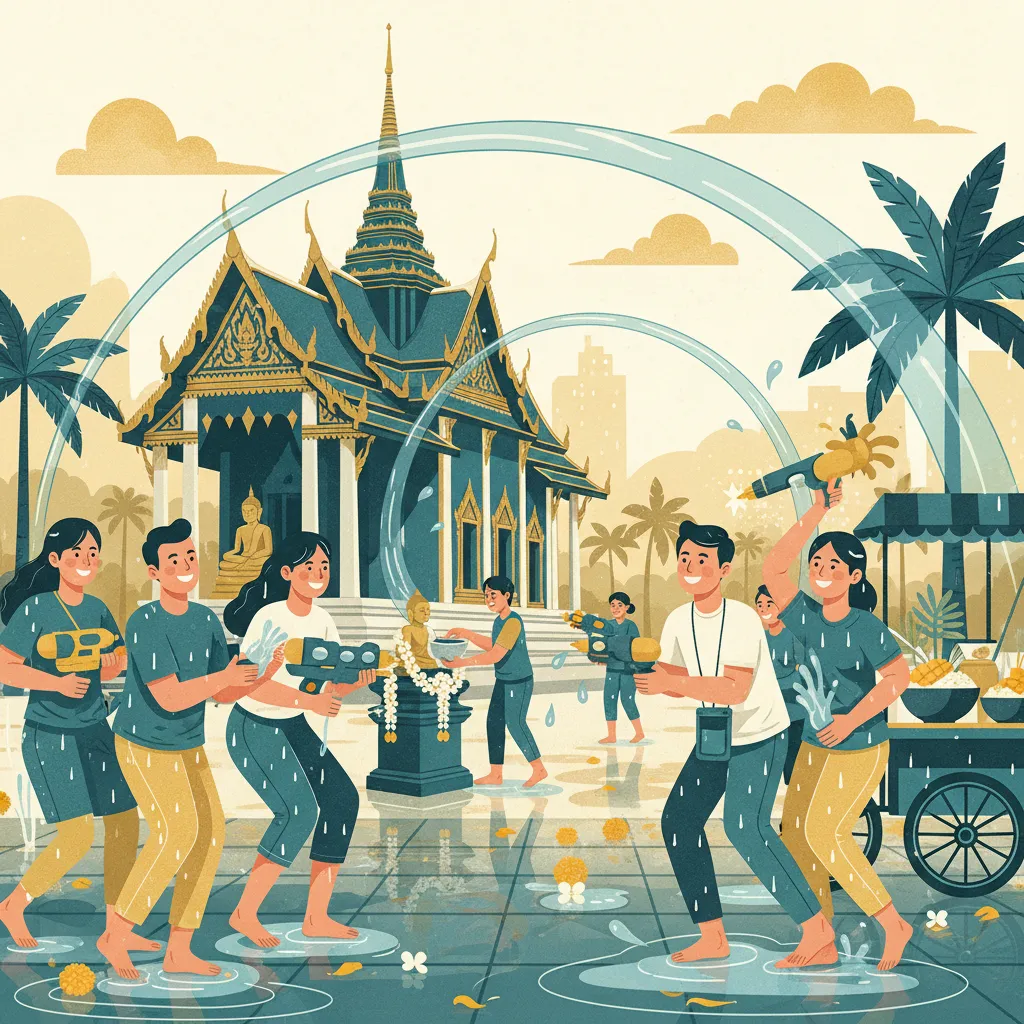
You are going to get soaked. That is not a warning — it is a guarantee. Every April, Thailand turns into a nationwide water fight that lasts three days (or more, depending on where you are). Strangers blast you with hoses. Children ambush you from doorways. Pickup trucks roll through streets loaded with barrels of ice water and a dozen people armed with Super Soakers.
Songkran is wild, joyful, and chaotic. It is also deeply traditional, culturally significant, and — if you are not paying attention — occasionally dangerous.
This is the practical version. Where to be. What to say. What to waterproof. What the safety numbers actually look like. And the Thai phrases that shift you from confused bystander to someone who belongs there.
What Songkran Actually Is
Most foreigners know Songkran as “the Thai water fight.” That sells it short.
sǒng-graanสงกรานต์Songkran — Thai New YearThe word comes from Sanskrit saṃkrānti, marking the passage of the sun into Aries. It has been the traditional Thai New Year for centuries. On December 6, 2023, UNESCO inscribed Songkran on its Intangible Cultural Heritage list at the 18th session in Kasane, Botswana — recognizing it as more than a party. The water pouring is a purification ritual. The temple visits are acts of merit-making. The family gatherings are the heart of the holiday.
The festival spans three days, each with its own name and purpose:
April 13 — Maha Songkran (มหาสงกรานต์(má-hǎa sǒng-graan)). The last day of the old year. Major ceremonies happen. In Bangkok, the Maha Songkran World Water Festival kicks off at Sanam Luang. People clean their homes, wash Buddha images, and visit temples.
April 14 — Wan Nao (วันเนา(wan nao)). The in-between day. Not the old year, not yet the new. Families prepare food and offerings. The water fighting is already in full swing by now, but the formal activities center on preparation.
April 15 — Wan Thaloeng Sok (วันเถลิงศก(wan thà-ləəng sòk)). New Year’s Day proper. Younger people pour scented water on the hands of elders to receive blessings — this is the rot nam dam hua ceremony. The water guns and street chaos coexist with genuinely tender family moments.
Where to Be (And What Each Place Is Like)
Songkran happens everywhere in Thailand, but the experience varies wildly by location.
Bangkok
The government has been consolidating Songkran in Bangkok around a few key zones. Silom Road and Khao San Road are the two famous ones. Silom transforms into a kilometers-long water battle — expect a dense crowd, music stages, and zero dry surfaces. Khao San is the backpacker epicenter, smaller but more intense per square meter.
The bigger story is Sanam Luang, near the Grand Palace. The Maha Songkran World Water Festival pulled 1.1 million attendees in 2025, generating an estimated 1.58 billion baht in revenue. The government is betting hard on this becoming the official face of Bangkok Songkran — cultural performances, traditional ceremonies, and yes, water.
Elsewhere in Bangkok, neighborhoods run their own smaller celebrations. Banglamphu, the streets around Wat Pho, various sois along Sukhumvit — if you are in Bangkok during Songkran, you cannot avoid it. Even walking to 7-Eleven becomes an expedition.
Chiang Mai
The most famous Songkran in Thailand, and the most intense. The moat around the Old City — roughly 4 km of road circling the historic center — becomes a continuous water war zone. People line both sides of the moat road. Pickup trucks circle endlessly, refilling from the moat itself, drenching everyone in range.
The Phra Buddha Sihing procession on April 13 is a major event: the sacred image is paraded from the Railway Station to Wat Phra Singh, a tradition that has followed its current procession route since approximately 1990. Crowds gather to pour water on the image for blessings. This is the traditional core of Chiang Mai Songkran, happening simultaneously with the moat madness a few hundred meters away.
Chiang Mai extends celebrations through April 15. By the last day, the water fighting starts to wind down, and many locals shift to temple visits and family time.
Pattaya
Pattaya does Songkran differently: it extends through April 19. The main celebrations in central Pattaya run April 13-15, but the Wan Lai festival in Naklua (the quieter northern end) happens around April 18-19. Beach Road is the main battleground — the beach-to-road corridor creates a natural arena.
Pattaya’s Songkran draws a mix of Thai and international visitors, and the atmosphere leans more party than tradition. If you want the cultural side of Songkran, this is not the place. If you want a five-day water party with a beach, it is.
Rural Thailand
The Thailand most tourists do not see during Songkran. In smaller towns and villages, Songkran is a family holiday. People return to their home provinces. Temple visits are the focus. The water pouring is gentler — a bowl of scented water on the hands of grandparents, not a pressure hose to the face.
If you are staying with Thai friends or in a homestay during Songkran, this is the version you will experience. It is quieter, more meaningful, and the food is outstanding because everyone is cooking.
Essential Songkran Phrases
These six phrases cover the key interactions you will have during Songkran. The greetings get smiles. The apology gets you out of accidental situations. The blessing acknowledgment shows you understand what is happening beyond the water fight.
Songkran Phrase Quick Reference
| Thai | Romanization | Meaning |
|---|---|---|
| สุขสันต์วันสงกรานต์ | sùk-sǎn wan sǒng-graan | Happy Songkran |
| ปีใหม่ไทย | bpii mài thai | Thai New Year |
| สาดน้ำ | sàat náam | splash water |
| ขอพร | khɔ̌ɔ phɔɔn | ask for a blessing |
| ขอโทษ | khɔ̌ɔ thôot | sorry / excuse me |
| สาธุ | sǎa-thú | amen (Buddhist acknowledgment) |
How to Use Them
sùk-sǎn wan sǒng-graanสุขสันต์วันสงกรานต์Happy SongkranThis is your all-purpose Songkran greeting. Shout it before you splash someone. Yell it when someone drenches you. Say it to the vendor selling waterproof phone pouches. It works in every context during the festival.
sàat náamสาดน้ำsplash waterThe verb for what everyone is doing. You will hear this constantly. “Sàat náam!” as someone runs past with a bucket. It is also useful for understanding what people are yelling right before you get hit.
khɔ̌ɔ phɔɔnขอพรask for a blessingAt temples, during the rot nam dam hua ceremony, or when elders pour water on your hands. This phrase signals you understand the spiritual dimension. If an older Thai person blesses you, respond with สาธุ(sǎa-thú) — hands pressed together in a wai.
khɔ̌ɔ thôotขอโทษsorry / excuse meYou will need this when you accidentally blast someone who did not want to be blasted (monks, elderly people carrying groceries, someone clearly trying to stay dry). It also works for navigating dense, slippery crowds.
Protect Your Stuff, Not Your Pride
You will get wet. Accept it. Plan around it.
Phone and wallet — Waterproof pouches are sold at every 7-Eleven, market stall, and tourist area for 50-200 baht during Songkran week. Buy one before April 13. The cheap ones work fine for a day of splashing. If you want to use your phone’s touchscreen through the pouch (for maps and photos), spend slightly more on a pouch designed for it. Test it in the sink before heading out.
Passport and documents — Leave them at the hotel. Carry a photocopy if you must have ID. Water damage to a passport is an expensive problem.
Clothing — Wear what you do not mind ruining. Quick-dry synthetics beat cotton, which gets heavy and stays cold. Dark colors over light — white clothing becomes transparent when wet, which is exactly as awkward as it sounds. Secure footwear with grip — the streets get slippery. Flip-flops slide. Water shoes or old sneakers are better.
Valuables — Leave anything you would be upset about losing at the hotel. Waterproof bag for your essentials (phone, cash, one card), and nothing else.
Sunscreen — This gets overlooked. April in Thailand is hot. You are standing in the sun getting repeatedly soaked, which washes off sunscreen. Reapply waterproof sunscreen throughout the day. Sunburn during Songkran is extremely common among tourists.
Safety: The Numbers You Should Know
Songkran has a reputation as a dangerous time on Thai roads, and the statistics back it up. The government tracks a period called the “Seven Dangerous Days” around the festival.
Road Safety
2024 numbers: Approximately 280 deaths and over 2,000 accidents during the Seven Dangerous Days. In 2025, increased enforcement brought those down to 253 deaths and 1,538 accidents — an improvement, but still grim.
The causes are consistent year to year:
- Drunk driving: The leading factor in fatal accidents
- Speeding: Another major contributor
- Motorcycles: 74-82% of all fatalities (depending on year)
Songkran falls during Thailand’s hottest month. People drink more. The roads are wet. Many riders are on motorcycles without helmets. The combination is predictable and deadly.
Drowning
This statistic gets less attention but matters: 327 drownings occur each April in Thailand. During the three peak days of Songkran (April 13-15), that rate climbs to approximately 15 drownings per day. Rivers, canals, and reservoirs become gathering spots for celebration, often involving alcohol. Children are particularly at risk.
What This Means for You
If you are a tourist on foot in a city center, your main risks are slipping on wet pavement and getting hit by something (a wayward bucket, a too-enthusiastic water gun at close range). Avoidable stuff. The serious danger is on the roads.
Do not ride a motorcycle during Songkran. The combination of wet roads, distracted drivers, alcohol, and people actively throwing water at moving vehicles makes this the most dangerous time to be on two wheels in Thailand.
Do not drive drunk. Thailand’s legal blood alcohol limit is 50 mg% BAC. Penalties are real: up to one year in jail for DUI.
Use ride-hailing apps (Grab, Bolt) instead of driving yourself. Expect surge pricing during peak Songkran hours but accept it as the cost of staying safe.
The Food
Songkran happens to fall during mango season. This is not a coincidence — it is a gift.
Mango Sticky Rice at Its Peak
khâao nǐao má-mûangข้าวเหนียวมะม่วงmango sticky riceApril is when Thai mangoes are at their best. The nam dok mai variety — golden, impossibly fragrant, almost too sweet — is the one you want. Mango sticky rice stalls multiply during Songkran. Prices are lower because supply peaks. If you eat this dish once in your life, eat it in April in Thailand.
Khao Chae: The Royal Cooling Dish
khâao châeข้าวแช่rice in jasmine-scented iced waterThis is the Songkran dish that most tourists miss. Rice soaked in jasmine-scented iced water, served with an array of small side dishes — stuffed peppers, sweetened shredded pork, fried shallots. Its origins are Mon (the dish was called poeng sangkran), and it entered Thai royal cuisine during the reign of King Rama II. It was originally palace food, made for the hottest days of the year.
Khao chae is labor-intensive to prepare and only appears in April and early May. High-end Thai restaurants serve it during Songkran season, and some street vendors in older Bangkok neighborhoods (Thonburi, Banglamphu) make it as well. Expect to pay 150-400 baht depending on the setting. Worth every baht.
The Nine Auspicious Desserts
Thai New Year celebrations traditionally feature nine auspicious desserts, many with names containing the word ทอง(thɔɔng) — symbolizing wealth and prosperity.
Three you will see everywhere:
- ทองหยิบ(thɔɔng yíp) — delicate, flower-shaped, made from egg yolk and sugar
- ทองหยอด(thɔɔng yɔ̀ɔt) — teardrop-shaped, same egg yolk base, syrup-coated
- ฝอยทอง(fɔ̌i thɔɔng) — golden threads of egg yolk drizzled into syrup
All three are Portuguese-influenced (introduced during the Ayutthaya period) and are fixtures at every temple fair and Songkran celebration. They are intensely sweet. Buy a small box to try — vendors at temple fairs sell mixed assortments.
Putting It All Together
Songkran is three days (or more) of controlled chaos set against a foundation of genuine cultural meaning. The best approach: spend the mornings at temples, where the traditional Songkran lives. Spend the afternoons in the water zones, where the modern Songkran thrives. Eat everything you can find. Say สุขสันต์วันสงกรานต์(sùk-sǎn wan sǒng-graan) to everyone. Mean it.
Waterproof your phone. Leave your pride at the hotel. Get drenched by a five-year-old with a bucket bigger than she is. Pour scented water on a stranger’s hands and receive a blessing you did not expect. Eat mango sticky rice while standing in a wet street at two in the afternoon.
That is Songkran.
Your trip has a date. Get the phrases into your memory before you land — start free with Jam Kham’s essentials pack.
Related reading: Songkran Thai: Vocabulary of Water, Blessings, and the Thai Calendar | From Sacred Water to Super Soakers: How Songkran Became Two Festivals | Bangkok Language Survival Guide | Chiang Mai Temple Etiquette