
Thai Dating Phrases: How Conversations Actually Flow
The Thai dating phrases that move a conversation from hello to LINE to dinner—how Thais actually flirt, signal interest, and read indirect cues.
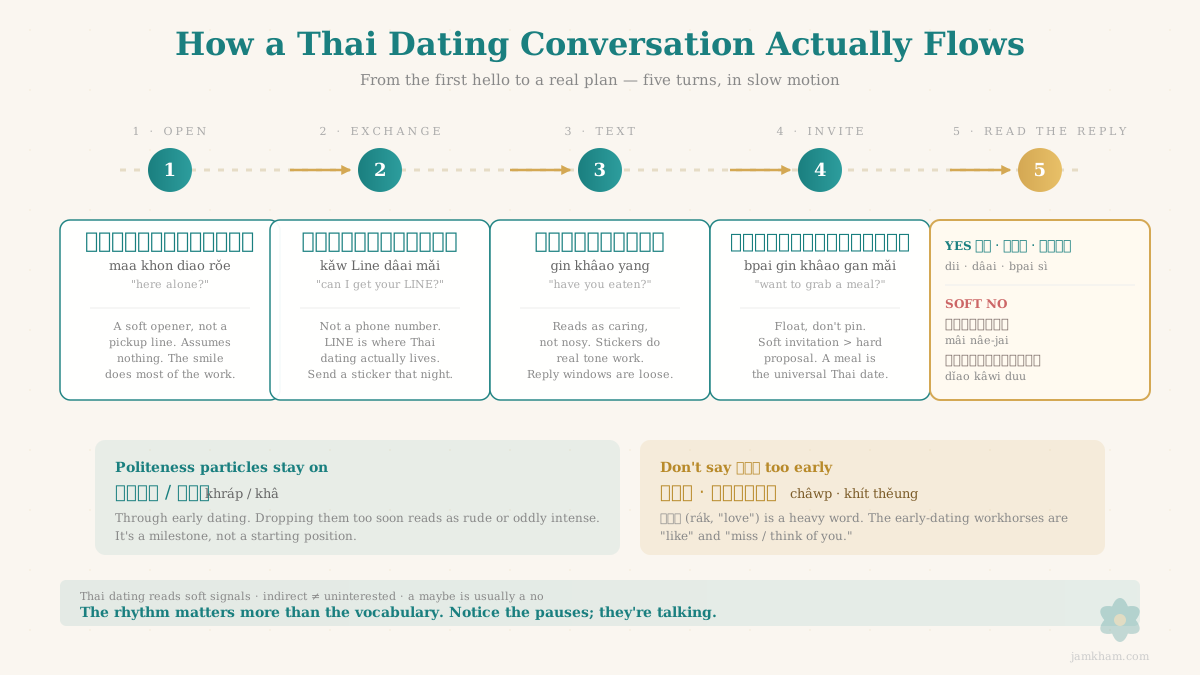
This isn’t a guide to Thai romantic vocabulary—we already wrote those. If you want to know how to say “I love you” or the poetry of ใจ(jai) words, see our companion posts on how to say I love you in Thai and Thai love words. What’s missing online is the in-between: the actual flow of a Thai dating conversation. How do you open? When do you ask for LINE? What does a Thai “maybe” mean? How do you set up dinner without sounding like a job interview?
These are Thai dating phrases that do social work, not declarations of love. They’re the lines that move you from a smile at a coffee shop to a LINE exchange to a meal—and they all hinge on a cultural rhythm that’s slower, softer, and more indirect than what most Western dating guides describe. The rhythm is the part worth getting right.
Before You Open Your Mouth: The Politeness Baseline
Every Thai social interaction sits on top of a politeness layer, and dating doesn’t turn it off. The two particles you’ve probably already met do most of the work:
Politeness particles you can't drop
| Thai | Romanization | Meaning |
|---|---|---|
| ครับ | khráp | polite particle (male speakers) |
| ค่ะ | khâ | polite particle, statement (female speakers) |
| คะ | khá | polite particle, question (female speakers) |
These attach to almost every sentence you say to someone you don’t know well, and that includes the person you’re flirting with. Dropping them too early reads roughly the way calling a near-stranger “babe” reads in English—either presumptuous or oddly intimate. Couples eventually drop them with each other, but that’s a milestone, not a starting position. For the full picture of how Thai politeness layers work, see Thai politeness: why ‘eat’ has 5 different words, and our Thai culture guide for the broader social context around respect, status, and indirectness.
The other thing happening before you speak: age. Thai conversation calibrates to who’s older. Slightly older Thais expect to be called พี่(phîi), slightly younger ones are น้อง(náwng). You don’t need to know exact ages to use these—they’re rough, friendly, and they show you know the rules. A 28-year-old guy meeting a 25-year-old woman at a bar might call her น้อง(náwng) and she’d call him พี่(phîi). Neither of those is romantic—they’re just the social default.
Opening Lines: Small Talk, Not Pickup Lines
Thai social culture isn’t allergic to flirting, but it’s allergic to abruptness. A direct compliment from a stranger—“you’re beautiful”—lands much more aggressively in Thai than in English. The opener that works almost everywhere is small talk that creates a reason to stand near someone for thirty seconds.
khon diao rǒe khrápคนเดียวเหรอครับhere alone? (male speaker)A gentle, slightly teasing line that opens a conversation at a bar, café, or food stall. It assumes nothing.
maa bàwi mǎi khrápมาบ่อยไหมครับdo you come here often? (male speaker)Yes, it’s the same line as in English, and yes, it’s a real Thai opener. Sincerely meant, it works.
à-râwi mǎi kháอร่อยไหมคะis it good? (female speaker, asking about their food)If you’re eating, ask about food. This is one of the safest, most natural Thai openers because food is the universal small-talk topic in Thailand. It also gives the other person three easy responses: yes, not really, or “want to try?”
khǎw-thôot ná khráp, thǎam... dâai mǎiขอโทษนะครับ ถาม…ได้ไหมexcuse me, may I ask... (male speaker)The framing is everything here. ขอโทษ(khǎw-thôot) at the start of a question to a stranger softens it dramatically. You can put almost anything after this—directions, a recommendation, the wifi password—and the conversation has an excuse to exist.
Getting to LINE: The Central Modern Moment
There’s a moment in a Thai dating arc that doesn’t really exist in Western culture: the LINE exchange. Asking for someone’s phone number is genuinely rare and slightly old-fashioned—you ask for their LINE. The app is so embedded in Thai social life that “getting LINE” is essentially the formal handoff from “we just met” to “we can keep talking.” If you don’t make this transition, there’s usually no way to pick the conversation back up once you’ve parted.
khǎw Line dâai mǎi khrápขอไลน์ได้ไหมครับcan I get your LINE? (male speaker) khǎw Line dâai mǎi kháขอไลน์ได้ไหมคะcan I get your LINE? (female speaker)The literal structure: “request LINE, possible question-particle.” It’s casual, polite, and used by everyone. The English word “LINE” gets pronounced roughly “lai,” with the same falling-ish intonation you’d give “five.” Don’t bother with the longer construction—ขอไลน์ได้ไหม(khǎw Line dâai mǎi) is the whole phrase.
A more casual variant you’ll hear among younger Thais:
àet Line gan mǎiแอดไลน์กันไหมwant to add LINE? (using English 'add')แอด(àet) is the borrowed English verb “add.” This skips the polite-request framing entirely and works among people in the same age bracket who already feel comfortable.
Once you have the LINE ID, the next move is to send something—anything—that night. A friendly ดีใจที่ได้รู้จักนะ(dii-jai thîi dâai rúu-jàk ná) with a small sticker is plenty. Thai LINE culture runs on stickers; not sending any reads as colder than you probably mean.
Texting Like a Thai: LINE Etiquette
You have LINE. Now what? Thai messaging follows different rhythms than American or European texting, and getting the rhythm wrong is one of the most common reasons foreign dating attempts quietly fade.
A few patterns worth knowing:
Reply windows are looser. Younger Thais usually reply within a few hours, but it’s not a same-minute culture. Sending a follow-up “you there?” message six hours later is a strong “too eager” signal.
Voice notes are normal. A 10-second voice message is more intimate than text and very common. If you’re learning Thai, voice notes from a Thai date are gold—real speech, real tones, on your phone.
Stickers carry tone. A cute sticker can do the work that an emoji might do in English texting, but Thai stickers are more elaborate and often replace text entirely. A sticker reply isn’t lazy—it’s the conversation.
Goodnight matters. A short ฝันดีนะ(fǎn dii ná) at the end of the day is a low-key affection signal. Sent two or three nights in a row, it reads as warm and consistent—exactly what early Thai dating prizes over big gestures.
LINE phrases for the first week of messaging
| Thai | Romanization | Meaning |
|---|---|---|
| ทำอะไรอยู่ | tham à-rai yùu | what are you up to? |
| กินข้าวยัง | gin khâao yang | have you eaten yet? (a real, caring question, not just small talk) |
| คิดถึงนะ | khít thěung ná | I’m thinking of you / I miss you |
| ฝันดีนะ | fǎn dii ná | sweet dreams |
| เดี๋ยวคุยกันใหม่นะ | dǐao khui gan mài ná | let’s chat again later |
| ระวังตัวนะ | rá-wang tua ná | take care of yourself |
That second one—กินข้าวยัง(gin khâao yang), “have you eaten yet?”—deserves a note. It’s a literal question, but it’s also a small expression of care, the way a Thai grandmother asks it. Sending it in the early evening reads as warm and attentive, not nosy.
Setting Up the Date: The Soft Invitation
Thai dating asks aren’t ultimatums. You don’t propose “Saturday at 8 at this restaurant.” You float something low-stakes and let the other person opt in or quietly opt out.
bpai gin khâao gan mǎiไปกินข้าวกันไหมwant to go eat together?This is the workhorse Thai dating phrase. Literally “go eat rice together, yes-no?” Casual, low-pressure, and culturally central—sharing a meal is the universal Thai date.
wâang wan nǎi kháว่างวันไหนคะwhich day are you free? (female speaker)A soft probe, asked after you’ve already floated the idea. Notice you’re not pinning them to a day—you’re asking which day suits them, which leaves them in control of the framing.
thǎeo níi ráan nǎi à-râwiแถวนี้ร้านไหนอร่อยwhich restaurants around here are good?This is a brilliantly indirect Thai dating phrase. You’re not asking them out—you’re asking for a recommendation. If they recommend a place and say ลองไปกินกันไหม(lawng bpai gin gan mǎi), you both just set up a date without anyone using the word “date.”
bpai thîao gan mǎiไปเที่ยวกันไหมwant to go out / take a trip together?เที่ยว(thîao) is a beautifully flexible verb covering everything from “go out tonight” to “take a weekend trip.” Use it for the second or third date when “meal” feels small.
A few more options worth having ready:
Date suggestions, ranked low- to higher-stakes
| Thai | Romanization | Meaning |
|---|---|---|
| ไปกินกาแฟกันไหม | bpai gin gaa-fae gan mǎi | want to get coffee? |
| ไปกินข้าวกันไหม | bpai gin khâao gan mǎi | want to grab a meal? |
| ไปดูหนังกันไหม | bpai duu nǎng gan mǎi | want to see a movie? |
| ไปเดินเล่นกันไหม | bpai doen lên gan mǎi | want to take a walk? |
| ไปตลาดนัดกันไหม | bpai tà-làat nát gan mǎi | want to go to the market? |
That last one—ตลาดนัด(tà-làat nát)—is a great Thai date suggestion that doesn’t translate cleanly. Bangkok’s Chatuchak, Chiang Mai’s Sunday Walking Street, Phuket’s Naka Market: these are date destinations in their own right, and the suggestion shows you know Thailand isn’t just bars and restaurants.
Reading the Reply: Thai Indirectness and What “Maybe” Means
Thai conversation tends to be more indirect than English-language norms, and Thai politeness culture makes direct refusal genuinely uncomfortable. The result: replies that look like maybes are often softly worded no’s. Reading them correctly will save you more first dates than any phrase on this page.
Watch for these patterns:
What it sounds like vs. what it usually means
| Thai | Romanization | What it usually means |
|---|---|---|
| ไม่แน่ใจค่ะ | mâi nâe-jai khâ | ”I’m not sure” → almost always a soft “no” |
| เดี๋ยวค่อยดูนะคะ | dǐao kâwi duu ná khá | ”I’ll see / let me check” → usually a polite delay-to-no |
| ยุ่งช่วงนี้ค่ะ | yûng chûang níi khâ | ”I’m busy these days” → maybe genuinely busy, often a soft decline |
| ดีค่ะ | dii khâ | ”good / okay” → this one really is positive |
| ได้ค่ะ | dâai khâ | ”yes / can do” → a clear yes |
| ไปสิ | bpai sì | ”let’s go!” → an enthusiastic yes |
If you get a maybe, take it as a no with grace and don’t push. Pushing through a soft Thai no is the foreign-dating mistake that most consistently nukes a budding connection. If you get a clear yes—ดี(dii), ได้(dâai), ไปสิ(bpai sì)—respond with a concrete follow-up the same day so the plan doesn’t drift.
The other thing happening here: silence is itself a signal. A reply that takes a day to arrive in early Thai dating, with no apology or follow-up, often means interest has cooled. You don’t need a hard answer to read this—you just need to notice the rhythm change.
On the Date: Phrases That Carry the Evening
You’ve made it to dinner. A few phrases that smooth out the actual date:
wan níi tàeng tua sǔai jangวันนี้แต่งตัวสวยจังyou look really lovely today (for a woman) wan níi tàeng tua làw jangวันนี้แต่งตัวหล่อจังyou look really handsome today (for a man)The framing—“today you’ve dressed nicely”—keeps the compliment about effort and presentation, which Thai culture receives more easily than open declarations about the person themselves. จัง(jang) at the end is a mild intensifier that keeps it light.
gin phèt dâai mǎiกินเผ็ดได้ไหมcan you eat spicy?A real and useful question, but also a standard mini-conversation starter at any Thai meal. The follow-up about spice tolerance—how spicy, what you can’t handle, where you’ve been surprised—is built-in.
khǎwng chǎn lawng nàwi mǎiของฉันลองหน่อยไหมwant to try a bit of mine? (female speaker)Sharing food is one of the most warmly received gestures on a Thai date. Order something distinctive enough to be worth sharing.
khàwp-khun ná thîi àwk-maa kheun níiขอบคุณนะที่ออกมาคืนนี้thanks for coming out tonightA sweet, gentle line at the end of the evening. Doesn’t presume; doesn’t undersell.
On paying: in early Thai dating, the person who invited usually pays, and that’s often the man on a first date, though Thai women increasingly split or alternate on later dates. The line that resolves the bill awkwardness:
wan níi phǒm líang eeng ná khrápวันนี้ผมเลี้ยงเองนะครับtonight is on me (male speaker) wan níi chǎn líang eeng ná khâวันนี้ฉันเลี้ยงเองนะคะtonight is on me (female speaker)The verb เลี้ยง(líang) covers everything from paying for dinner to raising a child—it’s the language of taking care of someone, and using it here signals that this evening was your gesture.
After the Date: The Small Texts That Matter
The post-date text is more important in Thai dating than in many Western contexts. Not getting one within the next morning is a soft signal of cooling interest. Two simple options:
mêua-kheun sà-nùk mâak loeiเมื่อคืนสนุกมากเลยlast night was really fun khàwp-khun ná thîi àwk maa mêua-kheunขอบคุณนะที่ออกมาเมื่อคืนthanks for coming out last nightA short, warm note like one of these, sent the morning after, holds the connection without rushing it. Pair it with a “want to do it again sometime?” floated a day or two later, not the same morning.
Meeting the Friend Group
A meaningful Thai dating signal that doesn’t really exist in Western culture: being invited to meet the friend group. Thai social life is heavily group-oriented, and getting included in someone’s กลุ่มเพื่อน(glùm phêuan) is a real escalation. If your date suggests:
bpai joe phêuan phêuan dûai gan mǎiไปเจอเพื่อนๆ ด้วยกันไหมwant to meet my friends together?This is significant. Treat the meeting like meeting a small jury—warmly. Show up with a small gift if it’s a dinner, learn one or two friends’ names ahead of time if you can, use พี่(phîi) / น้อง(náwng) based on rough age, and never, ever bypass the politeness particles. Their endorsement of you matters more than your last date matters.
A Note on Dating App Conversations
If you’re meeting people on Tinder, Bumble, or ThaiFriendly, the conversational rules above still apply, but two adjustments help:
Get off the app fast. Thai users tend to want to move to LINE quickly—a couple of exchanges is enough. The app-to-LINE transition is itself a positive signal.
Tone-aware voice notes work. Sending a short voice message in Thai—even a clumsy one—earns goodwill out of proportion to how good your Thai actually is. It signals effort and gives the other person a real sense of you.
A useful early line that works on apps:
khàwp-khun thîi máet ná kháขอบคุณที่แมตช์นะคะthanks for the match (female speaker) khàwp-khun thîi máet ná khrápขอบคุณที่แมตช์นะครับthanks for the match (male speaker)แมตช์(máet) is the borrowed English “match.” This opener acknowledges the platform without leaning on it.
The Phrases You’ll Use Most Often
Pulling the highest-frequency Thai dating phrases together in one place:
Top 12 Thai dating phrases, ranked by how often you'll use them
| Thai | Romanization | Meaning |
|---|---|---|
| ขอไลน์ได้ไหม | khǎw Line dâai mǎi | can I get your LINE? |
| ไปกินข้าวกันไหม | bpai gin khâao gan mǎi | want to grab a meal? |
| ว่างวันไหน | wâang wan nǎi | which day are you free? |
| ทำอะไรอยู่ | tham à-rai yùu | what are you up to? |
| กินข้าวยัง | gin khâao yang | have you eaten yet? |
| คิดถึงนะ | khít thěung ná | I’m thinking of you / I miss you |
| ฝันดีนะ | fǎn dii ná | sweet dreams |
| ระวังตัวนะ | rá-wang tua ná | take care |
| ดีใจที่ได้รู้จัก | dii-jai thîi dâai rúu-jàk | nice to have met you |
| ชอบมาก | châwp mâak | I really like (you / this) |
| วันนี้สนุกมาก | wan níi sà-nùk mâak | today was so fun |
| ไว้เจอกันใหม่นะ | wái joe gan mài ná | let’s meet again sometime |
If you can use those twelve with reasonable tones, you can carry an early Thai dating arc most of the way to a real relationship without ever needing the heavy romantic vocabulary. The heavy words come later, and they hit harder for it.
Frequently Asked Questions
What’s the most useful Thai dating phrase to learn first?
ขอไลน์ได้ไหม(khǎw Line dâai mǎi) (“can I get your LINE?”) is the single most useful Thai dating phrase because it converts a chance meeting into a real connection. LINE is the central messaging app in Thailand, and exchanging it is the cultural equivalent of “let’s keep in touch.”
Should I say “I love you” in Thai early in a relationship?
No. รัก(rák) carries much more weight in Thai than “love” does in English. Saying it within the first few weeks can feel intense or alarming. Use ชอบ(châwp) (“like”), ชอบมาก(châwp mâak) (“really like”), or คิดถึง(khít thěung) (“miss / think of you”) for early dating. See how to say I love you in Thai for the full hierarchy.
What does it mean when a Thai person says “maybe” to a date invitation?
In Thai conversation, “maybe” or phrases like ไม่แน่ใจ(mâi nâe-jai) (“not sure”) and เดี๋ยวค่อยดู(dǐao kâwi duu) (“let me see / I’ll check”) usually function as a soft “no.” Thai politeness culture makes direct refusal uncomfortable, so unclear replies often signal a polite decline. A clear yes sounds like ดี(dii) or ได้(dâai).
Is it normal to use LINE instead of phone numbers when dating in Thailand?
Yes—asking for someone’s phone number is unusual and slightly old-fashioned in Thailand; asking for their LINE is the social norm. LINE is so embedded in Thai social life that it’s the default way to keep in touch with someone you’ve just met, including dates.
Should I use politeness particles like ครับ and ค่ะ when flirting?
Yes. ครับ(khráp) (male) and ค่ะ(khâ) (female) stay on through early dating. Dropping them too soon reads as either rude or oddly intense. Couples eventually relax their use with each other, but that’s a milestone, not a starting point.
Practice These with Real Thai Voices
Knowing these Thai dating phrases on paper is half the work. The other half is hearing them at natural speed in a Thai voice and learning the tones well enough that ขอไลน์ได้ไหม(khǎw Line dâai mǎi) comes out the way a Thai person would actually say it—rising tone on ขอ(khǎw), falling tone on ได้(dâai), rising on ไหม(mǎi). Getting those wrong doesn’t make you unintelligible, but it does flag you as a beginner faster than necessary.
Jam Kham’s traveler track builds the high-frequency social Thai you’ll actually use—greetings, soft requests, food and meeting phrases—with clear audio at natural speed and visual tone contours so you can train your ear before you need it. Speak Thai is coming soon — join the waitlist for founding pricing.
Related reading: How to Say “I Love You” in Thai | Thai Love Words | Thai Politeness Levels