
Days of the Week in Thai: Names & Colors
All 7 Thai day names with pronunciation, lucky colors, and Thai script. Plus why Monday (วันจันทร์) has silent letters — the Sanskrit history.
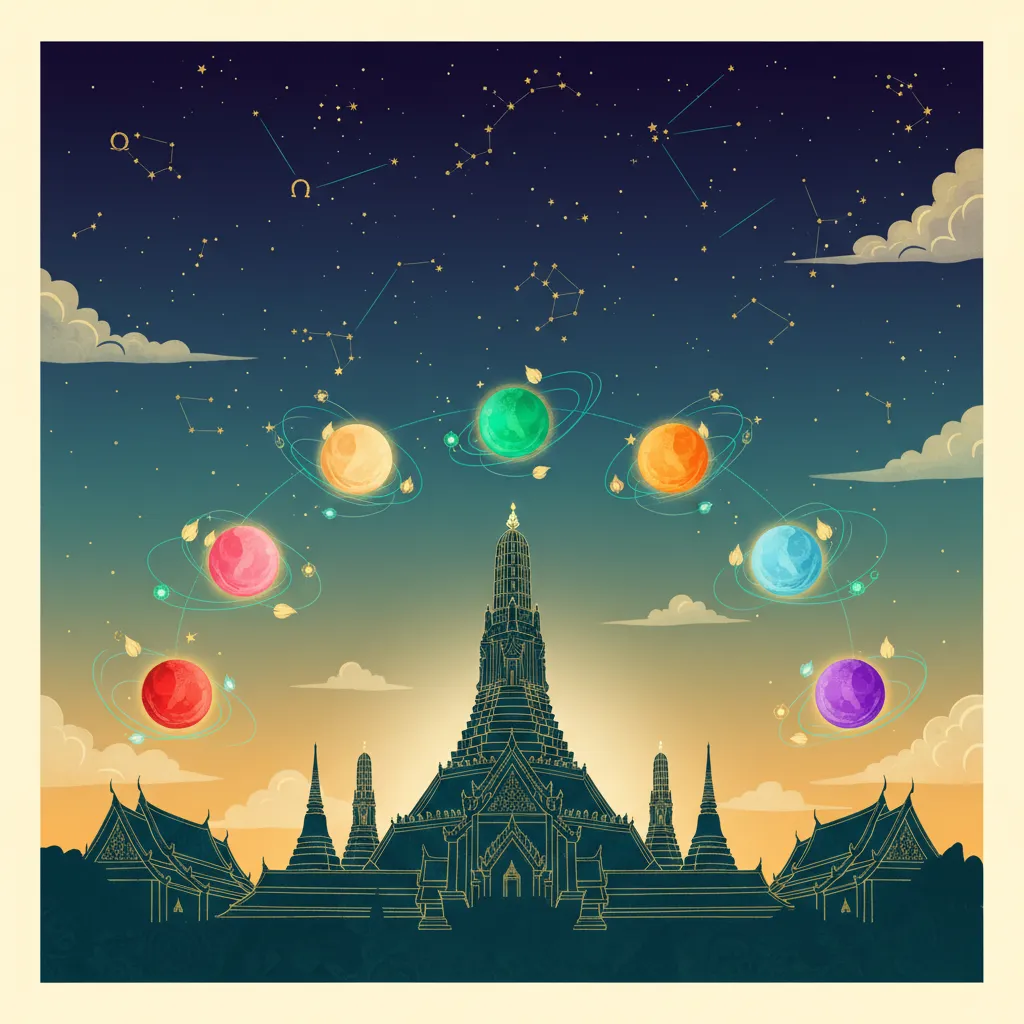
The 7 Days of the Week in Thai
| Day | Thai | Romanization | Color |
|---|---|---|---|
| Sunday | วันอาทิตย์ | wan aa-thít | Red |
| Monday | วันจันทร์ | wan jan | Yellow |
| Tuesday | วันอังคาร | wan ang-khaan | Pink |
| Wednesday | วันพุธ | wan phút | Green |
| Thursday | วันพฤหัสบดี | wan pá-rʉ́-hàt-sà-bɔɔ-dii | Orange |
| Friday | วันศุกร์ | wan sùk | Blue |
| Saturday | วันเสาร์ | wan sǎo | Purple |
Each day is named for a celestial body — the same Sun, Moon, and five planets that give English its weekday names. Each has an associated lucky color that Thais still wear today, especially on birthdays.
Why Do Thai Day Names Have Silent Letters?
Look at Monday: วันจันทร์ (wan jan). The word จันทร์ has four consonants—จ, น, ท, ร—but you only pronounce two of them. The ท and ร sit there silently, wearing little marks on top.
Why write letters you don’t say?
The answer involves Babylonian astronomers, Hindu astrologers, Sanskrit loanwords, and a fundamental clash between Thai phonology and Indic spelling. Understanding this history makes Thai orthography less arbitrary—and helps you remember how to spell these common words.
The Planetary Week: A Shared Ancient System
The seven-day week isn’t Thai, Indian, or European. It emerged in the Roman world around the 1st century BCE to 1st century CE, combining Babylonian astronomical knowledge with Greek planetary theory. The Babylonians had tracked seven celestial bodies—Sun, Moon, and five visible planets—for millennia. Greek astronomers assigned each hour of the day to a different planet in a specific sequence, and the planet ruling the first hour gave the day its name.
This system spread in every direction. The Romans adopted it. Indian astronomers absorbed it through contact with Hellenistic knowledge during the early centuries CE. From India, it traveled with Hindu-Buddhist culture into Southeast Asia.
The result: Thai, English, Japanese, and Hindi all name their weekdays after the same seven celestial bodies.
Sanskrit Roots: The Full Etymology
Thai day names come from Sanskrit through the Hindu Navagraha—the “nine celestial bodies” that include the Sun, Moon, five planets, plus Rahu and Ketu (the lunar nodes responsible for eclipses).
Each Sanskrit name carries meaning:
| Day | Sanskrit | Meaning | Thai Spelling | Thai Pronunciation |
|---|---|---|---|---|
| Sunday | आदित्य (Āditya) | “Son of Aditi” (Sun deity) | อาทิตย์ | aa-thít |
| Monday | चन्द्र (Candra) | “Shining” (Moon) | จันทร์ | jan |
| Tuesday | अङ्गारक (Aṅgāraka) | “Burning coal” (Mars) | อังคาร | ang-khaan |
| Wednesday | बुध (Budha) | “Awakening, intelligent” (Mercury) | พุธ | phút |
| Thursday | बृहस्पति (Bṛhaspati) | “Lord of prayer” (Jupiter) | พฤหัสบดี | pá-rʉ́-hàt-sà-bɔɔ-dii |
| Friday | शुक्र (Śukra) | “Bright, clear” (Venus) | ศุกร์ | sùk |
| Saturday | शनि (Śani) | “Slow one” (Saturn) | เสาร์ | sǎo |
The Sanskrit word चन्द्र (candra) for “moon” traces back to Proto-Indo-European *(s)kand- meaning “to shine”—the same root that gives English “candle” and “incandescent.” When you say วันจันทร์, you’re using a word related to “candle” by 4,000 years of linguistic descent.
Tuesday’s name is particularly vivid. Sanskrit अङ्गारक (aṅgāraka) means “burning coal”—describing Mars’s red glow in the night sky. The Thai spelling อังคาร preserves this etymology.
Why the Silent Letters? Thai Phonotactics Meets Sanskrit Spelling
Here’s the problem: Sanskrit allows consonant clusters and syllable-final sounds that Thai doesn’t permit.
Thai syllables follow strict rules. A syllable can end with a limited set of sounds: /p/, /t/, /k/, a nasal, /w/, /y/, or a vowel. Sanskrit words like चन्द्र (can-dra) or शुक्र (śuk-ra) end with clusters (-ndra, -kra) that violate Thai phonology.
Thai had two options:
- Simplify the spelling to match Thai pronunciation
- Preserve the Sanskrit spelling and mark unpronounced letters
Thai chose option two. The solution: thanthakhat (ทัณฑฆาต), written ◌์.
Watch it work:
- จันทร์ (jan): The thanthakhat above ร silences the final cluster ทร์. Preserves Sanskrit चन्द्र.
- ศุกร์ (suk): The ร is written but killed. Preserves Sanskrit शुक्र.
- อาทิตย์ (aa-thit): The ย is written but killed. Preserves Sanskrit आदित्य.
- เสาร์ (sao): The ร is written but killed. From Sanskrit शनैश्चर (śanaiścara, “slow-moving one”).
This wasn’t laziness or inconsistency. It was a deliberate choice to maintain visual connection to the source language—marking Thai as a language of learning that preserves its Indic heritage in writing.
Thanthakhat Patterns in Day Names
| Thai | Pronunciation | Silent Consonants | Notes |
|---|---|---|---|
| จันทร์ | jan | ทร์ | Final cluster silenced |
| ศุกร์ | sùk | ร์ | Final ร silenced |
| อาทิตย์ | aa-thít | ย์ | Final ย silenced |
| เสาร์ | sǎo | ร์ | Final ร silenced |
| พฤหัสบดี | pá-rʉ́-hàt-sà-bɔɔ-dii | — | All letters pronounced |
Cross-Language Comparison
The planetary week traveled globally, but each culture adapted it differently:
English substituted Germanic gods for Roman planets. Tuesday through Friday honor Tiw, Woden, Thor, and Frigg—gods mapped to Mars, Mercury, Jupiter, and Venus through interpretatio germanica.
Japanese and Korean use the same planetary system, arrived via Chinese astronomy and the Five Elements (fire, water, wood, metal, earth) plus Sun and Moon. The monk Kobo Daishi (Kukai) brought the planetary week calendar to Japan in 806 CE from Tang China.
| Japanese | Meaning | Planet |
|---|---|---|
| 日曜日 (nichiyoubi) | Sun day | Sun |
| 月曜日 (getsuyoubi) | Moon day | Moon |
| 火曜日 (kayoubi) | Fire day | Mars |
| 水曜日 (suiyoubi) | Water day | Mercury |
| 木曜日 (mokuyoubi) | Wood day | Jupiter |
| 金曜日 (kinyoubi) | Metal day | Venus |
| 土曜日 (doyoubi) | Earth day | Saturn |
Chinese abandoned planetary names entirely. Modern Mandarin uses numbers: 星期一 (xīngqīyī, “week-one”) through 星期六, with Sunday as 星期日 or 星期天.
Portuguese also uses numbers—but for theological reasons. Bishop Martin of Braga in 6th-century Iberia rejected pagan planetary names. Portuguese weekdays became segunda-feira (second day), terça-feira (third day), and so on. Only Saturday (sábado, from Sabbath) and Sunday (domingo, from Latin “Lord’s Day”) retain non-numerical names.
Practical Takeaway for Learners
Understanding etymology transforms spelling from arbitrary memorization into logical patterns.
When you see จันทร์ and wonder why there’s a ท and ร you don’t pronounce, you now know: they’re preserving the Sanskrit चन्द्र (candra). The thanthakhat marks them as silent.
This pattern extends beyond day names. Any Sanskrit or Pali loanword might contain silent letters:
- ศาสตร์(sàat) — the ร์ is silent
- สัตว์(sàt) — the ว์ is silent
- ประวัติศาสตร์(bprà-wát-dtì-sàat) — multiple silent letters
The rule is consistent: thanthakhat kills the letter it sits above. When you encounter it, you’re seeing Thai preserve its connection to classical languages.
The Weight of History
Every time a Thai speaker says วันจันทร์, they’re using a word that traveled from Babylonian star-gazers to Greek philosophers to Indian astronomers to Southeast Asian courts—accumulating meaning at each stop.
The silent letters aren’t mistakes or inefficiencies. They’re fossils of Sanskrit embedded in Thai orthography, visible evidence of Thailand’s deep connections to Indic civilization. The thanthakhat does its quiet work, marking where ancient sounds were sacrificed to Thai phonology while their spellings were preserved.
Understanding this makes Thai spelling less frustrating and more fascinating. Those silent consonants aren’t random—they’re history you can see.
Related: Thai Language History explores how Pali, Sanskrit, and Khmer shaped Thai vocabulary over centuries.
Etymology helps vocabulary stick. Try Jam Kham free—learn Thai words with the context and connections that make them memorable.