
5 Thai Learning Myths That Waste Your Time
These 5 Thai learning myths—script first, impossible tones, useless apps—keep beginners stuck. Here's what the research actually says, and what works.
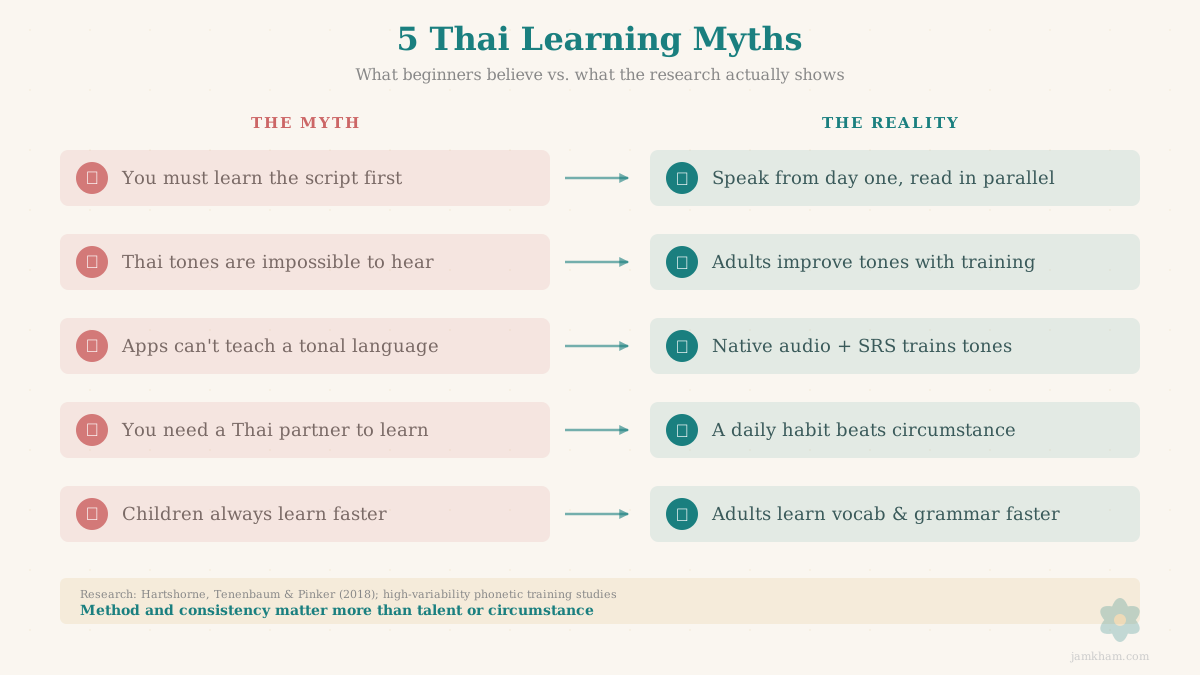
Ask ten people why Thai is hard to learn and you’ll hear the same handful of reasons: the alien script, the “impossible” tones, the idea that you really need a Thai girlfriend or boyfriend to get anywhere. Most of these Thai learning myths feel true. They’re repeated in forums, blog comments, and expat bars across Bangkok. And they sabotage beginners—not because Thai is easy, but because the myths point you at the wrong work.
Thai is a genuinely challenging language for English speakers. The U.S. Foreign Service Institute rates it Category IV, needing roughly 1,100 hours for professional proficiency. But difficulty and myth are two different things. The myths below aren’t about how hard Thai is—they’re about how it’s learned. Believe them, and you’ll spend your first three months optimizing for the wrong outcome. Let’s take them apart one at a time.
Myth 1: “You Have to Learn the Script Before You Can Speak”
This is the most common piece of advice handed to beginners, and it stalls more people than any other. The logic sounds reasonable: Thai is a tonal language, the script encodes the tones, so surely you must read before you speak. In practice, it gets the order backwards for most learners.
Reading Thai fluently takes two to three months of consistent practice—44 consonants in three tone classes, 28-plus vowel forms that wrap above, below, before, and after their consonants, and no spaces between words. If you make script mastery a prerequisite for opening your mouth, you’ve just put a two-month wall between yourself and your first conversation. Most people quit before they reach it.
The better approach is parallel, not sequential. Start speaking with high-quality romanization and clear Thai audio from day one, and learn the script alongside it as recognition rather than a separate gauntlet. Your ear and your tongue don’t need the script to copy สวัสดีครับ(sà-wàt-dii khráp) correctly—they need a model to imitate. The script becomes far easier to learn after you already know what a few hundred words sound like, because each character attaches to a sound you recognize instead of an abstract shape.
To be clear, the script is worth learning. It’s the only way to reliably predict tones, and it’s what lets you read menus, signs, and real Thai. But “script first, speaking later” is a sequencing mistake, not a law. Speak early; read in parallel. When you’re ready to break free of romanization, the Read Thai course teaches every character in the order you’ll meet it on signs and menus, with the tone rule behind it, so you’re reading real words in the first week instead of grinding a wall chart.
See how Thai reading actually works
So no — you don't have to learn the script before you speak. But it's still the only reliable way to read tones, menus, and real Thai. See how the alphabet works. First three modules free — no card.
Sound out your first Thai word →No account, no card — just the alphabet.
Myth 2: “Thai Tones Are Impossible for Western Ears”
The five Thai tones—mid, low, falling, high, and rising—terrify beginners. The fear is understandable: get the tone wrong and you get a different word. The classic pair is ใกล้(glâi) (falling) versus ไกล(glai) (mid)—identical letters to an English eye, opposite meanings. From there it’s a short leap to “my ear just can’t do this.”
The research says otherwise. Adults can and do learn to perceive lexical tones with structured practice. Studies using high-variability phonetic training—exposure to many different speakers saying the same tones—show consistent improvement in tone categorization, and a 2024 study found these gains even in native English speakers over the age of 60 learning Mandarin tones (Zhang, Liao & Truong, 2024). A separate study measured neural and behavioral improvement in English speakers learning to discriminate Thai tones after just a short perceptual training task (Kaan et al., via PMC). Your ear is not the problem.
What does trip people up is method. Three habits sabotage tone learning, and none of them are about your ears:
- Learning vocabulary without tones attached (“I’ll add the tones later”)
- Learning from audio that gets the tone wrong
- Practicing each tone in isolation instead of hearing it contrasted against the others
Tones require ear training, not talent. Train them deliberately—with clear models, in contrast, from day one—and they stop being a wall and become just another feature of the language. For the full system, see our complete guide to Thai tones.
Myth 3: “Apps Can’t Teach a Tonal Language”
There’s a kernel of truth buried in this one, which is exactly why it’s dangerous. Generic apps often do handle tones badly. A gamified course that rewards you for tapping the right English translation never checks whether you produced—or even heard—the correct tone. If your only tool teaches Thai as if it were Spanish, then yes, the app is failing you.
But the conclusion “apps can’t teach tonal languages” doesn’t follow. The thing that makes tones learnable—structured, repeated exposure to Thai audio with feedback—is exactly the kind of practice software delivers well, at scale, on demand. The variety has to come from hearing many Thai people; what software adds is the drilling. The phonetic-training studies above were largely delivered through software. The question was never “app or no app.” It’s “does this app actually train the tonal features of the language?”
A tool that teaches Thai properly will do a few specific things: play clear Thai audio with the tone easy to hear, show the pitch contour so you can see the melody you’re copying, test recognition before production, and label each word’s tone and consonant class so the patterns sink in. Those features aren’t exotic—they’re just the difference between an app built for Thai and an app that bolted Thai onto a generic template.
So judge the tool, not the category. The right app removes the two hardest barriers to consistent practice: needing a tutor available at all times, and needing the discipline to schedule your own reviews.
Myth 4: “You Need a Thai Partner (or to Live in Thailand) to Learn”
This myth is comforting because it’s an excuse. If real progress requires a Thai partner or a year in Chiang Mai, then your slow progress isn’t your method’s fault—it’s just your circumstances. Plenty of people quietly believe this, and it lets them off the hook.
Immersion and a patient native-speaker partner are genuinely wonderful. But they’re accelerants, not prerequisites—and on their own they’re surprisingly inefficient. Living in Thailand without structured study is how thousands of expats end up after five years with fluent taxi-and-restaurant Thai and almost nothing beyond it. Exposure without deliberate practice plateaus fast. A partner who loves you is also, usually, a terrible teacher: they’ll switch to English to be kind, correct you inconsistently, and have no idea why your rising tone keeps sliding into a mid tone.
What you actually need is consistent, structured input with clear Thai audio and a system that makes you retrieve words rather than just recognize them. That’s available anywhere with a phone. The learners who progress fastest aren’t necessarily the ones in Bangkok—they’re the ones who practice 20 focused minutes a day, every day, with good materials. Geography helps at the margins; consistency is the engine.
Myth 5: “Children Learn Languages Faster, So Adults Can’t Catch Up”
This is the most defeating myth of all, and it’s mostly backwards. The image of a toddler effortlessly soaking up language while you struggle is real—but it’s misleading about speed.
Research consistently finds that adults and older children make faster initial progress than young children in most areas of a second language. Adults learn grammar and vocabulary more quickly, recall more words after the same amount of instruction, and bring cognitive advantages young kids lack: reasoning, memory strategies, and a fully developed first language to build on (summary of the research). If you dropped an adult and a four-year-old into the same Thai class, the adult would be ahead for a good while.
Where children genuinely win is accent. Native-like pronunciation is much easier to achieve with an early start, and the large 2018 study by Hartshorne, Tenenbaum, and Pinker—analyzing data from roughly 670,000 people—found that the ability to learn grammar to a native-like ceiling stays stable until around age 17 before declining (study overview). Note what that finding actually says: the ceiling shifts with age, not your ability to learn the language well. A sharper accent than a native, sure. Functional, confident, even highly fluent Thai? Entirely available to adults.
So the honest framing isn’t “kids are faster.” It’s: adults are faster early and may settle a touch below a native accent. For anyone learning Thai to travel, work, connect, or live, that ceiling is irrelevant. You’re not auditioning to pass as Thai on the phone—you’re trying to communicate, and the evidence says your adult brain is well-equipped for it.
What’s Actually Behind Every Myth
Notice the pattern. Every one of these Thai learning myths redirects your attention away from the thing that matters and toward something you can’t control or shouldn’t prioritize. Script-first delays speaking. “Impossible tones” blames your ears. “Apps can’t” and “you need a partner” make tools or circumstances the villain. “Kids learn faster” makes your age the villain. None of them are the real lever.
The real lever is unglamorous: consistent daily practice with clear audio, tones trained from the start, and spaced repetition that makes you recall words just before you’d forget them. That’s it. It’s the same conclusion the science of learning keeps pointing to, and it’s why the best way to learn Thai looks less like a secret and more like a system you actually follow. The myths are seductive because they offer a reason it’s not working that isn’t “I haven’t built the habit yet.” Drop them, and Thai gets a lot more approachable.
Frequently Asked Questions
Do I need to learn the Thai script before I start speaking?
No. You can start speaking immediately using romanization and clear audio, and learn the script in parallel as recognition. The script is valuable—it’s the reliable way to predict tones and read real Thai—but treating it as a prerequisite for speaking creates a two-to-three-month barrier that stalls most beginners. Speak early, read alongside it.
Are Thai tones really impossible for English speakers?
No. Tones are difficult but learnable. Studies on high-variability phonetic training show adults—including learners over 60—measurably improve tone perception with structured practice. The common failure isn’t the ear; it’s method: learning words without tones attached, learning from audio that gets the tone wrong, and practicing tones in isolation rather than in contrast. Train tones deliberately with clear models, in contrast, from the start.
Can an app actually teach a tonal language like Thai?
Yes, if it’s built for the job. Generic apps that ignore tone production fail, which is where the myth comes from. But software is excellent at delivering exactly what tone learning needs—clear Thai audio, visual pitch contours, recognition-before-production testing, and spaced review. Judge the specific tool by whether it trains tones, not the whole category of apps.
Is it true that children learn languages faster than adults?
Mostly the opposite. Adults typically make faster initial progress in vocabulary and grammar and bring stronger memory and reasoning strategies. Children’s main advantage is accent—native-like pronunciation is easier with an early start. For travel, work, or daily life, an adult can absolutely reach confident, fluent Thai; only a fully native accent becomes harder with age.
What actually makes the difference in learning Thai?
Consistency and method, not circumstances. The learners who progress fastest practice about 20 focused minutes daily with clear audio, train tones from day one, and use spaced repetition so reviews happen at the right time. A Thai partner or living in Thailand can help at the margins, but neither replaces a daily habit with good materials.
Learn Thai the Way That Actually Works
If these myths have been shaping how you study—or why you haven’t started—this is your permission to drop them. Thai is hard, but it’s hard in predictable ways, and the method that handles them isn’t a secret.
Start Read Thai free → The first three modules cover the full alphabet with consonant-class labels, clear audio on every word, and tone rules built in — no credit card. The full vocabulary app (tone training, spaced repetition, all 8 card types) is waitlist-only for now; early supporters lock in founding pricing at launch. Just the right method, twenty minutes at a time.
Related reading: Is Thai Hard to Learn? | Why Spaced Repetition Works | Thai Tones Complete Guide
Start reading Thai today
Every myth in this post rests on the assumption that you can skip the script — Read Thai is built on the opposite bet: learning the alphabet first gives you the tone rules, which means every word you study sticks. First three modules free — no card.
Start the reading course →First 3 modules free — no card, and they don't expire.