
Turn Any Thai Reading into Student Practice Material
Upload any Thai PDF and get vocabulary cards with tones, romanization, and example sentences. No manual data entry. Built for teachers and students.
You assigned Chapter 7 of your Thai reader last week. Forty new vocabulary words. Your students need to learn them before the next discussion, and you know from experience that telling them to “review the chapter” won’t cut it. They need structured practice — flashcards, at minimum, but ideally something that tests production, not just recognition.
So you open a spreadsheet. You start typing Thai script, adding romanization, marking tones, writing English definitions, drafting example sentences. Forty words. Two columns each for Thai and romanized forms. Tone class for each syllable. At least one example sentence per word, ideally from the source text so students see the word in context.
You’re an hour in. You’ve finished twelve words. This is the vocabulary list problem, and every Thai language teacher knows it.
The Vocabulary List Problem
Creating practice material from Thai readings is disproportionately time-consuming compared to other languages. Thai script has no spaces between words — you can’t just scan a page and pull out vocabulary the way you could with French or Spanish. Romanization isn’t standardized, which means making and maintaining consistent choices across an entire word list. Then there’s tone annotation: every word carries a tone that changes its meaning, and skipping that data is like teaching English vocabulary without pronunciation. Add example sentences (ideally from the source text), and the per-word effort is substantial.
A 40-word vocabulary list — the kind you’d assign for a single chapter — with Thai script, romanization, tones, English meanings, and one example sentence per word takes two to three hours of focused work. That’s not lesson planning. That’s data entry.
The alternatives aren’t much better. Pre-made Anki decks and Quizlet sets rarely match your specific textbook or reading material. They use different romanization systems. They include words your students already know and miss words they don’t. And they almost never include tone data — which, for Thai, leaves out the one detail that determines a word’s meaning.
The third option is the one most teachers reluctantly fall back on: assign the reading and hope students figure it out. Some will. Most won’t. The gap between reading material and practice material stays wide, and the students who need structured practice the most are the ones least likely to create it themselves.
What Happens When You Upload a Thai PDF
Jam Kham’s PDF upload closes that gap. Here’s the actual process.
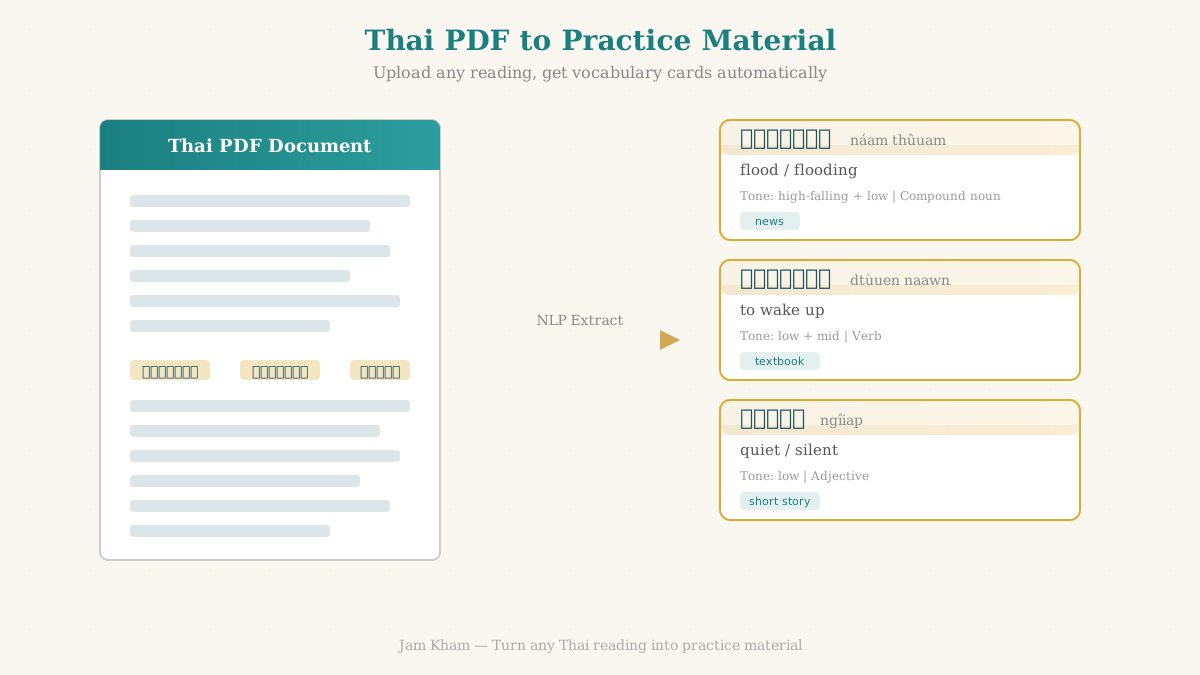
You upload a PDF — a textbook chapter, a news article, a worksheet you wrote, any document with Thai text. The system’s NLP pipeline processes the text: segmenting words (since Thai doesn’t use spaces), identifying compounds and multi-syllable terms, and analyzing each word in context.
Within minutes, you get back a structured vocabulary list. Not a raw word dump — a fully annotated set of entries, each with the data you’d normally spend hours producing by hand.
You review the list, remove words your students already know or that aren’t worth studying, and add any notes you want. Then you share it with your class. The whole process — upload, review, share — takes ten to fifteen minutes.
What You Get for Each Word
Each extracted word comes with the full set of data a student needs for effective practice. Here’s what the output looks like for words pulled from different source types.
From a news article about flooding:
náam thûuamน้ำท่วมflood / floodingThe system recognizes this as a compound — not two separate words น้ำ(náam) and ท่วม(thûuam), but a single vocabulary item with its own meaning and usage pattern.
From a university textbook chapter on daily routines:
dtùuen naawnตื่นนอนto wake upEach syllable comes with tone data: ตื่น(dtùuen) (low tone — mid-class consonant with mai ek) and นอน(naawn) (mid tone — low-class consonant, live syllable). That tone information feeds directly into tone training exercises, so students practice hearing and producing correct tones alongside the vocabulary itself.
From a short story:
ngîiapเงียบquiet / silentEach entry also includes the syllable breakdown that helps students work out unfamiliar Thai script. Instead of seeing เงียบ as an opaque block of characters, they see how the consonant cluster, vowel, and final consonant map to the pronunciation.
From Vocabulary List to Active Practice
Extracting vocabulary from a PDF is useful. But a word list alone doesn’t produce learning — it’s what students do with that list that matters.
Research on the testing effect is clear: students who test themselves on material retain substantially more than students who re-read it. And the type of testing matters. Recognizing a Thai word when you see it — picking the correct English translation from four options — is a fundamentally different cognitive task from producing that word when you need it in conversation.
This is the difference between recognition and active recall. Most flashcard tools test recognition almost exclusively. You see สวัสดี, you tap “hello,” you move on. That builds passive knowledge. It doesn’t build the production skills students need to actually use the word.
When extracted vocabulary enters Jam Kham’s spaced repetition system, each word gets practiced through 8 specialized card types: recognition, production, listening comprehension, audio production, tone identification, tone production, classifier matching, and sentence fill. Students don’t just memorize definitions — they build reading, writing, listening, and speaking skills around each word.
A static Quizlet deck tests one dimension of word knowledge. Eight card types test all of them.
Five Documents Every Thai Teacher Should Upload
The PDF upload works with any Thai-language document. But some source types produce especially useful practice material. Here are five worth starting with.
Textbook Chapters
The most obvious use case, and the highest-impact one. Upload the chapter you’re assigning this week. Students practice exactly the vocabulary their quizzes and exams will cover — no more studying generic word lists that overlap 60% with the textbook and miss the other 40%.
If your program uses a standard reader like Thai for Beginners or Read Thai in 10 Days, upload one chapter at a time. The extracted vocabulary accumulates into a growing study set that tracks the course progression.
News Articles
ข่าว(khàao) articles from Thai PBS, Matichon, or Khaosod give students exposure to current, authentic Thai. The vocabulary is topical and contextual — a piece about economics introduces financial terms naturally, while a sports article builds a different word set entirely.
News works especially well for intermediate and advanced students who need to move beyond textbook Thai into the language as it’s actually used. The vocabulary is denser and more varied than textbook prose, which means more new words per page and richer practice sets.
Short Stories and Literature
University-level Thai literature courses generate massive vocabulary loads. A single chapter of a Thai novel can introduce dozens of words students haven’t encountered before — many of them literary or archaic terms that don’t appear in standard frequency lists.
Upload a chapter before class discussion. Students who’ve practiced the key vocabulary engage with the text at a deeper level. They’re not stuck on individual words — they’re following the narrative, noticing style choices, and forming interpretations. That’s the discussion you want to have.
Song Lyrics
High student engagement, natural repetition of common phrases, and vocabulary that sticks because it’s attached to a melody. Thai pop music uses conversational language that maps well to everyday usage.
Students already want to understand the songs they listen to. Giving them structured vocabulary practice for those songs channels existing motivation into measurable learning. The emotional connection to music also improves retention — words tied to a song you like are harder to forget.
Teacher-Written Worksheets and Dialogues
If you write your own materials — dialogues, reading passages, situational exercises — the vocabulary practice comes automatically. Write the dialogue, export to PDF, upload it, and the practice set generates itself.
This is especially valuable for tutors and small-program instructors who create custom content for specific students. The material is already tailored to the student’s level and goals. Now the practice material matches too.
Classroom Workflow: Assign, Practice, Track
Here’s what the full cycle looks like in practice.
Monday: You upload the PDF for this week’s reading — say, a two-page news article about Thai education policy. The extraction identifies 35 new vocabulary items. You spend ten minutes reviewing: remove five common words your students already know, keep thirty. You share the practice set with your class.
Tuesday through Thursday: Students practice on their own schedule. The spaced repetition system handles timing — words they get right on the first try appear less frequently; words they struggle with come back sooner. Each session takes ten to fifteen minutes. The eight card types rotate automatically, so students build recognition, production, and listening skills without having to manage their own study plan.
Friday: Before class, you check the analytics dashboard. You see that 80% of the class struggles with นโยบาย(ná-yoh-baai) and หลักสูตร(làk-sùut). You know where to focus your class time. Instead of reviewing all thirty words — most of which students have already internalized through practice — you spend fifteen minutes on the five that gave the whole class trouble.
That’s a better use of class time than a vocabulary quiz that tells you what students didn’t learn. The analytics tell you what they’re struggling with before the assessment.
Students Can Do This Too
PDF upload isn’t limited to teachers. Students on the Study Thai plan can upload their own material.
The use cases vary. Self-study learners working through Thai for Beginners on their own can upload each chapter as they reach it — the practice material builds itself, matching their pace exactly. Exam prep looks different: upload past papers or study guides, and the spaced repetition system ensures the extracted terms actually stick before test day. And the reader working through a Thai novel chapter by chapter accumulates a personalized vocabulary set from the specific text, rather than scribbling words in a notebook they’ll never revisit.
For students building their own study path, the Thai Learning Roadmap provides structure, and PDF upload provides the raw material. For complete beginners, Thai for Beginners: 30-Day Plan is a better starting point — upload comes into its own once you’re working with Thai texts. And if you can’t yet read the script those texts are written in, start there: the Read Thai course takes you from zero to reading Thai words in about eight weeks, so the PDFs you upload later actually mean something.
What About Accuracy?
The extraction uses LLM-powered natural language processing. Thai text presents specific challenges that rule-based systems handle poorly: no spaces between words, compound terms whose meaning differs from their component parts, tonal ambiguity in romanization, and context-dependent readings of certain characters.
The NLP pipeline handles these well. It segments words accurately, identifies compounds as units rather than splitting them, assigns correct tones based on tone rules and exceptions, and generates romanization consistently.
It’s not perfect. The teacher review step exists for a reason. You’ll occasionally see a function word that isn’t worth studying, a compound that got split when it shouldn’t have, or a romanization that needs adjustment. In a typical 40-word extraction, you might correct three to five entries.
But here’s the math that matters: reviewing and correcting a pre-built list takes ten minutes. Building that list from scratch takes two to three hours. Even at 90% accuracy on first pass, the time savings are dramatic. And the output includes data — tone class, syllable breakdown, example sentences — that most teachers skip when building lists manually because it takes too long.
Try It with Your Next Reading
The extraction handles the tedious work — word segmentation, romanization, tone annotation, example sentence selection. You keep editorial control: reviewing the output, removing words that aren’t worth studying, adjusting anything the system got wrong. Your students get structured, multi-dimensional practice on exactly the words their coursework requires.
If you want to try it, upload a PDF you’re already planning to assign this week. Ten minutes of review, and your students have practice material that would have taken you an afternoon to build. Jam Kham’s full app is currently waitlist-only — join now for founding pricing at launch.
Start reading Thai today
Want the PDFs you upload to actually mean something? The Read Thai course teaches every character in the order you'll meet it, with the tone rule behind it. First three modules free — no card.
Start the reading course →First 3 modules free — no card, and they don't expire.
Related reading: Active Recall vs Recognition | The Testing Effect | Thai for Beginners: 30-Day Plan | How It Works