
Thai Regional Cuisine: Four Kitchens, One Country
Portuguese desserts in the south, Burmese curry in the north. How trade routes and geography gave Thailand four radically different cuisines.
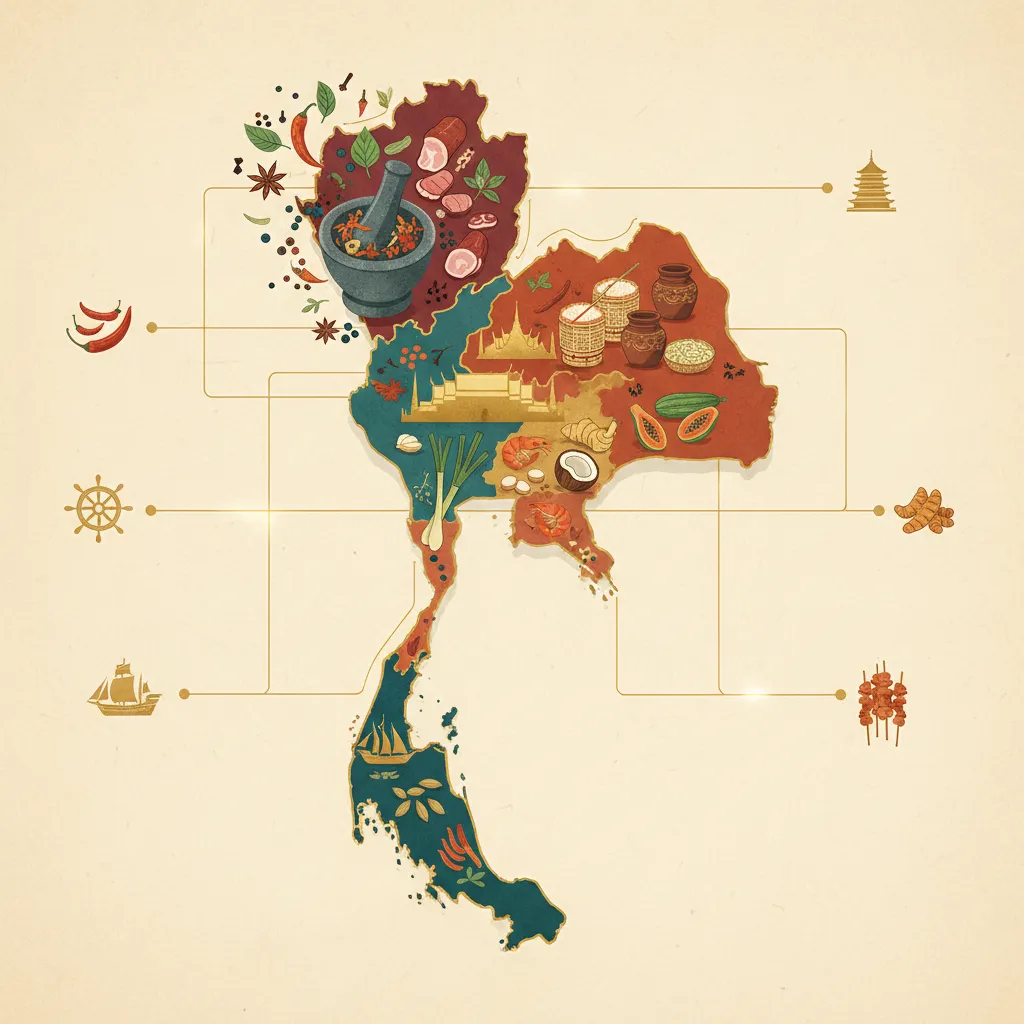
Order แกงฮังเล(gaeng hang lay) in Chiang Mai. Order มัสมั่น(mát-sà-màn) in Phuket. Order ส้มตำ(sôm tam) in Udon Thani. Three dishes, three regions, three histories---and if you listen to the words themselves, they’ll tell you where each dish came from. Hang lay is Burmese. Massaman is Persian-Arabic. Som tam’s preparation echoes Lao mortar-and-pestle traditions older than any national border on the map.
Thai food is not one cuisine. It’s four, stitched together by geography, trade, war, and royal ambition. The stitches show if you know where to look---and the clearest ones are in the language.
Central Thailand: The Royal Kitchen
The story of Central Thai food begins in a palace.
When King Ramathibodi I founded Ayutthaya in 1351, he inherited a court culture already shaped by the Khmer Empire. Khmer palace cooks came with the court’s administrative traditions, bringing techniques for elaborate food presentation, spice pounding, and the careful balancing of flavors that would define what we now call “royal Thai cuisine.” The Ayutthaya court ruled for over four centuries, and during that time, court kitchens became laboratories.
Royal cuisine had rules. All bones were removed from meat and fish---a royal person should never encounter a bone. Flavors were balanced across four registers: sweet, sour, salty, spicy. Ingredients had to be the finest available. Fruit was carved into flowers. Presentation was as important as taste. This wasn’t just food; it was statecraft, a demonstration of civilization meant to impress visiting diplomats from China, Persia, India, and Europe.
The result is what foreigners now think of as “Thai food”---the Central Thai canon of green curry, tom yum, pad thai, and coconut-milk-based curries. But much of it didn’t originate in Thailand at all.
The Portuguese Arrived, and Everything Changed
In 1511, Portuguese traders established themselves in Ayutthaya. They brought two things that remade Thai cuisine: chili peppers from the Americas and a tradition of egg-yolk confections.
Before the 16th century, Thai food got its heat from peppercorns and galangal. Chili peppers---Capsicum species from Central and South America---arrived via Portuguese trade routes that connected Lisbon to Goa to Malacca to Siam. Within a few generations, chili had become so thoroughly integrated that most Thais today consider it an ancient, indigenous ingredient. It isn’t. It’s barely 500 years old in Southeast Asia.
The egg-yolk desserts are even more telling. ฝอยทอง(fâwi thawng) comes directly from the Portuguese fios de ovos---literally, “egg threads.” The technique is identical: egg yolks dropped through a perforated spoon into boiling sugar syrup to form golden strands. ทองหยิบ(thawng yîp) and ทองหยอด(thawng yàwt) use the same yolk-and-sugar base. The word สังขยา(sǎng-khà-yǎa) names a custard that replaced Portuguese cow’s milk with Thai coconut milk---the original Iberian recipe adapted to local ingredients.
The woman credited with this transfer is Maria Guyomar de Pinha, born in Ayutthaya around 1664 to a Portuguese-Bengali-Japanese family. She married Constantine Phaulkon, the Greek adventurer who became Ayutthaya’s de facto foreign minister under King Narai. After Phaulkon’s execution in the 1688 revolution, Maria was confined to the royal palace and put to work in the kitchens, where she taught her family’s Portuguese confectionery techniques to Siamese cooks. Her desserts became royal court staples and eventually spread to the general population.
Today, these egg-yolk sweets are considered quintessentially Thai. They appear at every Thai wedding, every temple ceremony, every auspicious occasion. Almost nobody thinks of them as Portuguese.
Tom Yum Kung: River Communities and UNESCO
tôm yam gûngต้มยำกุ้งspicy-sour shrimp soup did not start in a palace. It started along the rivers and canals of the Central Plains, where freshwater shrimp were abundant and the local herbs---galangal, lemongrass, kaffir lime leaves, bird’s eye chili---grew wild on the banks.
The earliest documented recipe appears in a cookbook compiled in 1898 by teachers at the Harriet M. House School, a Bangkok missionary school for girls. But the dish is certainly older. The 1898 version simply provides the first written record. The recipe that most closely resembles what restaurants serve today was published in 1964 by M.R. Kitinadda Kitiyakara, a member of the royal family who codified many Central Thai dishes.
On December 3, 2024, in Asuncion, Paraguay, UNESCO inscribed tom yum kung on the Representative List of the Intangible Cultural Heritage of Humanity. It was the first---and so far only---Thai food to receive this designation. The UNESCO citation recognized the dish’s origin in Central Thai riverside communities and praised the “profound understanding of harmonious living with nature” reflected in its use of indigenous herbs and seasonal ingredients.
Pad Thai: Invented by Government Decree
Not every Central Thai dish has ancient roots. Some were engineered.
In the late 1930s and early 1940s, Prime Minister Plaek Phibunsongkhram promoted noodles as part of a nationalist campaign---specifically, a stir-fried rice noodle dish that used Thai-produced rice noodles while reducing dependence on imported wheat noodles and Chinese-run noodle shops. The recipe drew on Chinese stir-fry technique (the wok, the noodle, the tamarind-sugar flavor base) but was rebranded as Thai. Phibunsongkhram’s government promoted it as a national dish, part of a broader cultural nationalism campaign that also renamed the country from Siam to Thailand in 1939.
Pad thai is barely 85 years old. It’s also the single most recognized Thai dish on earth. Both facts are true at once.
Boat Noodles: Commerce on the Canals
ก๋วยเตี๋ยวเรือ(gǔai-dtǐao reua) have their own origin story rooted in geography. During the Ayutthaya period and well into the Bangkok era, Thailand’s central plain was a web of canals---คลอง(khlawng)---that functioned as highways, markets, and social centers. Food vendors sold from boats, paddling from customer to customer.
The signature feature of boat noodles is the tiny bowl. Why? Because on a rocking boat, handing over a full-sized bowl of hot soup was a recipe for disaster. Small portions meant less spilled broth, less wasted food, less scalded skin. Customers ate three, four, five bowls, stacking them to keep count.
In the 1970s, Bangkok began filling in its canals to build roads. The boat vendors moved to shophouses. The tiny bowls stayed. Today, boat noodle alleys in Bangkok’s Victory Monument area serve the same small portions at the same low prices---a fossil of canal-era commerce, preserved in ceramic.
Northern Thailand: The Lanna Legacy
The north is a different country, culinarily speaking. And for most of its history, it was a different country politically, too.
The Lanna Kingdom, founded by King Mangrai in 1292 with its capital at Chiang Mai, was independent of Ayutthaya and Sukhothai. It had its own script (Tai Tham), its own legal traditions, its own court culture. In 1558, the Burmese Toungoo dynasty conquered Chiang Mai and occupied it for over two centuries, until King Taksin’s forces drove them out in 1775. Even after incorporation into Siam, Lanna retained semi-autonomous status until the early 20th century.
Two hundred seventeen years of Burmese rule left deep marks on the food.
Kaeng Hang Lay: Burmese Curry, Lanna Identity
gaeng hang layแกงฮังเลBurmese-style pork belly curry is Northern Thailand’s most distinctive curry, and its name tells you exactly where it came from. “Hang lay” derives from the Burmese hin lay, meaning roughly “heavy curry” or “rich curry.” Some food historians argue the dish was introduced not by ethnic Burmese but by the Shan people, a Tai-speaking group who moved between what is now Myanmar and northern Thailand for centuries. Either way, the dish has no equivalent in Central, Isan, or Southern Thai cooking.
What makes it unusual is the spice profile. Hang lay uses dried spices---ginger, tamarind, turmeric, peanuts, sometimes star anise and cardamom---that are common in Burmese and Indian cooking but rare in the rest of Thai cuisine, where fresh herbs dominate. The curry paste is pounded from dried ingredients rather than fresh ones. The pork belly is braised slowly until tender, absorbing the sweet-sour-spicy sauce.
One more anomaly: hang lay is traditionally eaten with long-grained steamed rice, not the sticky rice that defines most Northern Thai meals. This suggests the dish may have arrived with its own serving conventions intact.
Northern Laab: Not the Salad You Think
If you’ve eaten ลาบ(lâap) in Bangkok, you’ve eaten the Isan-Central version---minced meat dressed with lime juice, fish sauce, chili flakes, and fresh herbs, served at room temperature. Northern ลาบเมือง(lâap meuang) is a completely different dish.
Northern laab is a dry stir-fry, not a salad. The spice paste includes cumin, cloves, long pepper, star anise, Sichuan peppercorn (prickly ash), cinnamon, and มะแขว่น(má-khwàen)---a Lanna pepper with a numbing, citrusy bite. No fish sauce. No lime juice. The meat is often cooked with animal blood, which gives the dish a dark color and distinctive richness. Some versions include offal.
The spice list reads like a trade route. Cumin and cinnamon point toward India and Burma. Long pepper and star anise suggest Chinese borderland influence. Prickly ash connects to Sichuan and Yunnan, just a few hundred kilometers north over the mountains. Northern Thai cooking sat at a crossroads, and the laab spice cabinet is the proof.
Khantoke: Eating as Ritual
The ขันโตก(khǎn tôhk) dinner---dishes served on a round pedestal tray about 35 centimeters in diameter, diners seated on the floor around it---has roots in Lanna court tradition. The modern revival of the khantoke as a cultural performance and tourist attraction was championed by Kraisi Nimmanhemin, a northern Thai cultural preservationist, in the 1950s and 1960s.
Typical khantoke dishes include hang lay, northern laab, น้ำพริกหนุ่ม(nám prík nùm) (a roasted green chili dip), แคบหมู(khâep mǔu), and sticky rice. The format---communal, floor-seated, shared dishes on a single raised platform---reflects a social eating culture distinct from the individual plate service common in Central Thai restaurants.
Climate and Altitude
Northern food is also shaped by cooler mountain temperatures. The highlands grow vegetables and herbs that don’t thrive in the tropical lowlands: roselle leaves, certain bitter greens, temperate-climate mushrooms. Northern cooks use less chili overall than their Central and Southern counterparts---more herbal complexity, less raw heat. The abundance of pork (northern Thailand has historically raised more pigs than cattle) gives the cuisine a different protein base than the fish-heavy south and coast.
Isan: Across the Mekong
The Mekong River forms Thailand’s northeastern border with Laos. In 1893, the Franco-Siamese Treaty drew that line on a map, splitting Lao-speaking communities who had been trading, intermarrying, and eating the same food for centuries. The border changed politics. It didn’t change dinner.
Isan cuisine is, in its bones, Lao cuisine adapted to the Khorat Plateau---a dry, poor-soil region that shaped what people grew, fermented, and ate. The food is intense, sour, salty, and built on a set of foundational ingredients that Central Thai cooking barely uses.
Pla Ra: The Heart of Isan
bplaa ráaปลาร้าfermented fish paste/sauce is the single most important ingredient in Isan cooking, and one of the oldest food preparations in mainland Southeast Asia. Archaeological evidence from Ban Chiang and other Khorat Plateau sites shows earthenware vessels dating back roughly 3,000 to 5,000 years. We can’t prove those vessels held fermenting fish. But the continuity of technique---whole small freshwater fish packed in salt and rice bran, sealed in clay jars, fermented for months---strongly suggests an unbroken tradition stretching back millennia.
Pla ra appears in som tam, in laab, in แจ่ว(jâew), in soups, in stir-fries. It provides the umami-salt backbone that fish sauce provides in Central Thai cooking, but with a funkier, more complex flavor profile. Central Thai cooks often find it too pungent. Isan cooks consider it irreplaceable.
A common Isan saying: pla ra is the heart and soul of Isan food. Without it, you’re just cooking Central.
Sticky Rice as Identity
khâao nǐaoข้าวเหนียวsticky rice in Isan is not a preference. It’s an identity marker.
Across the Khorat Plateau, sticky rice (glutinous rice) is the staple grain, eaten at every meal, shaped into small balls with the fingers of the right hand and used to scoop curries, dips, and salads. Many Isan people will tell you they “don’t feel full” after eating regular long-grain rice. The sensation of satiety is bound to the texture of sticky rice---its chewiness, its density, the way it holds together in the hand.
This isn’t metaphorical. Decades of eating sticky rice calibrate the body’s sense of what a meal feels like. The preference is physiological and cultural simultaneously.
Sticky rice production historically suited the Khorat Plateau’s poor, sandy soils better than jasmine rice varieties. Economic rationality and cultural identity reinforced each other over centuries.
Insects: Normal Food, Not Novelty
Thailand has over 200 documented edible insect species---second only to Mexico in diversity of entomophagy. But the practice is concentrated in Isan, where insects have been a protein source for as long as anyone can trace.
Dr. Yupa Hanboonsong, an entomologist at Khon Kaen University who has spent decades studying insect consumption in the northeast, puts it simply: “In the northeast, people eating insects is the culture. It’s normal.”
Crickets, silk pupae, bamboo worms, giant water bugs, red ant eggs---these aren’t exotic curiosities in Isan markets. They’re groceries. แกงไข่มดแดง(gaeng khài mót daeng) is a seasonal specialty available only from February to May, when ant colonies produce eggs. Harvesters climb tall trees with bamboo poles and baskets, shaking branches to collect the white, caviar-like eggs. The resulting soup---sour, rich, with a pop of texture from the eggs---is considered a delicacy worth the climb and the stings.
Southern Thailand: The Spice Trade
Sail south from Bangkok along the Gulf of Thailand, round the peninsula, and you enter a different culinary world. Southern Thai food is the spiciest of the four regions, the most influenced by foreign trade, and the most underrepresented in international Thai restaurants.
The Malay Peninsula was, for over a thousand years, the choke point of Asian maritime trade. Merchants from Arabia, Persia, India, China, and the Malay archipelago passed through the Strait of Malacca, and many settled on the Thai side of the peninsula. Muslim traders brought dried spices---cumin, cardamom, cinnamon, cloves---that are central to Southern Thai cooking and largely absent from the other three regions.
Massaman: A Persian Curry with a Thai Name
mát-sà-mànมัสมั่นMassaman curry is the most famous Southern Thai dish, and its etymology reveals its origin. The word derives from “Mosulman,” an archaic Persian-Arabic term for Muslim. The curry’s origins are traditionally associated with Persian and Muslim merchants who traded at the Ayutthaya court in the early 17th century. The dish fuses Persian dried-spice techniques (cardamom, cinnamon, clove, star anise, cumin) with Thai wet curry methods (coconut milk, lemongrass, galangal) and Malay-Indian influences (peanuts, potatoes, tamarind).
The result is unlike any other Thai curry. It’s sweet-savory rather than spicy-sour. It uses dried spices in quantities that would overwhelm a Central Thai curry. The coconut milk is rich and thick. Potatoes and peanuts give it heft. The flavor profile is recognizably Thai but also recognizably Middle Eastern---a 400-year-old fusion dish that predates the concept of fusion cuisine by centuries.
CNN’s viewers voted massaman the number one dish in the World’s 50 Most Delicious Foods list. Thailand placed more dishes on that list than any other country, including tom yum kung, pad thai, som tam, and green curry among the top entries.
Turmeric: The Southern Signature
If Central Thai food is defined by coconut milk and lemongrass, Southern Thai food is defined by turmeric. The rhizome appears in virtually every Southern curry, staining the sauces yellow-orange and providing an earthy, slightly bitter undertone absent from Central and Northern cooking.
Southern แกงส้ม(gaeng sôm) differs from its Central Thai namesake. In the south, it’s called แกงเหลือง(gaeng lěuang) elsewhere in the country---a name that reflects its turmeric-heavy color. The southern version is thickened by pounding white fish flesh directly into the curry paste, giving it body without coconut milk. It’s sour, spicy, and turmeric-forward. Central versions use tamarind for sourness and skip the fish-paste thickener entirely.
Malay loanwords appear throughout Southern Thai food vocabulary---สะเต๊ะ(sà-dtéh), โรตี(roo-dtii), and ข้าวหมก(khâao mòk) among them---reflecting centuries of cultural exchange along the peninsula. Cooking techniques, ingredient combinations, and flavor preferences all show the imprint of a region that was, for most of its history, more connected to maritime Southeast Asia than to Bangkok.
The Ingredient Geography
Beneath the four regional cuisines lies a map of ingredient production that shapes everything.
Fish Sauce: The Gulf Coast Industry
nám bplaaน้ำปลาfish sauce is Thai food’s defining condiment, and it comes from a narrow strip of Gulf coast. The major production centers---Rayong, Chonburi, and Samut Sakhon---line the eastern seaboard south of Bangkok. The first modern fish sauce factory was established in Chonburi province. Rayong Fish Sauce Industry Co., founded in 1954, became one of the earliest large-scale producers.
The process is simple and ancient: whole small fish (usually anchovies) are packed with 30—50% salt by weight in large vats and left to ferment for 12 to 18 months. Enzymes and bacteria break down the fish protein into amino acids, producing a clear, amber liquid with an intensely savory, salty flavor. The first press yields the highest-quality sauce. Subsequent presses yield progressively lower grades, often mixed with sugar and water for commercial sale.
Fish sauce is to Thai cooking what soy sauce is to Japanese and Chinese cooking---the foundational savory element. But it’s not universal within Thailand. In Isan, ปลาร้า(bplaa ráa) partially substitutes for it. In some Southern dishes, shrimp paste takes its place.
Shrimp Paste: Coast-Specific
gà-bpìกะปิshrimp paste varies dramatically by coast. The Gulf coast produces a different style from the Andaman coast. Southern Thailand alone recognizes at least three distinct types, each made from different shrimp species, fermented for different durations, and used in different dishes. What passes for “shrimp paste” in an international supermarket is typically a single, standardized product that represents none of these regional varieties accurately.
Coconut Milk: A North-South Divide
Coconut palms grow abundantly in Central and Southern Thailand. Coconut milk dominates the curries of both regions. In Isan and the mountainous north, coconut palms are scarce. Northern and Isan curries are typically broth-based or dry---no coconut milk at all. This isn’t a stylistic choice. It’s an agricultural fact.
The richness that foreigners associate with Thai curry---thick, creamy, sweet from coconut---is a Central and Southern characteristic. Half the country cooks without it.
Loanwords as Food History
The Thai menu is an archaeological record. Dig into the etymology and you find Persian merchants, Portuguese missionaries, Burmese generals, and Lao fishermen.
Food Loanwords: Where Thai Dishes Got Their Names
| Thai | Romanization | Origin | Meaning/Connection |
|---|---|---|---|
| มัสมั่น | mát-sà-màn | Persian/Arabic “Mosulman” | Muslim---the curry’s Persian-merchant origin |
| ฝอยทอง | fâwi thawng | Portuguese fios de ovos | ”Egg threads”---identical technique, adapted name |
| แกงฮังเล | gaeng hang lay | Burmese hin lay | ”Heavy/rich curry”---Burmese occupation legacy |
| ข้าวหมก | khâao mòk | Arabic/Persian maqbūlah | Biryani-style spiced rice---Muslim trade route dish |
| สะเต๊ะ | sà-dtéh | Malay satay | Grilled skewered meat---peninsular trade food |
| กะหรี่ | gà-rìi | Tamil kari | Curry---Indian trade connection |
| สังขยา | sǎng-khà-yǎa | Debated (possibly Portuguese concha or Pali) | Coconut custard---likely Iberian technique, Thai ingredients |
Each loanword is a fossil. มัสมั่น(mát-sà-màn) preserves the Persian word for “Muslim” in Thai phonology. ฝอยทอง(fâwi thawng) parallels the Portuguese name---ฝอย (threads/strands) echoes fios (threads), while ทอง (gold) describes the color, replacing the original de ovos (of eggs). แกงฮังเล(gaeng hang lay) keeps the Burmese pronunciation almost intact, just adapted to Thai phonological rules.
A parallel pattern exists in Thai’s Sanskrit, Pali, and Khmer vocabulary layers---loanwords from religion and governance that reveal the same kind of cultural absorption over centuries.
Thailand’s Gastrodiplomacy
In 2002, the Thai government decided to turn food into foreign policy.
The program was called “Global Thai.” The concept was straightforward: more Thai restaurants abroad meant more cultural influence, more tourism, more exports, and more soft power. The government offered $3 million in loans through the Export-Import Bank of Thailand to help Thai nationals open restaurants overseas. The annual budget for the program reached roughly 500 million baht ($16 million). A “Thai Select” certification program established quality standards for overseas Thai restaurants, complete with inspectors and branding guidelines.
The Economist magazine, covering the initiative, popularized the term “gastrodiplomacy” to describe it---the deliberate use of food culture as a diplomatic tool. The term stuck. Other countries (South Korea, Peru, Malaysia) later launched their own versions, but Thailand was first.
The numbers tell the story. Before the program launched, roughly 5,500 Thai restaurants operated outside Thailand. By 2023, that number had reached 17,478. The United States alone accounts for approximately 6,850---about 39% of the global total.
The tourism impact was equally dramatic. Thailand saw a roughly 200% increase in international tourism over the two decades following the program’s launch, with surveys indicating that nearly one in three first-time visitors cited food as a critical factor in choosing Thailand as a destination. The causal chain is hard to isolate---economic growth, airline routes, and infrastructure investment all contributed---but the correlation between restaurant proliferation and tourist arrivals is strong.
The program also standardized something. “Thai food” in the global imagination means Central Thai food: green curry, pad thai, tom yum, coconut milk, jasmine rice. The three other regional cuisines---Northern, Isan, Southern---are dramatically underrepresented in overseas restaurants. Massaman is an exception, and som tam has broken through, but hang lay, northern laab, pla ra-based dishes, and Southern sour curries remain largely unknown outside Thailand.
This is starting to change. A new generation of Thai chefs---Chudaree “Tam” Debhakam (Baan, Bangkok), Sujira “Aom” Pongmorn (Saawaan, Bangkok), Jay Fai (Raan Jay Fai, Bangkok)---are pushing regional dishes onto international menus. But the gap between what “Thai food” means inside Thailand and what it means in London, Los Angeles, or Tokyo remains wide.
Tom Yum Kung: UNESCO and National Identity
On December 3, 2024, in Asuncion, Paraguay, the UNESCO Intergovernmental Committee for the Safeguarding of the Intangible Cultural Heritage formally inscribed ต้มยำกุ้ง(tôm yam gûng) on its Representative List. Thailand had campaigned for the designation for years.
The UNESCO citation praised tom yum kung’s origin in Central Thai riverside communities and its reliance on indigenous herbs---lemongrass, galangal, kaffir lime, holy basil---that grow naturally along Thailand’s waterways. The committee wrote that the dish “reflects a profound understanding of harmonious living with nature” and noted its role in Thai social bonding, family cooking traditions, and intergenerational knowledge transfer.
Tom yum kung became the first and, as of early 2026, only Thai food on the UNESCO Intangible Cultural Heritage list. The inscription matters to Thais not just as international recognition but as a statement about cultural ownership. In a cuisine where so many signature dishes have foreign origins---Portuguese desserts, Persian curries, government-invented noodles---tom yum kung is definitively, provably, documentably Thai. Its ingredients are local. Its techniques are indigenous. Its history is riverine and communal, not royal or imported.
That may be why the UNESCO bid focused on tom yum kung rather than pad thai (too recent, too engineered) or massaman (too obviously foreign-influenced). Tom yum kung is the dish Thailand can claim entirely as its own.
Four Kitchens, One Table
The borders between Thai regions are porous, and they’re getting more porous every year. Bangkok supermarkets now stock Northern sausage, Isan fermented fish, and Southern curry paste. Migration from Isan to Bangkok over the last 50 years brought som tam and sticky rice to every corner of the capital. A Chiang Mai night market might sell both hang lay and pad thai from adjacent stalls.
But the differences persist. Order a laab in Chiang Mai and you’ll get a dark, dry, blood-enriched stir-fry seasoned with mountain spices. Order it in Bangkok and you’ll get a bright, lime-dressed salad with fish sauce and mint. Same word. Different dish. Different history.
The food vocabulary preserves what the geography produced and the history deposited. Persian merchants left massaman. Portuguese confectioners left foi thong. Burmese occupiers left hang lay. Lao communities left pla ra. Each loanword is a date stamp, a trade receipt, a cultural contact point frozen in the Thai language.
To understand Thai food is to understand Thai history. And the best way to start is to read the menu---not just what it says, but where the words came from.
Related: Eating Your Way Through Thailand’s Four Regions | Thai Food Vocabulary by Region | History of the Thai Language | Thai Dialects and Regional Variations
Want to learn Thai food vocabulary with context? Menu Thai, market Thai, the phrases that make ordering an adventure instead of a guess. Jam Kham’s vocabulary app is waitlist-only — join for founding pricing.
See how Thai reading actually works
Sound out your first Thai word →No account, no card — just the alphabet.
Start reading Thai today
Start the reading course →First 3 modules free — no card, and they don't expire.