
12 Thai Sounds English Speakers Get Wrong
The consonant and vowel sounds that trip up English speakers learning Thai. Concrete drills for each one.
Most Thai pronunciation guides start and end with tones. Tones matter — we wrote a complete guide to them. But tones are only half the story.
English speakers produce sounds that don’t exist in Thai, and miss sounds that do. You aspirate consonants that should be soft. You shorten vowels that should be long. You skip a vowel that has no English equivalent. Each error is small. Stacked together, they make your Thai unintelligible even when your tones are perfect.
These are the 12 sounds that cause the most problems, with specific drills for each.
Part 1: Consonant Problems
1. Aspirated vs. Unaspirated Stops
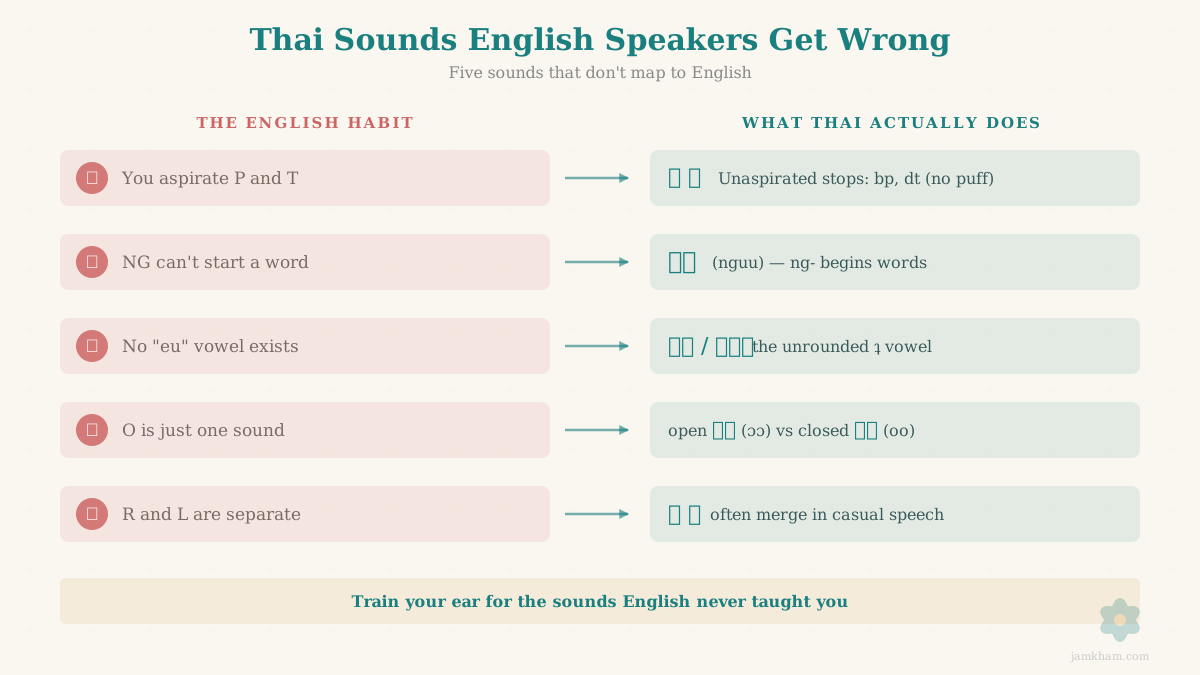
This is the single biggest consonant problem for English speakers learning Thai. Thai distinguishes between aspirated sounds (with a puff of air) and unaspirated sounds (without). English doesn’t make this distinction consistently.
Thai has three pairs:
| Unaspirated | Aspirated | English Habit |
|---|---|---|
| ป (bp) | พ (ph) | Always aspirated |
| ต (dt) | ท (th) | Always aspirated |
| ก (g) | ค (kh) | Always aspirated |
When you say “pat” in English, you aspirate the P — hold your hand in front of your mouth and feel the puff of air. Thai ป has no puff. It sits between English “b” and “p.” Similarly, Thai ต sits between “d” and “t.”
Example: ปลา(bplaa) starts with an unaspirated BP. If you aspirate the BP, Thai listeners may not recognize the word.
Drill: Hold a tissue in front of your mouth. Say “spa” — the P in “spa” is unaspirated (no tissue movement). That is your Thai ป. Now say “pa” — the tissue moves. That is Thai พ. Practice switching between them until you can control the puff consciously.
2. The BP Sound (ป)
Worth singling out because it causes the most confusion. Thai ป isn’t B and isn’t P. English has nothing exactly like it.
bpaiไปgo bpìtปิดclose/shut bpòetเปิดopenIf you say these with an English P, Thai listeners may hear the aspirated version and get confused. If you say them with an English B, the voicing is wrong. The target is between the two: lips together, release without voicing or aspiration.
3. The DT Sound (ต)
Same problem, different place in the mouth. Thai ต is between English D and T.
dtaaตาeye / grandfather dtâwngต้องmustDrill: Say “stop.” The T in “stop” is unaspirated. Isolate that T sound. That is closer to Thai ต than the T in “top” (which is aspirated).
4. NG at the Start of Words
English has the NG sound — at the end of words. “Sing,” “ring,” “long.” Thai puts it at the beginning.
nguuงูsnake ngoenเงินmoney ngâaiง่ายeasyEnglish speakers stumble here because their mouths have never started a word with this sound. Your tongue knows the position — it’s the same as the end of “sing” — but initiating a word from that position feels wrong.
Drill: Say “singing” slowly. Hold the NG between the two syllables: si-NNNG-ing. Now drop the “si” and start from the NG. That is your Thai ง.
5. Thai R vs. L
Thai ร (r) and ล (l) are distinct sounds, but in casual Bangkok speech, many Thais substitute L for R. This creates confusion for learners: should you say R or L?
ráwnร้อนhot láwnล้อน(not a word)The formal answer: use R. ร้าน(ráan) is R, not L. In careful speech, news broadcasts, and formal contexts, the R is always an R. In casual speech, many Thais say L instead, and they will understand you either way.
For learners: Aim for R. You won’t sound strange using R where Thais use L, but you may sound unclear using L where R is required.
6. Unreleased Final Consonants
In English, final consonants get a little burst of air: “cat” ends with a tiny T explosion. In Thai, final consonants are stopped — your mouth moves to the position but doesn’t release.
กบ(gòp) — your lips close on the P but don’t pop open.
มาก(mâak) — your tongue touches the K position but doesn’t release.
จบ(jòp) — same: lips close, no release.
This affects every Thai word ending in a stop consonant (ก, บ, ด, and their equivalents). If you release these finals, you add a vowel sound that changes the word.
Drill: Say “apt” and hold the final T — tongue on the roof of your mouth, no release. That held-in-place feeling is how every Thai final stop should end.
Part 2: Vowel Problems
7. Short vs. Long Vowels
English doesn’t distinguish meaning by vowel length. Thai does. These are different words:
| Short | Long | Difference |
|---|---|---|
| กัน(gan) | กาน(gaan) | Vowel length only |
| จิน(jin) | จีน(jiin) | Vowel length only |
English speakers tend to make every vowel medium-length. In Thai, short vowels are clipped and quick; long vowels are held noticeably longer.
Drill: Exaggerate the difference. Make short vowels absurdly short and long vowels absurdly long. Then dial back to natural. Most learners err toward making everything the same length, so overcorrection helps.
8. The eu Vowel (อือ)
This vowel doesn’t exist in English. It sits between “oo” (as in “food”) and “ee” (as in “feet”) — your lips are rounded like “oo” but your tongue is positioned like “ee.”
nèungหนึ่งone kheuคือis/means rûuรู้to knowWait — รู้(rûu) uses อู (uu), not อือ (eu). The difference is tongue position. For อู, your tongue is back. For อือ, your tongue is forward while your lips stay rounded.
Drill: Say “ee” as in “feet.” Hold that tongue position. Now round your lips without moving your tongue. That new sound is Thai อือ.
9. The oe Vowel (เออ)
Similar to the English “uh” in “butter” but longer and more deliberate. English speakers tend to reduce this to a quick, throwaway sound. Thai holds it as a full vowel.
joeเจอto meet bpòetเปิดto open ngoenเงินmoneyThe short version (oe) appears in unstressed syllables. The long version (oe) appears in words like เจอ(joe). Both are more central and deliberate than the English schwa.
10. The aw Vowel (ออ)
Thai aw is more open and further back than most English speakers produce. Think of the British pronunciation of “caught” or “law” — that open, rounded back vowel.
khǎwขอto request jàwtจอดto park hâwngห้องroom à-râwyอร่อยdeliciousAmerican English speakers especially struggle because American English largely merges this vowel with other sounds. If you say ขอ(khǎw) with an “oh” sound instead of an open “aw” sound, it shifts toward a different word.
Drill: Drop your jaw lower than feels natural. Round your lips. Say “aw” as in British “law.” That is Thai aw.
11. เ (ay) vs. แ (ae)
These two vowels sound identical to most English speakers but are distinct in Thai.
| Vowel | Sound | Example |
|---|---|---|
| เ- | Like “ay” in “say” | เก่ง(gèng) |
| แ- | Like “a” in “bad” | แพง(phaeng) |
เก่ง(gèng) uses a closed E sound (mouth more closed, tongue higher). แก่(gàe) uses an open AE sound (mouth more open, tongue lower).
Drill: Say “bet” and “bat.” The vowel difference between those two words is approximately the difference between Thai เ and แ. Exaggerate it.
12. Three-Part Vowel Combinations
Thai has diphthongs and triphthongs that combine vowel sounds in ways English doesn’t.
sǐaเสียbroken / to waste — the เีย combination glides from “ee” to “ah.”
dtuaตัวbody / classifier — the ัว combination glides from “oo” to “ah.”
reuaเรือboat — the เือ combination glides from “eu” to “ah.”
English speakers tend to pronounce these as a single vowel or collapse them into a familiar diphthong. The glide matters — เรือ(reua) isn’t “rua” or “roo-a.” It starts from the unfamiliar eu vowel and glides down.
Drill: Practice each combination in slow motion: hold the first vowel for two beats, then glide to the second. Speed up gradually until it sounds natural.
The Hierarchy of Pronunciation Problems
If you fix these in order of impact:
- Aspirated vs. unaspirated stops — the single biggest source of miscommunication
- Vowel length — short vs. long changes meaning
- The aw vowel — appears in some of the most common Thai words
- Unreleased finals — affects every sentence you say
- Initial NG — common in everyday vocabulary
- Everything else improves with exposure and practice
You don’t need to master all 12 before your trip. Getting the top 4 right will make a bigger difference than perfecting your tones while ignoring your consonants.
Frequently Asked Questions
What Thai sounds don’t exist in English?
The biggest gaps are the unaspirated stops (BP and DT), which sit between English voiced and voiceless pairs. English doesn’t have a sound between B and P or between D and T, but Thai does. Initial NG (as in งู, “snake”) uses a sound English only places at the end of words. The eu vowel (อือ) has no English equivalent at all — it combines the lip rounding of “oo” with the tongue position of “ee.”
What is the hardest Thai sound for English speakers?
The aspirated vs. unaspirated stop distinction (ป vs. พ, ต vs. ท, ก vs. ค) causes the most miscommunication. English speakers aspirate all their stops by default, so every P sounds like PH and every T sounds like TH to Thai ears. This changes the word you’re saying, and Thai listeners won’t “fill in” the correct meaning the way English listeners do with accent variations.
Does vowel length matter in Thai?
Yes. Short and long vowels are completely different sounds in Thai, and they change word meaning. กัน (gan, short) means “each other,” while กาน (gaan, long) is a different word entirely. English speakers tend to make every vowel medium-length, which means Thai listeners can’t tell which word you intended.
How do I practice Thai pronunciation?
Start with the aspiration drill: hold a tissue in front of your mouth and practice saying “spa” (unaspirated, no tissue movement) vs. “pa” (aspirated, tissue moves). Once you can control that puff of air consciously, apply it to Thai BP and DT sounds. For vowels, exaggerate the difference between short and long until it feels natural. Most importantly, listen to native speakers and practice minimal pairs — hearing the contrast trains your ear faster than reading descriptions.
Train Your Ear, Not Just Your Eyes
Reading about sounds teaches you what to listen for. Hearing them trains your brain to distinguish them. Producing them correctly takes practice with feedback.
Jam Kham’s tone training includes the consonant and vowel distinctions covered here. Every phrase comes with clear Thai audio, so you hear the difference between aspirated and unaspirated, short and long, open and closed — not just read about it.
Every one of these sounds maps to a specific Thai letter, so learning to read the script puts the right consonant — aspirated or not, long vowel or short — on the page before you say it. No more guessing from romanization. See if Thai script clicks — no account needed.
Start reading Thai today
Break free of romanization and read the sounds straight from the script. Every character in the order you'll meet it, with the tone rule behind it. First three modules free — no card.
Start the reading course →First 3 modules free — no card, and they don't expire.
Related reading: Thai Tones: The Complete Guide · Thai Minimal Pairs: 50+ Words Tones Tell Apart · Thai Consonant Classes Explained