
Thai Street Food: Order Like a Local
Street food in Thailand has no menus and no English. Here's how to step up, point, order, and customize — from first stall to confident regular.
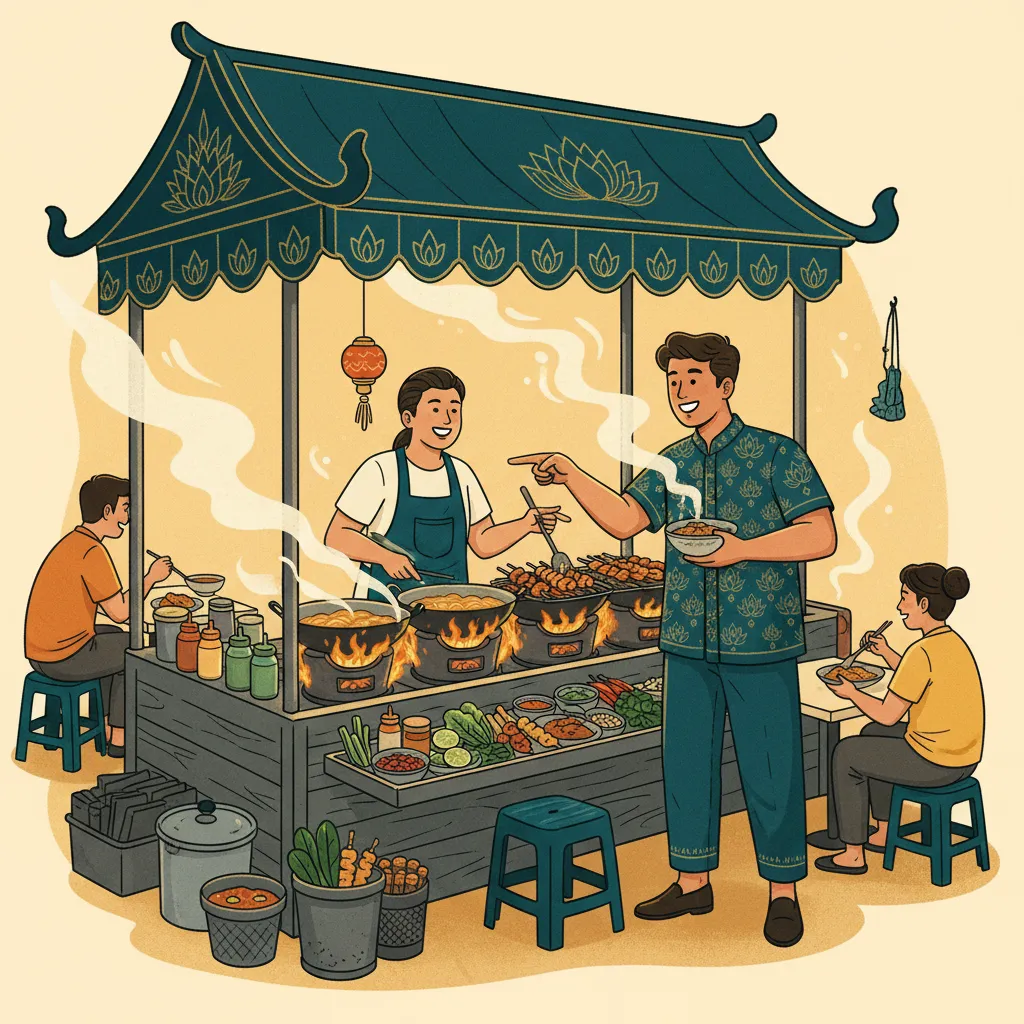
Thai street food is one of the best food experiences on the planet. It’s also one of the most intimidating if you’ve never done it — no printed menus, vendors who speak limited English, a line of locals who all seem to know exactly what they’re doing, and you standing there trying to figure out what to point at.
Here’s the thing: the system is simple once you understand it. Street food operates on patterns. Every stall follows roughly the same flow. Learn the pattern, learn a handful of phrases, and you go from “confused tourist pointing at things” to “person who orders in Thai and gets exactly what they want.”
For the complete vocabulary set, our Thai phrases for ordering food guide covers everything from street stalls to sit-down restaurants.
Street Food Operates on Its Own Rules
Forget everything you know about restaurant dining. Street food is a different system with different rules.
No menus. Most stalls serve one to five dishes. What’s available is what you see being prepared. The food on display is the menu. Sometimes there’s a handwritten sign in Thai with prices — but often not even that.
No waiters. You walk up to the stall, catch the vendor’s eye, and state your order. The vendor is cooking, serving, and taking money simultaneously. There is no one coming to your table to take your order.
Speed matters. A popular stall serves dozens of customers during a rush period. The vendor needs to process orders quickly. Having your order ready before you step up isn’t just efficient — it’s respectful of everyone else’s time.
The flow works like this:
- Scan what’s being cooked or displayed
- Decide what you want
- Get the vendor’s attention
- State your order (with any customizations)
- Pay (usually before you eat)
- Find a seat at the nearby plastic tables, or take it to go
The Anatomy of a Street Food Order
Every order follows the same structure. Learn this formula and you can order at any stall in Thailand.
The Basic Order
aoเอาI want / I'll takeThis is your core word. เอา(ao) plus the dish name is a complete order. “Ao pad thai” — done. You’ve ordered pad thai.
If you don’t know the dish name, point and say: เอาอันนี้(ao an níi)
Quantity
หนึ่ง(nʉ̀ng) (one) or สอง(sɔ̌ɔng) (two). Or just hold up fingers. Vendors are used to finger-counting from foreigners and it works fine.
For a full order: “Ao pad thai song” = I want two pad thais.
To-Go or Eat Here
sài thǔngใส่ถุงput in a bag / to-go gin thîi nîiกินที่นี่eat hereMost street food defaults to takeaway (in a plastic bag). If you want to eat at the tables next to the stall, say กินที่นี่(gin thîi nîi). If you want it bagged up, say ใส่ถุง(sài thǔng) or just point at the bags.
The Complete Formula
Want + Item + Modification + Quantity
Example: เอาข้าวผัดไม่เผ็ดสองจาน(ao khâao phàt mâi phèt sɔ̌ɔng jaan)
That’s the whole system. Everything else is customization.
(For more on why phone-based translation breaks down at street stalls, see Google Translate’s Thai problem.)
12 Dishes You’ll See Everywhere (And How to Say Them)
These twelve dishes account for the vast majority of what street food stalls serve across Thailand. Know these names and you know what’s on offer at most stalls you’ll encounter.
12 Essential Thai Street Food Dishes
| Thai Name | Romanization | What It Is |
|---|---|---|
| ผัดไทย | phàt thai | Stir-fried rice noodles with shrimp, tofu, peanuts, bean sprouts |
| ข้าวผัด | khâao phàt | Fried rice — usually with egg, vegetables, and your choice of protein |
| ส้มตำ | sôm tam | Green papaya salad — pounded in a mortar, ranges from mild to volcanic |
| ผัดกระเพรา | phàt grà-phrao | Stir-fried meat with holy basil and chili, served over rice with a fried egg |
| ต้มยำ | dtôm yam | Hot and sour soup, usually with shrimp (กุ้ง, gûng) or pork (หมู, mǔu) |
| ข้าวมันไก่ | khâao man gài | Hainanese chicken rice — poached chicken on fragrant oiled rice |
| หมูปิ้ง | mǔu bpîng | Grilled pork skewers, marinated and served with sticky rice |
| โรตี | roo-dtii | Thai-style flatbread, often with banana and condensed milk (dessert version) |
| ข้าวเหนียวมะม่วง | khâao nǐao má-mûang | Mango sticky rice — seasonal but ubiquitous when mangoes are ripe |
| ก๋วยเตี๋ยวเรือ | gǔai dtǐao rʉa | Boat noodles — rich, dark broth with pork or beef, served in small bowls |
| สะเต๊ะ | sà-dtéh | Grilled meat skewers with peanut sauce and cucumber relish |
| ขนมเบื้อง | khà-nǒm bʉ̂ang | Thai crispy crepes — sweet or savory, often found at temple fairs |
A few pronunciation notes that matter:
Pad thai — most foreigners already know this one, but the Thai pronunciation emphasizes the falling tone on ผัด(phàt). Listen for the difference between how Thais say it and how tourists say it.
Pad kra pao (ผัดกระเพรา(phàt grà-phrao)) — the most ordered dish in Thailand, more popular even than pad thai among locals. If you learn one dish name with correct pronunciation, make it this one. Most stalls serve it over rice with a fried egg on top (ไข่ดาว(khài daao)).
Som tam (ส้มตำ(sôm tam)) — be warned about spice levels. When the vendor asks how many chilies, one or two is plenty for most foreigners. The som tam vendor at a local market may default to four or five, which will be painfully hot by Western standards. Say ไม่เผ็ด(mâi phèt) or เผ็ดนิดเดียว(phèt nít diao).
Hearing “khao man gai” pronounced correctly once is worth more than reading about it ten times. Jam Kham’s food pack includes audio for every dish name at natural and slow speeds — try the free essentials.
The Customization Phrases That Separate Tourists from Regulars
Ordering a dish by name gets you food. Customizing it in Thai gets you exactly what you want — and a look of mild surprise from the vendor.
Spice Level
mâi phètไม่เผ็ดnot spicy phèt nít diaoเผ็ดนิดเดียวjust a little spicy phèt mâakเผ็ดมากvery spicyThai “not spicy” is often still mildly spicy by Western standards. If you truly cannot handle any heat, say ไม่เผ็ดเลย(mâi phèt ləəi). The เลย(ləəi) emphasizes that you mean zero chili.
Add or Remove Ingredients
mâi sài phàk chiiไม่ใส่ผักชีno cilantroThis one saves the cilantro-averse among us. The formula: ไม่ใส่(mâi sài) + ingredient.
sài khàiใส่ไข่add eggThe formula: ใส่(sài) + ingredient. Works for anything: ใส่ผัก(sài phàk), ใส่หมู(sài mǔu).
Protein Swaps
Most stir-fry and fried rice stalls let you choose your protein:
- ไก่(gài)
- หมู(mǔu)
- กุ้ง(gûng)
- เต้าหู้(dtâo hûu)
- ทะเล(thá-lee)
“Ao pad kra pao gai” = I want holy basil stir-fry with chicken. “Ao pad kra pao muu” = same dish, pork instead. Simple swap.
Other Useful Modifiers
mâi sài nám dtaanไม่ใส่น้ำตาลno sugarRelevant for som tam (some recipes add sugar), Thai iced tea, and sweet desserts. Thai food often uses more sugar than foreigners expect.
phí-sèetพิเศษspecial / extra portionAsking for พิเศษ(phí-sèet) gets you a larger portion or extra toppings, usually for 10-20 baht more. At a boat noodle stall, “phiset” means extra meat. At a pad thai stall, it might mean extra shrimp.
Reading the Stall (When You Can’t Read the Signs)
Most stall signs are in Thai only. But you don’t need to read Thai to figure out what’s on offer.
Visual Cues Are Your Menu
What’s being cooked tells you what’s available. A wok with noodles means pad thai or pad see ew. A mortar and pestle means som tam. Skewers on a grill mean moo ping or satay. A pot of simmering broth means soup — tom yum, tom kha, or boat noodles. A glass case of pre-made curries over rice means ข้าวราดแกง(khâao râat gaaeng) — point at which curries you want.
Pre-Made vs Made-to-Order
Pre-made stalls display finished dishes in trays or warming containers. You point at what you want. Customization is limited — what you see is what you get. These are faster and easier to order from. Curry-over-rice stalls are the classic example.
Made-to-order stalls cook your dish fresh when you order. This is where customization matters. Pad thai, fried rice, stir-fries, som tam — all made to order. You have time to specify preferences while the vendor preps.
Knowing which type you’re at prevents confusion. Don’t try to customize at a pre-made stall. Don’t expect instant food at a made-to-order stall during rush hour.
The Point-and-Nod Strategy
Let’s be clear: pointing at food and nodding is a completely valid ordering strategy. Vendors are used to it. It works. Nobody judges you for it.
But adding two Thai words to the pointing changes the interaction. “Ao an nii” (I want this one) while pointing gets a smile. “Ao an nii, sai thung” (I want this one, bag it) gets a bigger smile and a more responsive vendor. You’ve gone from mute tourist to person attempting communication, and Thai vendors reward the attempt.
Paying and Tipping at Street Food Stalls
Cash Is King
Most street food stalls are cash only. Some in touristy areas accept mobile payments (PromptPay QR codes), but don’t count on it. Carry small bills: 20s, 50s, and 100s. Handing a 1,000-baht note for a 40-baht pad thai will earn you a weary look (and possibly a refusal if the vendor doesn’t have change).
To confirm the price: เท่าไหร่(thâo rài). Most street food in Bangkok ranges from 40-80 baht per dish. Provincial prices are lower — sometimes 30-50 baht. If a stall quotes you significantly more than what locals appear to be paying, check you’re at the right type of stall (tourist-area stalls do charge premiums, and it’s usually not worth arguing about).
Tipping
Tipping at street food stalls is not expected and not customary. This is not a social error on your part — street food vendors price their food to include their margin. Rounding up on small amounts is fine (paying 50 for a 45-baht dish), but leaving a 20% tip at a sidewalk noodle stall would be unusual.
The Best Tip You Can Give
Say อร่อยมาก(à-rɔ̂i mâak) as you hand back the plate or leave the stall. This is not a tip in the monetary sense — it’s better. Food vendors who spend 12 hours a day over a hot wok light up when someone acknowledges their food is good. It costs you nothing and means more than money.
If the food was genuinely outstanding: อร่อยมากมาก(à-rɔ̂i mâak mâak) with a smile. You’ll be remembered if you come back.
For returning to the same stall, a simple มาอีกแล้ว(maa ìik láaeo) with a smile turns you from anonymous tourist into a regular. Regulars get better food — more care, bigger portions, sometimes an off-menu dish the vendor is experimenting with.
Build Your Food Vocabulary Before You Go
The difference between reading dish names on a screen and recognizing them when a vendor says them at full speed is practice. Specifically, listening practice — training your ear to catch “khao pad” and “pad kra pao” and “sai thung” in the rapid-fire rhythm of a real Thai food stall.
Build these food phrases into your muscle memory before your trip. Try the free essentials pack to start with the core ordering phrases, then explore the full food and ordering vocabulary in our Thai phrases for ordering food collection.
The food is the reason many people go to Thailand. The language is what turns eating from an activity into an experience.
Related reading: How to Order Food in Thai | Thai Phrases Every Tourist Needs | Complete Food Guide