
Thai Tones: 5 Pitches English Can't Teach You
In Thai, saying 'beautiful' with the wrong pitch means 'unlucky.' Learn to hear and produce all 5 tones with the famous 'mai' test -- 5 meanings, 1 syllable.
At a Bangkok street stall, a friend ordered what she thought was white rice. The vendor brought it without hesitation—context made the meaning clear—but she’d actually said something closer to “beautiful rice.” The confusion: ขาว(khǎao) (rising tone) versus ข้าว(khâao) (falling tone).
Same consonants, same vowels, different pitch contour, different word.
If you’re just getting started, check out our tone training feature that uses visual pitch contours to build tone recognition.
Pitch as Meaning
English uses pitch for emotion. “Really?” rises because it’s a question, but “really” means the same thing at any pitch.
Thai encodes meaning in pitch. Linguist Arthur S. Abramson’s 1962 research—still the standard reference—established that Standard Thai has five distinct lexical tones. Change the tone, get a different word.
This isn’t a quirk. The Kra-Dai language family (Thai, Lao, Shan, and relatives) developed tonal systems over millennia. Tonality is built into how these languages work.
The Five Tones
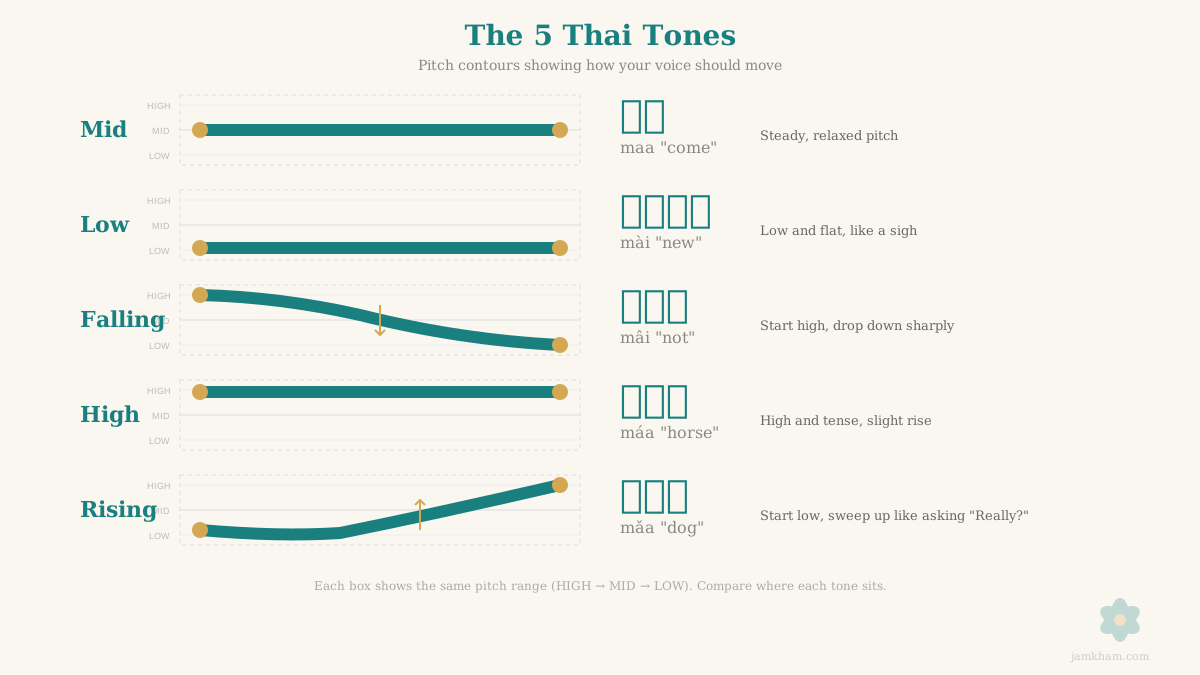
Three stay relatively flat (mid, low, high). Two move (falling, rising).
Relaxed, neutral pitch. Not high, not low.
Bottom of your comfortable range, held flat. A disappointed 'oh...'
Starts high, drops sharply. Emphatic 'No!' in English.
Starts low, curves up. Questioning 'huh?'
High pitch with slight tension. Surprised 'really?!'
The “Mai” Set
The classic “mai” example shows how tones change meaning:
| Tone | Thai | Romanization | Meaning |
|---|---|---|---|
| Mid | ไม | mai | mile (rare) |
| Low | ใหม่ | mài | new |
| Falling | ไม่ | mâi | not |
| High | ไม้ | mái | wood, stick |
| Rising | ไหม | mǎi | silk / question particle |
Note: The “mai” set is one of the most famous tone demonstrations in Thai—five tones, five meanings, one syllable. Pay close attention to ไม่ (mâi, “not,” falling) versus ไม้ (mái, “wood,” high)—these are the pair learners confuse most often.
See our minimal pairs practice guide for more examples of how a single tone change completely changes meaning.
Context Fills Gaps
Thai speakers parse imperfect tones from context constantly. Order “khâao” with a wobbly tone at a restaurant—they’ll bring rice, not legs.
Research on tone perception shows native speakers draw on vowel length, consonant information, surrounding words, and situation, not just pitch alone.
You can communicate while learning. Perfect tones aren’t required for basic interactions. But native speakers do notice, and some word pairs genuinely confuse without correct tones. (In formal contexts, register choices matter more than minor tone variations.)
The Underlying System
Tones follow rules. Three factors determine a syllable’s tone:
- Consonant class — every Thai consonant is high, mid, or low class
- Syllable type — “live” (long vowel or sonorant ending) vs. “dead” (short vowel or stop ending)
- Tone marks — four diacritics that modify the default
The Thai Script guide covers this in detail. The practical point: once you know consonant classes, you can predict tones from spelling. Romanization hides this logic; Thai script exposes it.
Quick Reference
| Tone | Thai Name | Mark | Shape |
|---|---|---|---|
| Mid | สามัญ (sǎa-man) | (none) | → flat |
| Low | เอก (èek) | ่ | ↓ flat |
| Falling | โท (thoo) | ้ | ↘ down |
| High | ตรี (dtrii) | ๊ | ↗ up |
| Rising | จัตวา (jàt-dtà-waa) | ๋ | ⤴ curve |
Tone marks modify the default tone based on consonant class—they don’t indicate tones directly.
Training
Charts help; repeated listening builds the actual skill. For structured practice, try our Master the 5 Tones guide which includes the tone rules based on consonant classes.
Effective approaches:
- Minimal pairs (words differing only by tone, played back-to-back)
- Shadowing native speakers
- Noticing tone patterns in Thai media, even without understanding words
- Spaced repetition—short daily sessions beat weekly cramming
This is where Jam Kham’s approach matters: every vocabulary card includes audio with correct tones, and the spaced repetition system ensures you encounter each word at optimal intervals for retention.
What to Expect
Tones feel impossible initially. Around month 2-3 of consistent practice, the contours start sounding distinct without conscious effort.
Studies confirm that tone awareness develops alongside vocabulary—learning words with their tones from the start produces better results than adding tones later.
Thai speakers appreciate the effort. A slightly off tone earns a smile and gentle correction, not confusion.
Ready to practice? Start tone training now with our research-backed spaced repetition system—each card includes native speaker recordings.
Next: Thai Script—how consonant classes determine tones.