
Spaced Repetition: Why It Boosts Recall 200%
Spaced repetition improves vocabulary retention by 200-300%. The science behind lasting memory—and how to use it for Thai.
Most people study the same way they always have: cram before a test, forget afterward, repeat when needed. It feels productive in the moment. The information is right there, accessible, familiar.
Then a week passes. Maybe two. And it’s gone.
There’s a better approach—one backed by over a century of research. Spaced repetition works by matching your study schedule to how memory actually functions. See how we implement this in our 3-layer spaced repetition system.
The Forgetting Curve
In 1885, German psychologist Hermann Ebbinghaus conducted a grueling experiment on himself. He memorized thousands of nonsense syllables—meaningless combinations like “DAX” and “BUP”—then tested how quickly he forgot them.
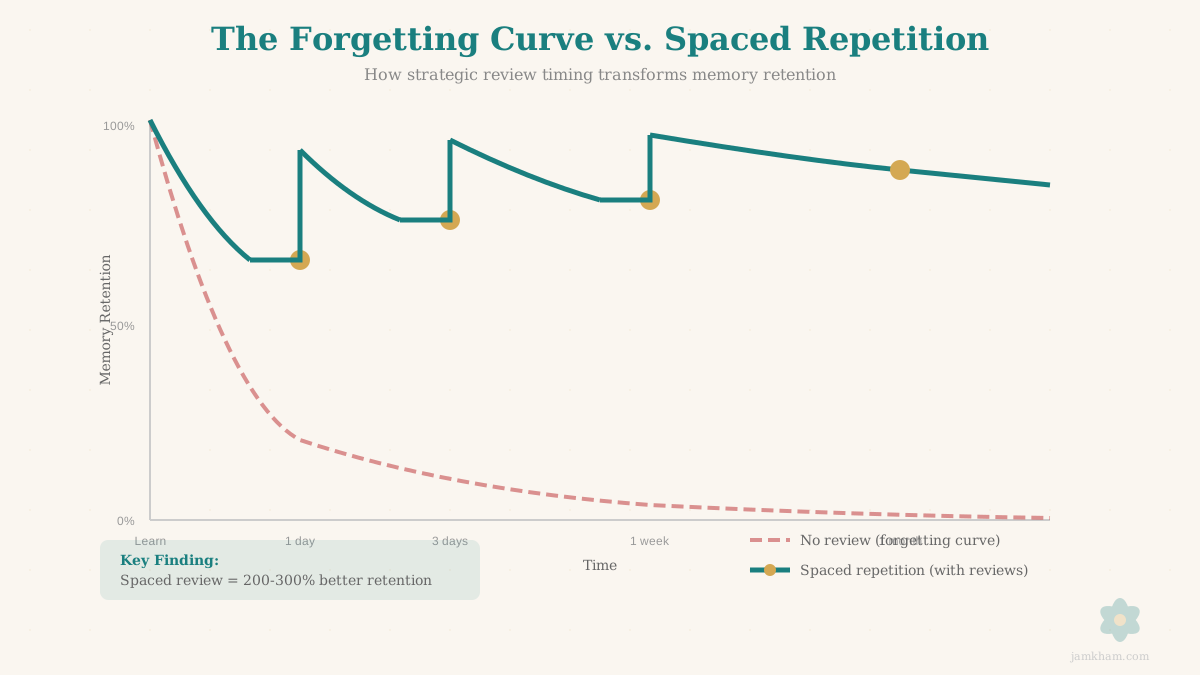
His findings, published in Memory: A Contribution to Experimental Psychology, revealed something uncomfortable: without review, we forget roughly 70% of new information within 24 hours. After a week, retention drops to about 20%.
Ebbinghaus called this pattern the “forgetting curve.” It’s exponential—steep at first, then gradually leveling off. The initial hours after learning are when memories are most vulnerable.
Our brains constantly filter information, discarding what seems unimportant to make room for what matters. The problem is that your brain can’t distinguish between vocabulary you’re trying to learn and random noise—unless you signal that the information is worth keeping.
The Spacing Effect
Ebbinghaus discovered something else: when you review matters as much as whether you review.
Distributed practice—spreading study sessions over time—produces dramatically better retention than massed practice (cramming), even when total study time is identical. Researchers call this the spacing effect—one of the most replicated findings in memory science.
A 2006 meta-analysis by Cepeda and colleagues examined 317 experiments spanning a century of research. Their conclusion: distributed practice improves long-term retention by 200-300% compared to massed practice. Not a modest improvement—a fundamental difference.
Why does spacing work so well? The leading theory involves something called “desirable difficulty.” When you review material that’s still fresh, retrieval is easy—but easy retrieval doesn’t strengthen memory much. When you wait until the material has started to fade, retrieval requires effort. That effort signals to your brain: this information matters, keep it accessible.
This connects to our research on the testing effect and active recall.
How It Works in Practice
Knowing that spacing helps is one thing. Implementing it is another. How do you know when to review?
This is the problem that spaced repetition systems (SRS) solve. The most influential algorithm, SM-2, was developed by Piotr Wozniak in the late 1980s. It works like this:
- Initial learning: You see a new item and try to recall it
- Performance rating: You rate how well you remembered (easy, hard, forgot)
- Interval calculation: Based on your rating, the algorithm schedules your next review
- Adaptive scheduling: If you remember well, the interval grows. If you struggle, it shrinks.
The goal is to show you each item just before you would have forgotten it. This maximizes the strengthening effect of each review while minimizing wasted time on material you already know well. Our learning tracks are designed around optimal spacing intervals.
A 2019 study by Nakata and Suzuki specifically examined spaced repetition for second language vocabulary. They found that spacing tripled retention compared to massed practice—and the benefits persisted even after delays of several weeks.
What This Means for Learning Thai
Thai vocabulary presents a particular challenge. The words don’t look or sound like anything in English. There are no cognates to lean on, no familiar roots. Each word is genuinely new.
This makes spaced repetition especially valuable. When learning Thai vocabulary:
- Tonal words need repeated exposure: Distinguishing ข้าว (khâao, rice) from ขาว (khǎao, white) requires hearing and producing these words multiple times across different sessions
- Script recognition builds slowly: Thai characters need repeated, spaced encounters to become automatic
- Context matters: Seeing words in different example sentences across sessions builds flexible, usable knowledge
Jam Kham implements a three-layer spacing system: micro-spacing within each session (new words appear 3 times with intervening cards), SM-2 scheduling across days and weeks, and curriculum sequencing that balances review with new material. The algorithm handles the scheduling so you can focus on what matters—actually learning Thai.
The Takeaway
Spaced repetition isn’t a hack. It’s how memory works—we just finally have the tools to use it properly.
The forgetting curve is real, but it’s not destiny. Strategic review at the right intervals flattens that curve. You don’t need to calculate the intervals yourself; modern spaced repetition systems handle the scheduling. What matters is showing up: short daily sessions, letting the algorithm surface what needs review, and accepting that some forgetting between sessions is part of the process.
The slight struggle to recall something you almost forgot? That’s not a problem. That’s the point.
Experience spaced repetition designed specifically for Thai: try Jam Kham free—the algorithm handles the scheduling while you focus on learning Thai.
Related reading:
- The Testing Effect—why quizzing yourself works better than re-reading
- Why Mixing Things Up Helps You Learn—the counterintuitive power of interleaved practice