
The Thai Alphabet: 44 Consonants, Not A to Z
There's no Thai ABC. The Thai alphabet is 44 consonants in 3 classes, with vowels that attach as marks and tones built into the script — here's how it works.
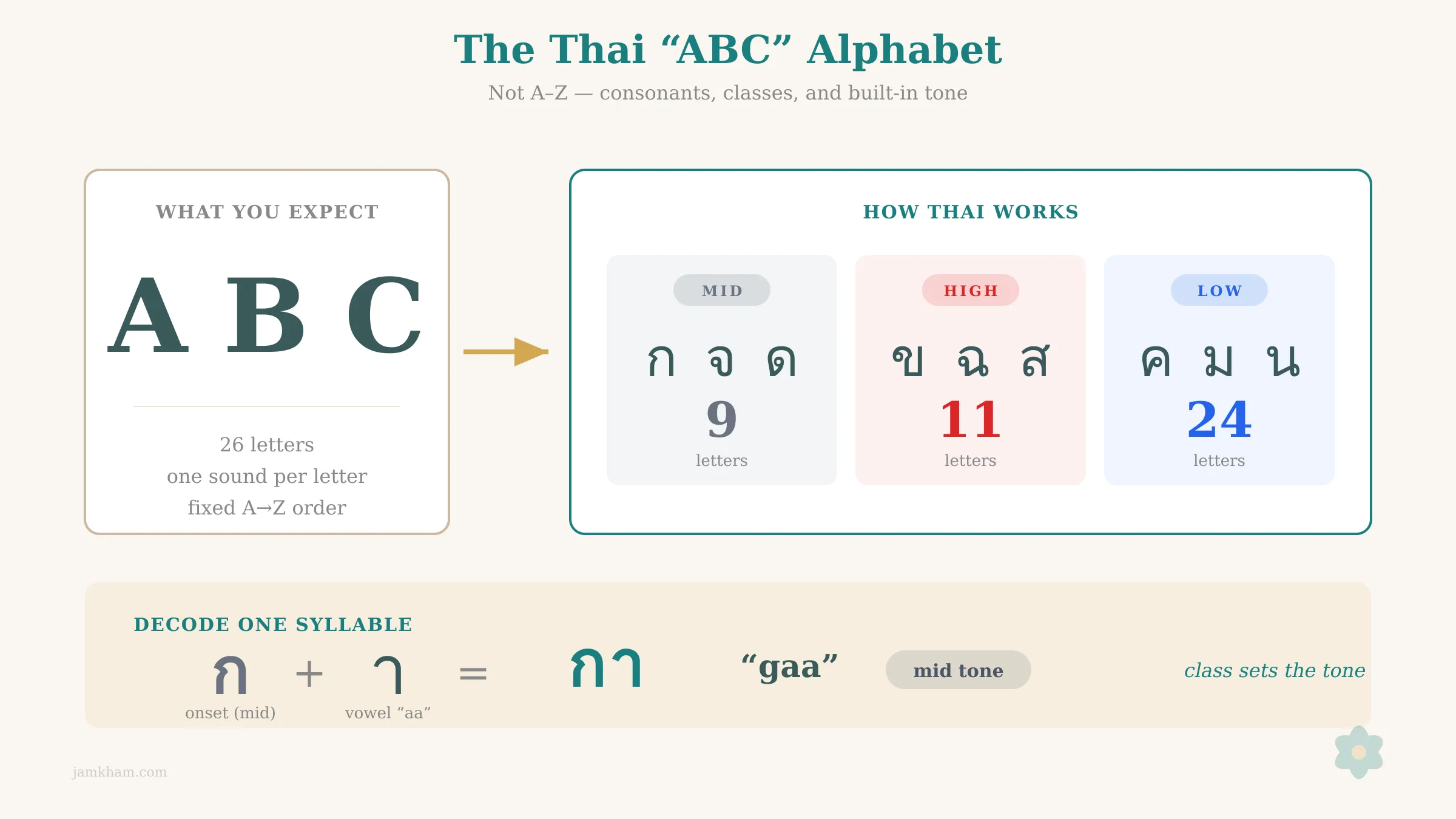
If you searched for ABC in Thai or the Thai ABC alphabet, you’re starting where almost everyone does. Most people approach Thai with the mental model they use for any other writing system: a fixed set of letters, in a set order, one sound per symbol. That’s how English works, and how Spanish, French, and German work. It’s a reasonable place to start.
But Thai runs on different logic, and once someone walks you through that logic, the whole thing clicks. Thai isn’t a bigger, stranger English alphabet. It’s a different type of writing system, with its own rules for consonants, vowels, and tones — and those rules are consistent. Thai spelling is far more predictable than English spelling once you can see the system underneath it. That’s the whole premise of the Read Thai course: the script isn’t an impossible task, it’s a structured one.
This article covers the four things you need in order to start reading Thai: how the 44 consonants are organized, how vowels attach to them, how tone gets decided, and how to sound out your first real syllable. By the end you’ll have a working mental model of the script — not just a list of facts to memorize.

See the full Thai alphabet chart with tone rules for a printable reference to keep beside this guide.
Why the Thai “ABC” Alphabet Isn’t an A-to-Z System
Searching for the “Thai ABC alphabet” is a natural starting point. English speakers default to the A-to-Z framework because every script they’ve met maps onto it. The framing is a useful scaffold — it just needs one adjustment before you start.
Thai is technically an abugida: a consonant-based script where vowels attach to consonants as marks rather than standing as independent letters. You don’t need the term to learn the script, but you do need to know what’s structurally different. Three things will surprise you right away:
- Thai has 44 consonant symbols, not 26.
- There’s no uppercase or lowercase — one form per letter, always.
- The consonants aren’t in a phonetic A-B-C order. They’re grouped by consonant class, and that class is the engine behind the entire tone system. (We unpack the three classes in Thai consonant classes explained.)
The A-B-C analogy does hold in one useful way. Every Thai consonant has a two-part name that learners recite in order, exactly the way Thai children do. ก(gaw gài) means “g, like chicken.” ข(khaw khài) means “kh, like egg.” Learning the names in sequence ties each abstract shape to a sound and a reference word at the same time. Let go of the expectation that Thai will behave like English, and you’ll find it’s more internally consistent than English spelling ever was. If you want the writing system end to end first, start with the Thai script guide.

Where the Thai Alphabet Comes From: The Khmer Script Connection
The Thai alphabet is younger than the language it writes. It was adapted in the Sukhothai kingdom in the late 13th century — traditionally credited to King Ramkhamhaeng around 1283 — from the Khmer script already in use across mainland Southeast Asia. Set Thai and Khmer side by side today and the family resemblance is still obvious: one grew directly out of the other.
The line runs back further than Sukhothai. The Khmer script itself descends from the Pallava script, a southern branch of India’s Brahmi family that traders and Hindu-Buddhist missionaries carried into Southeast Asia to write Sanskrit — the same Pallava-Grantha tradition that shaped writing systems across the region. That inheritance is why Thai behaves the way it does. Every script in this family — Thai, Khmer, Lao, Burmese — is an abugida, where each consonant carries a built-in vowel and the other vowels hang off it as marks. Thai didn’t invent that structure. It inherited it.
Knowing the lineage takes the mystery out of two things beginners find strange. The abugida logic — vowels as attachments rather than standalone letters — isn’t an arbitrary choice; it’s the standard Indic design, shared across every script in the region. And the alphabet’s most striking feature, the sheer number of consonants, traces back to this same origin: Thai kept extra letters to spell the Sanskrit and Pali words it borrowed through the Indic channel. More on that below.
Thai Consonants and Vowels: The Building Blocks of the Script
The 44 Consonants: Three Classes That Set Every Tone
Thai has 44 consonant symbols, but 2 of them (ฃ(kho khuat) and ฅ(kho khon)) are obsolete and never appear in modern writing, so in practice you work with 42. And despite all those symbols, there are only 21 distinct initial consonant sounds — many letters that look different make the same sound at the start of a syllable.
Instead of a linear A-to-Z list, the consonants divide into three classes: mid class (9 letters), high class (11 letters), and low class (24 letters). This isn’t an organizational quirk. The class of the first consonant in a syllable directly determines what tone the syllable carries. Think of the classes less as categories and more as a dial that shifts the pitch of every syllable they anchor.
- Mid class includes the most common letters: ก(g), จ(j), ด(d), ต(dt), บ(b), ป(bp), and อ(aw) (the silent carrier). These give the most predictable, neutral tone behavior, which is exactly why they’re the right place to start.
- High class letters like ข(kh), ฉ(ch), and ส(s) default to a rising tone when unmarked.
- Low class, the biggest group at 24 letters, holds many of the most frequent sounds in everyday Thai: น(n), ม(m), ค(kh), and ง(ng).
One upside most beginners overlook: there’s no uppercase or lowercase at all. There’s one form of ก(g), always. That removes an entire layer of memorization English carries by default. The trade-off is that some consonants behave differently at the end of a syllable than at the start — but that’s a functional rule, not a second visual form. For the complete class-by-class chart, see Thai consonant classes explained.
Vowels That Move: Above, Below, Before, and After
Thai has 32 vowel symbols, and the system is tidier than that number suggests. Most vowels come in pairs — a short version and a long version of the same sound. The duration changes the meaning, but the base sound stays recognizable. There are 9 core vowel sounds, each with a short and long form, plus diphthongs that glide between two sounds. Focus on the 9 basics before the compound forms.
The biggest structural break from English is that Thai vowels don’t stand as independent letters. They’re marks that attach to a consonant, and they appear in four positions:
- above it — ดิน(din)
- below it — ดุ(du)
- in front of it — เก(ge)
- after it — กา(gaa)
Some compound vowels wrap around a consonant from more than one position at once. That looks complicated until you train your eye to find the consonant first and read the vowel out from there. For the full set of forms and positions, see the Thai vowels reference.
Why the Thai Alphabet Has So Many Letters
Forty-four consonants is a large number for a language that has only 21 distinct initial consonant sounds. English manages with 26 letters; Thai uses nearly double that for a sound inventory that isn’t much bigger. The overlap isn’t waste — those repeated letters are doing two jobs at once.
The first job is etymology. Thai borrowed heavily from Sanskrit and Pali — the languages of Buddhism, law, and the royal court — and it kept separate letters to preserve those words in something close to their original spelling. That’s why there are five letters for a “kh” sound and six for a “th” sound: most of them exist to write loanwords the way their source language did, even where Thai now pronounces them identically. It’s the same instinct that keeps the silent “k” in the English word knight.
The second job is tone, and for a reader it’s the one that matters most. Many of those same-sounding letters sit in different consonant classes, and the class you see is a clue to the tone. ข(kh) and ค(kh) both sound like “kh,” but one is high class and the other is low class — so the letter itself narrows down the syllable’s default tone before you’ve read anything else. A tidy 26-letter alphabet with one symbol per sound couldn’t carry that. Thai’s larger set earns its size: each “extra” consonant fixes both where a word came from and how its syllable is pitched. The full class-by-class breakdown is in Thai consonant classes explained.
How Tone Gets Decided — and It’s Not a Guess
Thai has five tones: mid, low, falling, high, and rising. Every syllable carries exactly one, and it’s decided by four inputs working together: the consonant class of the initial consonant, whether a tone mark is present, the vowel length, and whether the syllable is “live” or “dead.”
A live syllable ends in a long vowel or a sonorant sound (m, n, ng, y, w). A dead syllable ends in a short vowel or a stop sound (p, t, k). This live/dead split shifts the default tone for low- and mid-class consonants, which is why you can’t read tone off the consonant class alone. There’s a focused breakdown in the tone rules guide.
Thai has four tone marks: ก่(mai ek), ก้(mai tho), ก๊(mai tri), and ก๋(mai chattawa). Here’s the part that surprises most learners: the same tone mark produces different tones depending on which class it sits on.
- Mai ek gives a low tone on mid- and high-class consonants, but a falling tone on a low-class one.
- Mai tho gives a falling tone on mid and high class, but a high tone on low class.
- Mai tri and mai chattawa only work on mid-class consonants.
This is why memorizing tone marks in isolation doesn’t work — class and mark have to be read together. The formal mappings (and the handful of exceptions) live in the Thai tone rules, and the 5 Thai tones guide covers the sounds themselves. The takeaway: this is a system, not chaos. Once you know a consonant’s class and whether the syllable is live or dead, the tone follows consistent rules, with very few exceptions in everyday written Thai.
Decoding Your First Thai Syllable
Every Thai syllable has the same four-part shape: an onset consonant, a vowel, an optional final consonant (the coda), and a tone set by the class of the onset. Learning to see those four pieces as separate and identifiable is the skill that turns shapes into reading.
Take กา(gaa) as a worked example. The onset is ก(g), a mid-class consonant. The vowel is า(aa), the long “aa” sound, sitting after the consonant. There’s no final consonant. Mid class + long vowel + no tone mark = a live syllable on a mid-class onset, which produces a mid tone. So กา(gaa) reads as “gaa” at a level, neutral pitch.
The 4-step syllable check
Run any new syllable through these in order:
- Onset — which consonant starts it, and what class is it (mid, high, low)?
- Vowel — find the vowel mark (it may sit above, below, before, after, or wrap around the onset). Short or long?
- Final — is there a coda consonant? Does it make the syllable live (long vowel / sonorant ending) or dead (short vowel / stop ending)?
- Tone — combine class + live/dead + any tone mark to land the tone.
Once you can run that loop on a simple syllable, you have the framework for any syllable you’ve never seen. Most Thai materials present letters as things to memorize by rote, which builds recognition without understanding. Decoding is the opposite: meet a new word, work through the four steps, and arrive at a reasonable pronunciation. That’s the real goal of script literacy — not memorizing a fixed list, but having the tools to read what you haven’t seen yet.
The Structured Path to Reading Thai Script
The most common way beginners stall is trying to learn all 44 consonants at once as pure memorization — no connection to their classes, their sounds inside real syllables, or their role in tone. That builds a fragile, disconnected pile of facts. Recognition without understanding doesn’t transfer to reading, and it fades fast. (We laid out exactly where the free-resource route leaves gaps in free Thai alphabet resources vs a structured course.)
A sequenced course works differently. It introduces consonants in class groups, pairs them with the vowels they actually appear with, and teaches tone rules in context, so each new letter builds on a working model instead of lengthening a list. Romanization systems like RTGS (the Royal Thai General System of Transcription) can help you recognize a street sign, but they drop tones, ignore vowel length, and spell several distinct Thai sounds with the same Latin letters — so leaning on RTGS to learn pronunciation leaves real gaps. The most direct path is learning the script itself; for a short beginner walkthrough, see how to read Thai.
The Read Thai course was built for exactly this. It covers all 44 consonants with their class groupings, the full vowel system with positioning rules, the complete live/dead tone framework, and enough syllable-level practice to move from recognition to actual decoding — in a sequence designed for adult learners starting from zero. The first modules are free, so you can test the sequence on your own eyes before paying.
See how Thai reading actually works
See the system in action — try the alphabet demo and read your first real Thai syllable. No signup needed.
Sound out your first Thai word →No account, no card — just the alphabet.
The Thai Script Is Learnable Once You Know Where to Start
Thai script isn’t a bloated English alphabet — it’s a different system with its own internal logic: 44 consonants in three classes, 32 vowels that attach from four positions, and tones set by class plus tone marks plus vowel length plus syllable type. Every one of those pieces follows consistent rules.
It looks overwhelming only because most people try to swallow it whole. Learners who take it in a structured order — consonant classes before tone marks, live and dead syllables before complex vowel combinations — are reading basic Thai syllables within the first few weeks. The script stops being a visual blur and starts being text you can read.
If you’re ready to move from theory to practice, the Read Thai course is built around exactly the framework in this article, in a sequence made for adults starting from zero.
Related: Thai Consonant Classes Explained | Thai Script Guide | The Romanization Trap