
Thai Food Vocabulary: 3 Words for 'Delicious'
Three words for 'delicious,' a rice vocabulary system, and the cooking-method prefixes that decode any Thai menu -- organized by region.
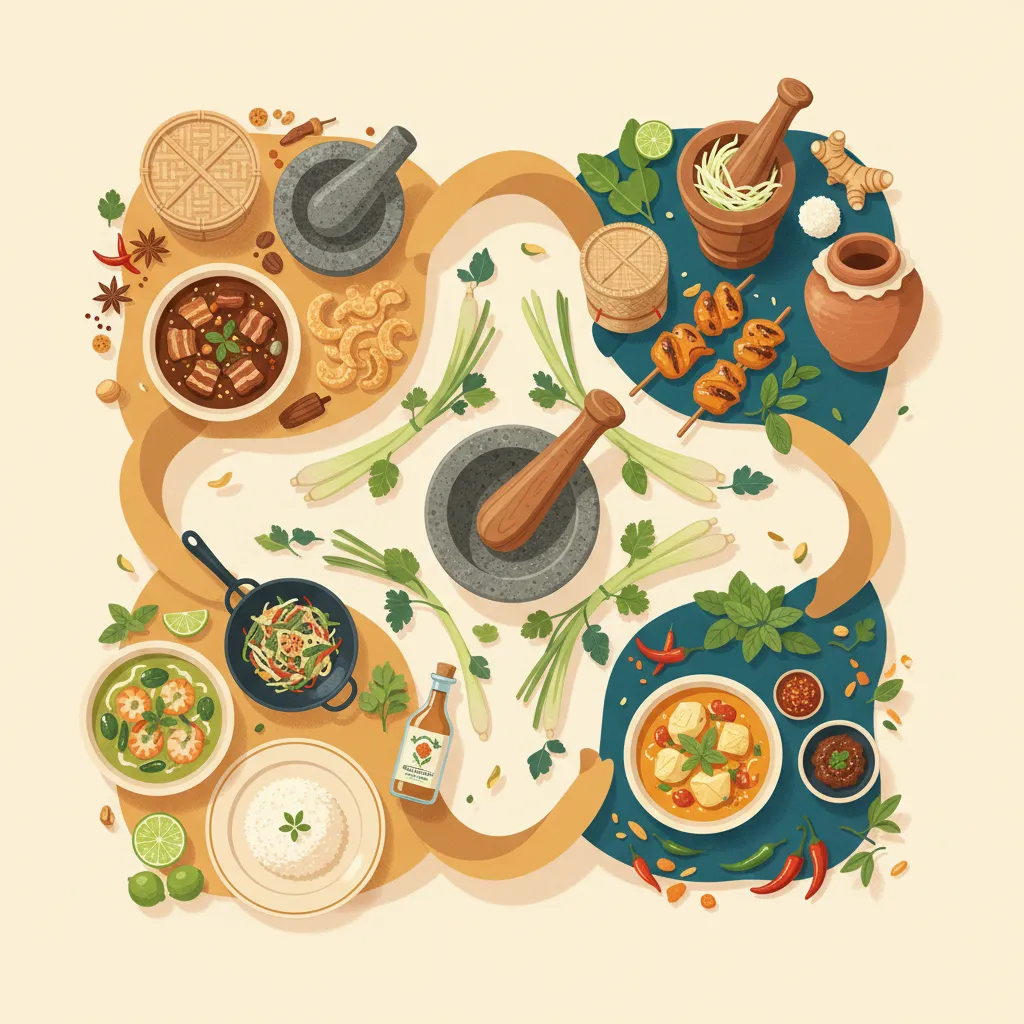
Every Thai region has its own word for “delicious.” That single fact tells you more about Thai food culture than any restaurant guide. The vocabulary isn’t just different words for the same thing --- it reflects different ingredients, different techniques, different ideas about what food should taste like.
If you’ve spent time in Bangkok, you know อร่อย(à-rɔ̂i). It’s the word textbooks teach. But cross the Khorat Plateau into Isan or head south past Chumphon, and that word marks you as an outsider faster than your accent does.
Three Words for Delicious
อร่อย (à-rɔ̂i) --- Central Thai Standard
à-rɔ̂iอร่อยdeliciousThis is the word you already know. Standard Central Thai, understood everywhere, used in Bangkok, on cooking shows, and in formal contexts nationwide. When a restaurant reviewer writes about food, they use อร่อย. When your phrasebook tells you to compliment the chef, it gives you อร่อย.
It works. It’s correct. But it’s also generic --- like complimenting a Neapolitan pizza by saying “yummy.”
แซบ (sɛ̂ɛp) --- Isan
sɛ̂ɛpแซบdelicious, flavorful (Isan)In Isan, แซบ(sɛ̂ɛp) is the word. It carries a specific connotation that อร่อย doesn’t --- boldness. When something is แซบ, it hits hard. Sour, salty, fermented, spicy, pungent. The word itself sounds punchy, and it describes food that is punchy.
You’ll hear แซบหลาย(sɛ̂ɛp lǎai) --- “very delicious” in Isan dialect --- at som tam carts and laab stalls across the northeast. The word แซบ shares roots across Tai-Kadai languages; you’ll find cognates in Lao, Shan, and other related languages, a reminder that Isan food culture has as much in common with Laos as with Bangkok.
Using แซบ at an Isan food stall instead of อร่อย earns you a grin. You’re speaking the food’s own language.
หรอย (rɔɔi) --- Southern Thai
rɔɔiหรอยdelicious (Southern Thai)Down south --- Nakhon Si Thammarat, Songkhla, Trang, Phuket --- the word is หรอย(rɔɔi). Less widely known among learners, partly because Southern Thai dialect gets less attention in language courses, and partly because fewer tourists spend time in the deep south where the word is common.
Southern food is the spiciest in Thailand. When something is หรอย, it’s delicious in the Southern way --- hot, intense, built on shrimp paste and fresh turmeric rather than the sour-salty balance of Isan or the sweet-savory blend of Central cooking.
The Rice Vocabulary System
In English, “rice” is one word. You might specify “brown rice” or “fried rice,” but the base word stays the same. Thai has a different approach: the word for rice changes depending on whether it’s growing in a field, sitting in a bag, steamed on your plate, or fried in a wok.
This isn’t pedantic vocabulary --- it’s functional. When you order food, the rice word tells the vendor exactly what form of rice you want, and in some cases, where you’re from.
Thai Rice Vocabulary
| Thai | Romanization | What It Means |
|---|---|---|
| ข้าว | khâao | rice (generic, also “food/meal” in some contexts) |
| ข้าวเหนียว | khâao nǐao | sticky/glutinous rice (Northern and Isan staple) |
| ข้าวสวย | khâao sǔai | steamed jasmine rice (Central and Southern standard) |
| ข้าวเปล่า | khâao plào | plain rice (no toppings, no seasoning) |
| ข้าวผัด | khâao phàt | fried rice |
| ข้าวต้ม | khâao dtôm | rice porridge/congee |
| ข้าวแช่ | khâao châe | scented water rice (ceremonial, Songkran season) |
| ข้าวเกรียบ | khâao grìap | rice crackers |
The big regional divide: ข้าวเหนียว(khâao nǐao) versus ข้าวสวย(khâao sǔai). In Isan and the North, sticky rice is the default. It comes in a bamboo basket, you pinch off a ball with your fingers, and you use it to grab food. In Central and Southern Thailand, steamed jasmine rice on a plate is the default. This difference shapes entire meal structures --- sticky rice is eaten with hands, jasmine rice with a spoon and fork.
The word ข้าว(khâao) itself does double duty. กินข้าว(gin khâao) literally means “eat rice,” but it’s the standard way to say “eat” or “have a meal.” กินข้าวหรือยัง(gin khâao rʉ̌ʉ yang) --- “Have you eaten rice yet?” --- is one of the most common greetings in Thai, especially among older generations. The equation is simple: rice equals food equals sustenance. Not a side dish. The meal itself.
khâao châeข้าวแช่scented water rice deserves a footnote. This is rice served in jasmine-scented iced water, eaten with elaborately prepared side dishes during Songkran (Thai New Year, mid-April). It has Mon origins and was historically court food. You’ll find it at a few specialty restaurants year-round, but it’s mainly a seasonal dish --- and knowing what it is marks you as someone who pays attention.
Cooking Method Vocabulary: The Prefix System
Here’s the single most useful pattern in Thai food vocabulary: dish names almost always start with a cooking method. Learn seven prefixes, and you can decode any Thai menu.
Cooking Method Prefixes
| Thai | Romanization | Method | Example Dish |
|---|---|---|---|
| ผัด | phàt | stir-fry | ผัดไทย (phàt thai), ผัดกระเพรา (phàt grà-phrao) |
| ต้ม | dtôm | boil/soup | ต้มยำ (dtôm yam), ต้มข่า (dtôm khàa) |
| แกง | gaeng | curry | แกงเขียวหวาน (gaeng khǐao wǎan) |
| ย่าง | yâang | grill | ไก่ย่าง (gài yâang), ปลาย่าง (plaa yâang) |
| ทอด | thɔ̂ɔt | deep-fry | ปลาทอด (plaa thɔ̂ɔt), กล้วยทอด (glûai thɔ̂ɔt) |
| ยำ | yam | spicy salad | ยำวุ้นเส้น (yam wûn sên), ยำถั่วพลู (yam thûa phluu) |
| ลาบ | lâap | minced meat salad | ลาบหมู (lâap mǔu), ลาบเป็ด (lâap bpèt) |
Once you see this pattern, menus stop being walls of incomprehensible Thai and start being [cooking method] + [main ingredient]. ผัดกระเพรา(phàt grà-phrao) = stir-fry + holy basil. ต้มข่า(dtôm khàa) = boiled/soup + galangal. ปลาทอด(plaa thɔ̂ɔt) = fish + deep-fried.
A few notes on individual methods:
ผัด (phàt) is the workhorse of Thai cooking. A carbon-steel wok over extremely high heat, oil, aromatics, protein, sauce --- thirty seconds to two minutes from start to plate. The speed matters: proper wok hei (the smoky sear from a screaming-hot wok) requires heat that home stoves outside Asia typically can’t produce. This is why street pad kra pao tastes different from what you make at home.
ต้ม (dtôm) covers both clear soups and complex broths. ต้มยำ(dtôm yam) is the famous one --- sour with lime, hot with chili, fragrant with lemongrass and galangal. ต้มข่า(dtôm khàa) is its coconut-milk counterpart, milder, richer, built around galangal root. The word ต้ม alone just means “boil,” but in food contexts it always implies a soup or broth with layers of flavor.
ลาบ (lâap) is often translated as “salad,” which confuses Westerners expecting lettuce. A lâap is minced meat --- pork, chicken, duck, beef, fish, or mushroom --- mixed with lime juice, fish sauce, roasted rice powder, chili flakes, and fresh herbs. It’s served at room temperature or warm, and in Isan tradition, it’s eaten with sticky rice pinched in the fingers. ลาบหมู(lâap mǔu) (pork) is the most common. ลาบเป็ด(lâap bpèt) (duck) is a Northern specialty.
The Curry Color System
Thai curries are categorized by color, and the color tells you more than just what the dish looks like --- it tells you which chilies went into the paste.
gaeng khǐao wǎanแกงเขียวหวานgreen curry (lit. sweet green curry) --- Green curry gets its color from fresh green chilies. The name literally means “sweet green curry,” referring to the coconut milk sweetness, not sugar. It’s the hottest of the standard curries despite what many foreigners assume. Green chilies are hotter than dried red ones.
gaeng daengแกงแดงred curry --- Red curry uses dried red chilies. Medium heat, versatile, often paired with bamboo shoots, Thai eggplant, and duck or chicken. This is the all-purpose Thai curry that works with almost any protein.
gaeng lʉ̌angแกงเหลืองyellow curry --- Yellow curry gets its color from turmeric, not yellow chilies. Milder than green or red, with a Southern Thai origin. Southern yellow curry typically includes fish and is thinner than the coconut-heavy Central version.
gaeng mát-sà-mànแกงมัสมั่นmassaman curry --- Massaman is an outlier. Its spice profile --- cardamom, cinnamon, cloves, star anise --- reflects Muslim and Persian trade influences in Southern Thailand. It’s sweeter and milder than other Thai curries, often made with potatoes, peanuts, and slow-cooked beef or lamb. The name likely derives from “Muslim” or “Mussulman.”
phá-nɛɛngพะแนงpanang curry --- Panang is thick, rich, and served without much liquid --- more like a sauce coating the protein than a soupy curry. It’s made with a red curry base but is drier, nuttier (ground peanuts), and less spicy. The earliest known recipe appears in Tam Raa Kap Khao (ตำรากับข้าว), a Thai cookbook compiled in the early 1900s --- one of the first printed Thai recipe collections.
Taste Vocabulary and Regional Interpretation
Six words form the Thai taste vocabulary. The words are the same across the country. How each region interprets them is not.
เผ็ด(phèt) --- spicy (chili heat)
เปรี้ยว(prîao) --- sour
เค็ม(khem) --- salty
หวาน(wǎan) --- sweet
ขม(khǒm) --- bitter
มัน(man) --- oily/rich/fatty
That sixth one --- มัน(man) --- is important and often left out of Western descriptions. มัน covers the richness from coconut cream, the savory depth from rendered pork fat, the satisfying oiliness of a properly fried dish. It’s not negative. A Thai diner who says a dish is มัน is often pleased about it.
Here’s where it gets regional:
Southern Thailand pushes เผ็ด(phèt) hardest. Southern curries use more chilies per serving than any other region. A “medium spicy” Southern curry will wreck most Central Thai diners, to say nothing of foreign visitors. The heat is offset by เปรี้ยว(prîao) from tamarind and sour fruits, creating a hot-sour intensity that defines the region.
Central Thailand (including Bangkok) aims for balance. The ideal Central Thai dish hits sweet, salty, sour, and spicy in proportion --- no single taste dominates. This is the cuisine that gets exported internationally, and its balanced profile is why. The sweetness comes from palm sugar; the saltiness from fish sauce; the sour from lime; the heat from chilies. When a Central Thai cook says a dish is กลมกล่อม(glom glɔ̀m), they mean all four tastes are present and balanced.
Northern Thailand leans toward มัน(man) and herbal. Northern curries are often made without coconut milk --- instead getting richness from pork fat and offal. Spice levels are moderate. The flavor profile relies on dried spices, turmeric, and bitter herbs. แกงฮังเล(gaeng hang lay), the Burmese-influenced pork belly curry of Chiang Mai, is a perfect example --- rich, warm-spiced, not particularly hot.
Isan (Northeast) is the salty-sour-pungent corner. เค็ม(khem) from fermented fish, เปรี้ยว(prîao) from lime, and a particular funk from ปลาร้า(plaa ráa) that is an acquired taste for most outsiders. Isan food doesn’t aim for Central Thai balance. It aims for impact --- bold, direct, unapologetic.
Regional Salty Condiments: The Signature Ingredients
Every Thai region has a base salty condiment that defines its cooking. Learning which condiment belongs where tells you more about regional cuisine than memorizing dish names.
Regional Salty Condiments
| Region | Thai | Romanization | What It Is |
|---|---|---|---|
| Central | น้ำปลา | nám plaa | fish sauce (clear, amber liquid) |
| Isan | ปลาร้า | plaa ráa | fermented freshwater fish (thick, pungent paste/liquid) |
| South | กะปิ | gà-bpì | shrimp paste (dense, purple-brown, intensely savory) |
| North | ถั่วเน่า | thùa nâo | fermented soybean (disc-shaped, sun-dried) |
น้ำปลา (nám plaa) --- Fish Sauce is the one you know. Clear, amber, salty, made from anchovies fermented in brine for months to years. It’s the salt of Central Thai cooking --- almost nothing is seasoned with actual salt. Modern fish sauce production centers around Rayong and Chonburi provinces on the Eastern Seaboard, an industry that scaled up in the 1950s when factory production replaced village-level fermentation. Quality varies enormously: a good single-fermentation fish sauce from Rayong tastes clean and almost sweet, while cheap industrial fish sauce tastes like salt water with a chemical edge.
ปลาร้า (plaa ráa) --- Fermented Fish is Isan’s signature. It’s made from freshwater fish (snakehead, catfish, or whatever the Mekong provides), salted, and fermented in clay jars for at least six months. The smell is… assertive. It’s the ingredient that makes som tam Isan different from som tam Thai, that gives laab its depth, that makes Isan fried rice taste nothing like Central fried rice. Bangkok Thais historically looked down on plaa ráa as rustic poverty food. That attitude has shifted in the last two decades as Isan cuisine has gained prestige --- though you’ll still see some Central Thai diners wince at the smell.
กะปิ (gà-bpì) --- Shrimp Paste anchors Southern cooking. It comes in at least three distinct types: กะปิเคย(gà-bpì khoei) (made from tiny krill, the most common), กะปิกุ้ง(gà-bpì gûng) (from larger shrimp, darker and stronger), and a wet, almost liquid version used in some Southern curry pastes. Shrimp paste is also used in Central cooking --- it’s essential to pad thai sauce and many Central curry pastes --- but the South uses it in quantities that would shock a Bangkok cook.
ถั่วเน่า (thùa nâo) --- Fermented Soybean is Northern Thailand’s contribution. Sun-dried into thin discs, it adds umami depth to Northern curries and chili pastes. It’s functionally similar to Japanese miso or Chinese douchi --- a fermented soybean product --- but processed differently. You’ll find it in Chiang Mai and Chiang Rai markets, stacked in flat rounds, smelling like concentrated savory funk.
Nam Prik: The Regional Chili Paste Map
nám phríkน้ำพริกchili paste/dipping sauce is Thailand’s oldest food category --- predating curries, stir-fries, and every dish you’ve seen on a tourist menu. It’s a pounded paste of chilies plus other ingredients, eaten with rice and raw or blanched vegetables. Every region makes its own version, and the differences are stark.
Central/Bangkok: น้ำพริกกะปิ(nám phrík gà-bpì) --- shrimp paste, chilies, garlic, lime juice, palm sugar. Served with fried mackerel, raw cucumber, Thai eggplant, and long beans. This is the nam prik you’re most likely to encounter in Bangkok, and it’s the version that appears in royal Thai cuisine.
Southern: น้ำพริกกุ้งสด(nám phrík gûng sòt) --- fresh shrimp (not dried, not paste), pounded with chilies and lime. Hotter and more immediate than the Central version. Also น้ำพริกไตปลา(nám phrík dtai plaa), made from fermented fish innards --- intense, funky, and an acquired taste.
Northern: น้ำพริกอ่อง(nám phrík ɔ̂ɔng) --- minced pork and tomato pounded with dried chilies. Milder, almost meaty, closer to a bolognese than a hot sauce. Served with crispy pork rinds and steamed vegetables. Also น้ำพริกหนุ่ม(nám phrík nùm), made from roasted green chilies --- smoky, medium heat, eaten with sticky rice and แคบหมู(khɛ̂ɛp mǔu).
Isan: แจ่ว(jɛ̀ɛo) is the Isan equivalent --- technically a different category from nam prik, but fills the same role. It’s thinner, built on roasted chilies, fish sauce, lime juice, and toasted rice powder. You’ll get it alongside grilled chicken (ไก่ย่าง(gài yâang)) and sticky rice at every Isan restaurant.
The nam prik tradition is old. Really old. One of the earliest Thai cookbooks --- Tam Raa Kap Khao compiled by Lady Plian Phasakorawong in the early 1900s --- devotes extensive space to nam prik variations, and the tradition was already centuries established by then. Before the wok arrived from China (bringing stir-frying), before the chili arrived from the Americas via Portuguese traders (16th century), Thai cooking was built around fermented pastes, fresh herbs, and rice. The chilies changed the intensity, but the structure of pounding ingredients together into a paste predates them.
Putting It Together: A Regional Vocabulary Map
When you walk into a restaurant and see the menu, the vocabulary gives you a GPS fix on which region’s food you’re eating:
If you see ข้าวเหนียว(khâao nǐao), ลาบ(lâap), ส้มตำ(sôm tam), and ปลาร้า(plaa ráa) --- you’re eating Isan.
If you see แกงฮังเล(gaeng hang lay), ข้าวซอย(khâao soi), น้ำพริกอ่อง(nám phrík ɔ̂ɔng), and แคบหมู(khɛ̂ɛp mǔu) --- that’s Northern.
If the curries are thin, turmeric-yellow, built on กะปิ(gà-bpì) and ขมิ้น(khà-mîn), and the spice level makes your eyes water --- you’re in the South.
If everything balances sweet, salty, sour, and spicy in careful proportion, served with jasmine rice and a side of น้ำพริกกะปิ(nám phrík gà-bpì) --- that’s Central.
The vocabulary is the map. Learn the words, and you know where you are --- and what to expect when the food arrives.
Build Your Food Thai
Food vocabulary is some of the most immediately useful Thai you can learn. You use it multiple times a day, vendors respond to it with visible delight, and every correct word gets you closer to eating exactly what you want instead of whatever the default tourist order is.
Jam Kham builds food vocabulary into spaced repetition sets organized by real use cases --- not alphabetical lists, but the actual words you need at a street stall, a restaurant, or a market. Start free and see how fast menu Thai starts sticking.
Related reading: Eating Your Way Through Thailand’s Four Regions | Four Kitchens, One Country: How History Shaped Thai Cuisine | Thai Dialects and Regional Variations | Thai Street Food Ordering Guide