
How to Read Thai Street Signs (Bangkok BTS & Beyond)
Most expats walk past 40+ Thai signs a day without reading any of them. With the right 20 words, the city becomes a daily reading practice — for free.
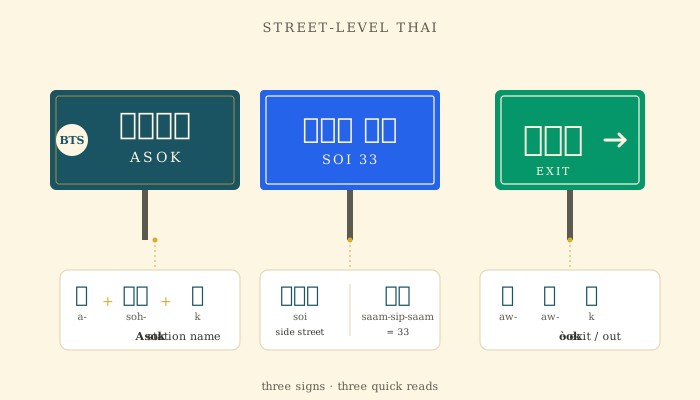
Two words that open up most addresses — thanon and soi
Almost every Bangkok address comes down to two Thai words. ถนน (thanon) is a main road. ซอย (soi) is a side street that branches off a thanon. Once you can spot these two words on a sign, most addresses stop being mysterious.
Take "Sukhumvit Soi 33". On a Thai address sign that reads ถนนสุขุมวิท ซอย ๓๓ — ถนน + สุขุมวิท (Sukhumvit) gives you the main road; ซอย ๓๓ gives you the side street number. Sois off a thanon are numbered odd on one side and even on the other (Soi 1, 3, 5 face Soi 2, 4, 6 across the road), so once you find your thanon you can predict roughly where your soi will be.
Two words. Recognising them on a blue-and-white street sign is the difference between "lost in Bangkok" and "I know which way the taxi should go."
BTS and MRT station names — your daily reading drill
Bangkok commuters see the same 30–40 station names every day. The Thai is printed on top, the romanization underneath — same size, same sign. If you commute, you have a free reading practice that's already scheduled into your week.
Five worked examples, broken into chips:
- อโศก (Asok) — three characters. อ is a silent consonant carrying the vowel โ (long "oh"); ศ is an "s" sound; ก closes the syllable as a "k". The interchange station between BTS and MRT.
- อ่อนนุช (On Nut) — two syllables. อ่อน (on, soft) + นุช (a person's name). The tone mark ่ over the first syllable is what gives "on" its low tone.
- สยาม (Siam) — three characters, one syllable. ส (s) + ย as a vowel combiner + า (long "aa") + ม (m). The old name for Thailand, and the city's main interchange.
- ชิดลม (Chit Lom) — two syllables. ชิด (chit, close to) + ลม (lom, wind). "Close to the wind." Reads cleanly left-to-right with no surprises.
- พญาไท (Phaya Thai) — two syllables. พญา (phaya, lord) + ไท (thai, Thai). Above the BTS station of the same name, you'll see exactly this — easy to lock in on the platform every morning.
Five stations, about fifteen characters total. After a week of looking at them on purpose instead of glazing past them, they stop being shapes and start being words. After a month, you'll catch yourself reading new stations before the romanization comes into focus.
Common directional words on street signs
After station names, the next layer of city signage is directions. Seven words cover most of what you'll see on traffic signs, parking lots, BTS platforms, and shop fronts:
- ทาง (thaang) — way, direction. The lead word on most directional signs.
- ออก (oo-k) — exit. Every BTS station has these arrows; ทางออก (thaang oo-k) is the literal "way out".
- เข้า (khao) — entry. The companion to ออก; you'll see ทางเข้า on car park entrances.
- หยุด (yut) — stop. Painted on the road and printed on traffic signs at intersections.
- ขวา (khwaa) — right.
- ซ้าย (saai) — left.
- ตรง (trong) — straight. Most often heard from taxi drivers (trong pai, "straight on") but also printed on lane-direction signs.
Add these to the thanon/soi pair and you can read most of what's printed at street level on a Bangkok block.
Reading neighborhood names
Neighborhood names split into two groups. Some are short and pure Thai; others are compounds borrowed from Pali or Sanskrit that have to be read syllable-by-syllable.
- สีลม (Silom) — named for the windmills (ลม = lom, wind) that pumped water along the canal in the 1800s. Guidebooks often gloss it as "four winds" by reading สี as sii (four), but strictly that would need a tone mark (สี่); the unmarked สี means "colour". Treat "four winds" as folk etymology and the windmill story as the real one. ลม is a common Thai word you'll learn early.
- ทองหล่อ (Thonglor) — ทอง (thong, gold) + หล่อ (lor, to cast / mold). The "gold-casting" neighborhood, named for the goldsmiths who used to work there. Now mostly cocktail bars.
- อารีย์ (Aree) — three characters and the silent-letter mark ์ at the end of ย์. The mark tells you that final letter is not pronounced — useful to recognise because it shows up on a lot of Thai words borrowed from older languages.
- สุขุมวิท (Sukhumvit) — three syllables. สุ (su) + ขุม (khum) + วิท (wit). A longer borrowed name, named after a former Director-General of the Highway Department. Reads in three even chunks once you know to break it that way.
The pattern: short Thai-root names you can guess from the parts (สีลม, ทองหล่อ), longer borrowed names you read in chunks (สุขุมวิท, รัชดาภิเษก). Both are easier than they look the first time. Wikipedia explains how a soi is numbered off its parent road if you want the bigger picture.
Why BTS reading practice compounds fast
The cheapest reading practice in Thailand is the one already in your calendar. Five days a week, twice a day, the same 30–40 station names pass under your eyes. No headphones. No app. No streak to maintain.
Most language practice fails because it has to fight for time. Sign reading doesn't — the signs are already there. The only thing that changes is whether you decide to read them or scroll past them. After a few weeks of choosing to read, the station names become permanent furniture in your head, and new signs start to make sense automatically.
Want to read more than the station names?
The Read Thai course gets you reading signs, menus, and forms in about 8 weeks — modules 1–3 free, no card needed.
Start reading Thai today
Start Read Thai free →First 3 modules free — no card, and they don't expire.
Common questions about reading Thai signs
- What's the difference between soi and thanon?
- ถนน (thanon) is a main road. ซอย (soi) is a side street running off a thanon — typically numbered (Soi 1, Soi 3, Soi 5 on the odd side; even numbers on the other). Reading these two words alone makes most Bangkok addresses navigable.
- How do BTS / MRT station names work in Thai?
- Most stations have a one- or two-syllable Thai name written in the same large display as the romanization. The Thai is on top. Reading it (rather than relying on the romanization) is fast practice — you see the same words every day.
- Are Thai numerals (๐๑๒๓...) used on signs?
- Sometimes — official government signs, dates on official notices, traditional shophouses. Most modern signs use Arabic numerals (0–9). It's worth learning Thai numerals as a small additional skill, but signs alone won't force the issue.
- Why are some signs in two scripts (Thai + English)?
- Government policy in tourist areas, plus most major chains adopt bilingual signage. Outside of tourist zones — most residential sois, government offices, neighborhood shops — signs are Thai-only.
- What's the fastest way to get sign-reading practice?
- BTS / MRT stations during a commute. You see the same 30–40 station names repeatedly, so recognition compounds. The Read Thai course is built around this idea — characters are taught in order of real-world frequency, not alphabetical order.
The signs are everywhere. The skill compounds every time you ride the train.
Start reading Thai today
Start Read Thai (free) →First 3 modules free — no card, and they don't expire.