
Reading Thai Signs: 50 Words and Characters to Know
Reading Thai signs doesn't require the whole alphabet. Learn ~50 high-frequency characters and words to navigate Thailand on your own.
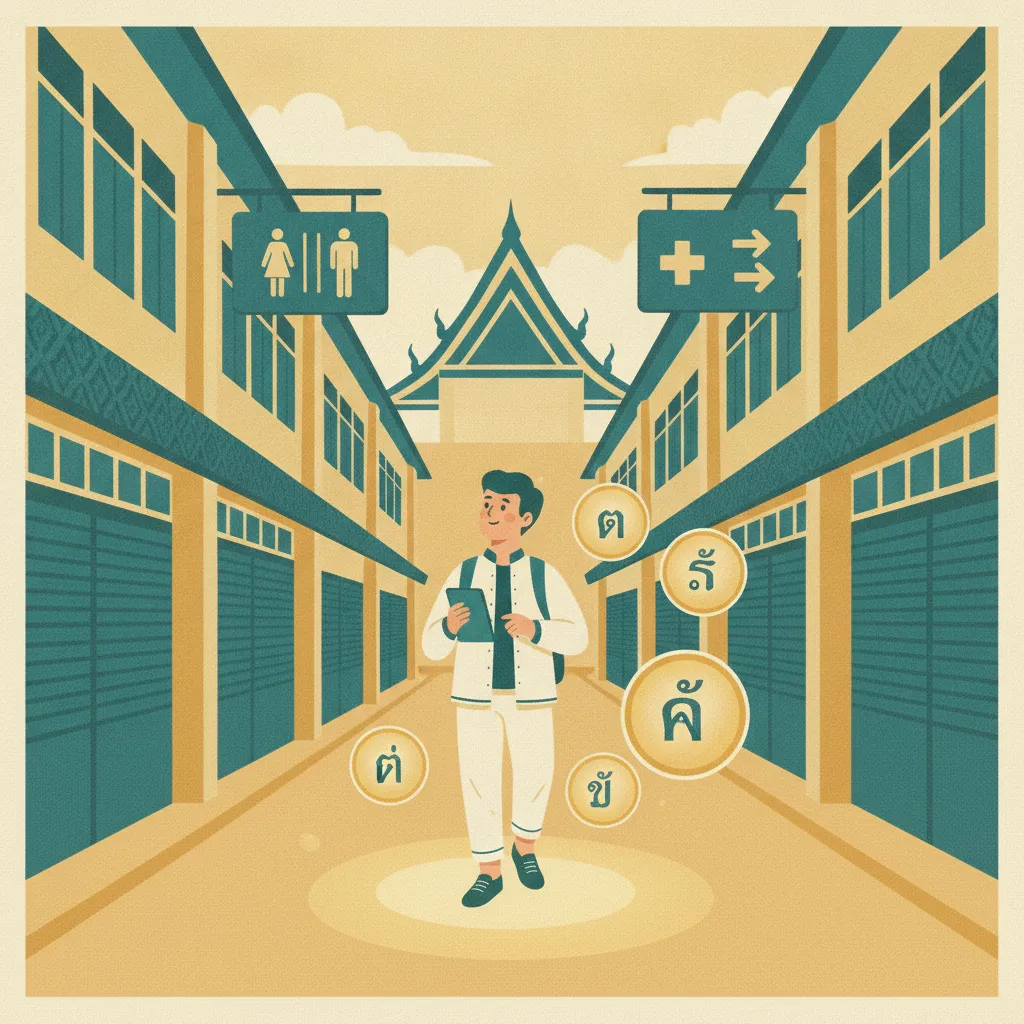
Reading Thai signs is the highest-return skill most travelers skip. People assume it means memorizing all 44 consonants and 30-odd vowels before a single sign makes sense—so they don’t start. But that’s not how sign literacy works. You don’t read the word “EXIT” by sounding out E-X-I-T; you recognize the whole shape at a glance. Thai signs work the same way, and the same small set of words shows up again and again. Learn about fifty of them by shape and you stop being dependent on English signage, helpful strangers, and Google Translate’s camera.
This isn’t a full script course. It’s a field guide to the characters and words you’ll actually see on doors, walls, ticket booths, and station platforms—the ones that make the difference between guessing and knowing.
Why Reading Thai Signs Pays Off (Even Though English Is Everywhere)
Bangkok is easy for non-readers. The BTS Skytrain and MRT subway are fully bilingual—every station name, platform sign, and ticket machine offers English, and announcements play in both Thai and English. If your whole trip is Sukhumvit, Siam, and the airport rail link, you can get by without recognizing a single Thai character.
The value of reading Thai signs shows up the moment you step off that track: a night market in Chiang Mai, a back-lane (soi) noodle shop in Ari, a provincial bus station, a temple ticket booth, a pharmacy in a town with no English menu. That’s where signs go Thai-only, and where a few recognized words turn confusion into competence.
There’s also a money angle that surprises people. Dual pricing, where foreigners pay more than Thais at temples, national parks, and some attractions, is widespread and ongoing. Major temples may charge foreign visitors 100–500 baht while Thais enter free or for far less. The catch travelers miss: the foreign price is often printed in Arabic numerals (100), while the lower Thai price sits right beside it in Thai numerals (๒๐ for 20). You can’t argue the policy, but you can at least read it—and recognizing คนไทย(khon thai) versus ชาวต่างชาติ(chaao dtàang-châat) on a sign tells you exactly what’s going on.
Sight-Reading vs. Sounding Out: The Mental Shift
Fluent readers of any language don’t process letters one at a time—they recognize word shapes. You want to skip straight to that stage for a tiny, high-value vocabulary, instead of learning to “sound out” everything.
The trick is anchor words. A handful of Thai words appear inside dozens of signs, so learning the anchor gets you the whole family:
- ร้าน(ráan) starts the name of nearly every business: ร้านอาหาร(ráan aa-hǎan), ร้านขายยา(ráan khǎai yaa), ร้านกาแฟ(ráan gaa-fae).
- ห้อง(hâwng) starts most room signs: ห้องน้ำ(hâwng náam), ห้องพัก(hâwng phák), ห้องครัว(hâwng khrua).
- ทาง(thaang) starts most directional signs: ทางเข้า(thaang khâo), ทางออก(thaang àwk), ทางด่วน(thaang dùan).
Spot ร้าน(ráan), ห้อง(hâwng), and ทาง(thaang) reliably and you’ve already cracked the front of most everyday signs. Now you only need the second word to know what kind of shop, room, or way you’re looking at.
The Five Categories That Cover Almost Everything
1. Bathrooms
The single most-searched sign for a reason. The standard word is ห้องน้ำ(hâwng náam), but formal or older signs use สุขา(sù-khǎa) and you’ll occasionally see ห้องส้วม(hâwng sûam) on basic facilities. The gender words matter when there’s no pictogram:
| Thai | Romanization | Meaning |
|---|---|---|
| หญิง | yǐng | women |
| ชาย | chaai | men |
| ห้องน้ำหญิง | hâwng náam yǐng | women’s bathroom |
| ห้องน้ำชาย | hâwng náam chaai | men’s bathroom |
Memory hook: ชาย(chaai) for chaps, both starting with a “ch” sound. Get these two and you’ll never push the wrong door again.
2. In, Out, Open, Closed
These govern doors, gates, and shop hours. They’re short, common, and worth knowing cold.
| Thai | Romanization | Meaning |
|---|---|---|
| เข้า | khâo | enter / in |
| ออก | àwk | exit / out |
| ผลัก | phlàk | push |
| ดึง | deung | pull |
| เปิด | bpòet | open |
| ปิด | bpìt | closed |
เปิด(bpòet) and ปิด(bpìt) look almost identical and mean opposite things—the difference is the leading เ vowel, easy to miss when you’re moving fast. This is the pair worth drilling, because a wrong guess wastes a trip across town to a shuttered shop.
3. Warnings and Prohibitions
When a sign is trying to stop you doing something, it usually leads with one of these. The most important is ห้าม(hâam)—if you see it at the start of a sign, whatever follows is forbidden.
| Thai | Romanization | Meaning |
|---|---|---|
| ห้าม | hâam | prohibited / do not |
| ห้ามเข้า | hâam khâo | no entry |
| ระวัง | rá-wang | caution / careful |
| อันตราย | an-dta-raai | danger |
4. Help: Pharmacy, Hospital, Police, Bank
The signs you want to find fast in a bad moment—so you don’t want to be sounding out letter by letter when it counts.
| Thai | Romanization | Meaning |
|---|---|---|
| ร้านขายยา | ráan khǎai yaa | pharmacy |
| โรงพยาบาล | roong phá-yaa-baan | hospital |
| ตำรวจ | dtam-rûat | police |
| ธนาคาร | thá-naa-khaan | bank |
Pharmacies usually pair the Thai ร้านขายยา(ráan khǎai yaa) with a green cross, so the symbol and the script reinforce each other. Notice the anchor again: it’s just ร้าน(ráan) + ขายยา(khǎai yaa). For the deeper emergency vocabulary you’d actually say, our Sick in Thailand phrases guide covers the spoken side.
5. Prices and Thai Numerals
This is where reading earns its keep. Thailand uses Arabic numerals everywhere in daily commerce, but Thai numerals (๐–๙) still appear on temple tickets, government notices, and traditional menus—and, as noted, on the local half of dual-price signs.
| Arabic | Thai | Romanization |
|---|---|---|
| 0 | ๐ | sǔun |
| 1 | ๑ | nèung |
| 2 | ๒ | sǎwng |
| 3 | ๓ | sǎam |
| 4 | ๔ | sìi |
| 5 | ๕ | hâa |
| 6 | ๖ | hòk |
| 7 | ๗ | jèt |
| 8 | ๘ | bpàet |
| 9 | ๙ | gâo |
The shapes follow the same place-value system you already know, so ๒๕๐ is simply 250. Pair the numerals with บาท(bàat) and ราคา(raa-khaa) and you can read most price tags and ticket booths. A useful one to add: ฟรี(free)—a direct English loanword, written and pronounced almost the same.
Anchor Characters Worth Knowing on Their Own
Whole-word recognition gets you far, but a few individual characters appear so often that knowing them sharpens your guessing. You’re not learning consonant classes here—just visual landmarks. (When you do want the system behind tones, the consonant classes guide explains why these letters behave the way they do.)
- ห (h) — leads ห้อง(hâwng) and ห้าม(hâam). A tall character with a distinctive notch; spotting it flags “room” and “don’t.”
- ร (r) — leads ร้าน(ráan). Once you see this opening a sign, a business name usually follows.
- ท (th) — leads ทาง(thaang). Directional signs start here.
- น้ำ (náam, water) — appears in ห้องน้ำ(hâwng náam) and on countless water and drink labels.
Notice that Thai is written with no spaces between words, which is why anchor-word recognition beats reading letter by letter. You’re looking for familiar chunks inside an unbroken string, not working through each character.
A Weekend Plan to Become Sign-Literate
You don’t need months for this. Sign literacy is a small, closed vocabulary, so it responds well to a short, focused sprint.
Saturday morning — the essential eight. Learn ห้องน้ำ(hâwng náam), หญิง(yǐng), ชาย(chaai), เข้า(khâo), ออก(àwk), เปิด(bpòet), ปิด(bpìt), and ห้าม(hâam). These eight alone cover the doors and bathrooms you’ll meet on day one.
Saturday afternoon — help and danger. Add ร้านขายยา(ráan khǎai yaa), โรงพยาบาล(roong phá-yaa-baan), ตำรวจ(dtam-rûat), and อันตราย(an-dta-raai). Test yourself on shapes, not pronunciation—you need to recognize these, not say them.
Sunday — numerals and anchors. Drill the Thai numerals ๐–๙ until 250 baht in Thai script reads as fast as in Arabic, then practice spotting the anchor words ร้าน(ráan), ห้อง(hâwng), and ทาง(thaang) inside longer signs.
That’s the whole weekend. If you want to keep going afterward—reading menus, then sentences, then the script as a system—the complete Thai script guide and the structured lessons at our script learning hub take you the rest of the way at a realistic two-to-three-month pace.
Printable cheat sheet: 12 signs to know before you go
- ห้องน้ำ (hâwng náam) — bathroom
- หญิง / ชาย (yǐng / chaai) — women / men
- ทางเข้า / ทางออก (thaang khâo / thaang àwk) — entrance / exit
- เปิด / ปิด (bpòet / bpìt) — open / closed
- ห้าม (hâam) — prohibited / do not
- อันตราย (an-dta-raai) — danger
- ร้านขายยา (ráan khǎai yaa) — pharmacy
- โรงพยาบาล (roong phá-yaa-baan) — hospital
- ตำรวจ (dtam-rûat) — police
- บาท (bàat) — baht
- ๐ ๑ ๒ ๓ ๔ ๕ ๖ ๗ ๘ ๙ — Thai numerals 0–9
When You’ll Be Glad You Learned This
Picture the situations English signage doesn’t reach. At a small-town bus terminal, you work out which gate is ทางออก(thaang àwk) and which leads to the platforms. At a temple in Ayutthaya, the dual-price board finally explains why the booth quoted you a higher number than the locals pay. You hunt for a ร้านขายยา(ráan khǎai yaa) on a soi with no green cross in sight, scanning shopfronts for the script. And the อันตราย(an-dta-raai) sign on a cliff path with no English at all? You trust it.
None of this requires fluency. It requires the fifty-odd words and characters above, recognized on sight. Recognize those, and you stop feeling like a passenger in someone else’s country and start moving through it on your own terms. For the spoken side of getting around the capital, pair this with our Bangkok language guide—reading and speaking reinforce each other fast.
Frequently Asked Questions
How many Thai characters do I need to read signs?
You don’t need the full alphabet. To read the most common signs, focus on recognizing about 50 high-frequency words and characters by shape—bathrooms, in/out, warnings, pharmacy, hospital, police, prices, and the Thai numerals 0–9. That’s a weekend’s work, not the two-to-three months it takes to read Thai script fluently.
Do I really need to read Thai if signs are in English?
In Bangkok’s BTS and MRT, signage and announcements are fully bilingual, so you can manage without reading Thai. The value appears off the tourist track—provincial bus stations, local markets, small-town pharmacies, temple ticket booths—where signs are often Thai-only. Reading a few key words there is the difference between guessing and knowing.
What’s the most important Thai sign word to learn first?
ห้องน้ำ (hâwng náam, bathroom) is the most useful everyday word, and อันตราย (an-dta-raai, danger) is the most important for safety. After those, the in/out pair เข้า (khâo) and ออก (àwk) come up constantly on doors and gates.
Why are some prices written in Thai numerals?
Thai numerals (๐–๙) still appear on temple tickets, government notices, and traditional menus. They also show up on dual-price signs, where the higher foreign price may be printed in Arabic numerals and the lower local price in Thai numerals. Learning the ten digits lets you read both rates instead of only the one meant for tourists.
Is learning to read Thai signs the same as learning the Thai alphabet?
No. Sign reading is whole-word recognition of a small, fixed vocabulary—you learn shapes, not the writing system. Learning the Thai alphabet means understanding all 44 consonants, the vowels, the tone marks, and the rules that connect spelling to pronunciation. Sign literacy is a fast first step that the full script later builds on.
Read Thailand on Your Own Terms
Sign literacy is the cheapest confidence you can buy before a trip. Fifty words and ten numerals, recognized on sight, and you’re no longer leaning on English signage or a stranger’s directions.
But shape-recognition has a ceiling. It gets you doors, prices, and warnings—not the menu you want to order from, the rental contract before you sign it, or the LINE message your landlord just sent. For those, recognizing isn’t enough; you have to actually read, which means the whole alphabet plus the tone and sound that tell you what each word means.
That’s what Read Thai teaches, and it starts where you just did: by shape, then sound. Each character lands in spaced reviews with clear audio and the script beside the romanization, so letters feel familiar the first time you meet them on a real door. The jump from sign-spotting to real reading is shorter than it looks.
Start reading Thai today
From spotting signs to actually reading Thai — a structured course that teaches the alphabet with tone and clear audio on every card. First 3 modules free.
Start the reading course →First 3 modules free — no card, and they don't expire.
Related reading: Thai Script Complete Guide | Thai Consonant Classes Explained | Bangkok Language Guide