
Thai Pronouns: How 'I' and 'You' Actually Work
Thai pronouns map relationships, not grammar. Which 'I' and 'you' to use — phǒm, chǎn, khun — when to use names instead, and the pronouns to avoid.
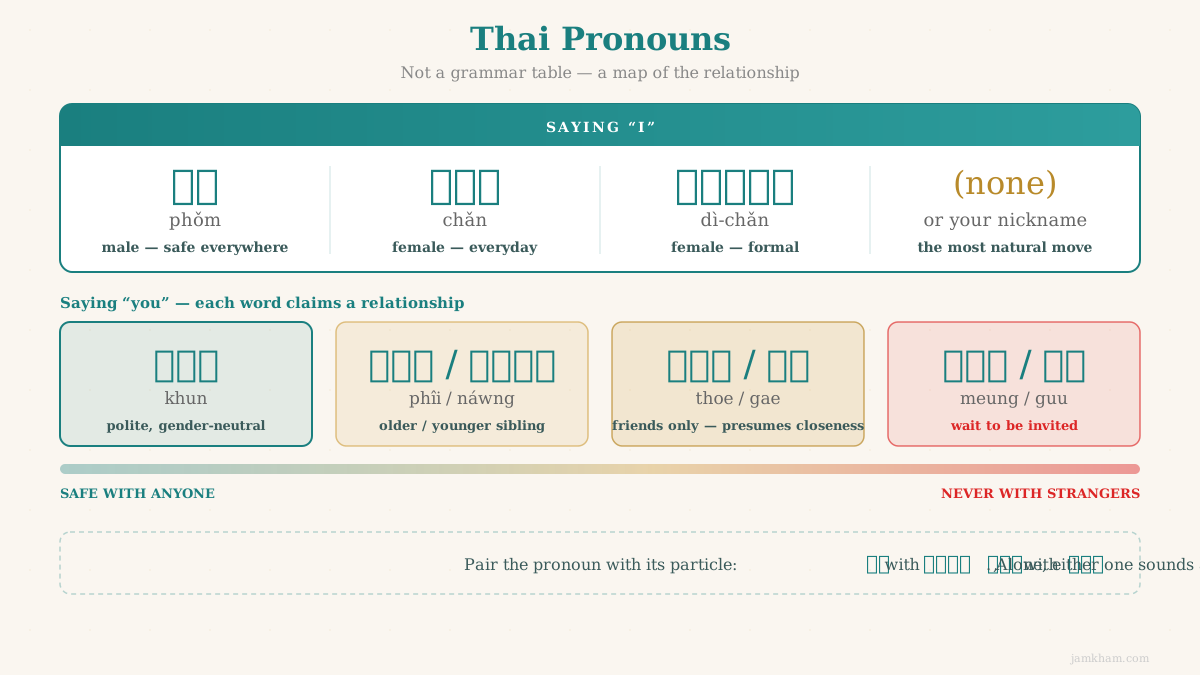
Thai pronouns are the first place where learning vocabulary stops being enough. In English, “I” is “I” whether you’re talking to your boss, your grandmother, or your dog. In Thai, how to say “I” and “you” depends on who you are, who you’re talking to, and what the relationship between you is — and picking the wrong word doesn’t just sound off, it makes a claim about that relationship you didn’t mean to make.
That sounds intimidating, and textbooks make it worse by printing a table of twenty pronouns with no guidance about which ones you’ll actually use. Here’s the honest version: you need about five to speak politely, another handful to understand what’s happening around you, and one core insight to make the whole system click — Thai pronouns aren’t grammar, they’re social positioning. Get that, and the “minefield” turns into something closer to a seating chart.
Why Thai Pronouns Work Differently
English pronouns encode number and gender, and that’s it. Thai pronouns encode the speaker’s gender, the listener’s relative age, the social status of both, the formality of the setting, and how close the two people are. That’s why there’s no single translation for “I” — the language forces you to declare where you stand before you can say anything about yourself.
This is the same status-sensitivity that runs through all of Thai politeness registers: the particles you end sentences with, the verbs you pick, and the pronouns you choose all move together. If you’ve noticed that Thais often ask your age within minutes of meeting you, this is why. It’s not nosiness — they’re working out which words the conversation should use.
The practical upshot: you don’t learn Thai pronouns as a list. You learn them as situations.
Saying “I”: Your Options, From Safe to Risky
Ways to say 'I' in Thai
| Pronoun | Romanization | Who uses it | When |
|---|---|---|---|
| ผม | phǒm | Male speakers | The polite default — works almost everywhere |
| ดิฉัน | dì-chǎn | Female speakers | Formal: business, officials, first meetings |
| ฉัน | chǎn | Female speakers (mostly) | Everyday conversation; the practical default |
| หนู | nǔu | Younger speakers (esp. women) | Talking to someone clearly older/senior |
| (your name) | — | Anyone, informally | With friends; common and natural |
| เรา | rao | Anyone, casual | Literally “we,” used as a soft “I” among peers |
| กู | guu | Very close friends only | Rough, intimate slang — not for learners yet |
If you’re a man, this is easy: ผม(phǒm) covers you from the immigration counter to the noodle stall. It’s polite without being stiff, and no one will ever fault you for it.
If you’re a woman, there’s a real choice. ดิฉัน(dì-chǎn) is the formal option — correct for job interviews, government offices, and meeting your partner’s parents, but noticeably starchy in daily life. Most women use ฉัน(chǎn) in ordinary conversation, and that’s the one worth making automatic. (You’ll also hear men use ฉัน(chǎn) in songs and with intimate partners — one of many signs that these words track relationships, not dictionary categories.)
หนู(nǔu) literally means “mouse,” and younger speakers — especially women — use it with people clearly senior to them: a student to a teacher, a young employee to an older boss. It signals “I’m the junior here” with a warmth English can’t really reproduce.
Two more you’ll hear constantly. Thais often skip pronouns and use their own nickname for “I” — a woman named Nok might say นกหิว(nók hǐu) to friends. And เรา(rao), which formally means “we,” doubles as a soft, gender-neutral “I” among people of the same age. Both will feel odd to an English speaker for about a month, and then they’ll feel friendly.
Then there’s กู(guu). It’s the oldest “I” in the language, and between close friends it signals total ease — no politeness needed, we’re past that. From anyone else it’s aggressive. You’ll hear it in markets, dramas, and Thai slang you’ll actually hear; leave it in your listening vocabulary for now.
Saying “You”: Where the Real Danger Is
Choosing “I” mostly affects how you come across. Choosing “you” makes a claim about the other person — which is why the risky end of this list is riskier.
Ways to say 'you' in Thai
| Pronoun | Romanization | Relationship it claims | Risk level |
|---|---|---|---|
| คุณ | khun | Polite, neutral distance | Safe everywhere |
| คุณ + name | khun + name | Polite and personal | Safe, warmer |
| เธอ | thoe | Close, affectionate, or to juniors | Fine with friends; too intimate for strangers |
| แก | gae | Very casual, same-age friends | Rude outside close friendships |
| มึง | meung | Extremely close — or hostile | Never with strangers |
คุณ(khun) is your workhorse: gender-neutral, polite, appropriate with strangers, service staff, colleagues, and officials. Even better is คุณ(khun) plus the person’s first name — คุณสมชาย(khun sǒm-chaai) — which is how Thais address each other politely and personally at the same time. Thai uses first names where English would use surnames, even in formal settings.
เธอ(thoe) is the “you” of pop songs and close friendships — affectionate between partners, normal between female friends, and standard from teachers to students. Used on a stranger, it presumes an intimacy that isn’t there. แก(gae) is a notch rougher: fine and common between same-age friends, jarring from a foreigner who’s misjudged the relationship.
And มึง(meung) is the partner of กู(guu): between old friends it’s camaraderie, from anyone else it’s a provocation. The pair even has a name — พูดกูมึง(phûut guu-meung) — and Thai parents actively police it in their kids. If a Thai friend starts using it with you, congratulations: you’ve been promoted. Don’t initiate.
The Most Thai Move: No Pronoun at All
Here’s what the tables don’t tell you: fluent Thai drops pronouns constantly. If context makes clear who’s doing what, the pronoun simply isn’t said.
“Have you eaten yet?” is กินข้าวหรือยัง(gin khâao rěu yang) — no “you” anywhere. “I’m going to the market” is ไปตลาด(bpai dtà-làat) — no “I.” A beginner who translates every English pronoun into Thai produces sentences that are grammatically fine and unmistakably foreign, like someone saying “I myself am going personally to the market.”
This is good news. The politest possible answer to “which pronoun should I use here?” is often “none,” and omission is a skill you can practice from day one: when the sentence still makes sense without the pronoun, leave it out.
Kinship Terms: The System Hiding Behind the System
Spend a day listening to Thai conversation and you’ll notice something the pronoun tables miss entirely: much of the time, Thais don’t use pronouns or names. They use family words — for everyone, related or not.
Kinship terms used as pronouns
| Term | Romanization | Literal meaning | Used for |
|---|---|---|---|
| พี่ | phîi | older sibling | Anyone somewhat older than you |
| น้อง | náwng | younger sibling | Anyone younger; also calls a server over |
| ลุง | lung | uncle | Men around your parents’ age |
| ป้า | bpâa | aunt | Women around your parents’ age |
| ยาย / ตา | yaai / dtaa | grandma / grandpa | The elderly (warm, familiar) |
These work as “you,” as “I,” and as a name. The woman grilling chicken at the market is ป้า(bpâa) even though you’ve never met; the twenty-something server is น้อง(náwng); your slightly older coworker is พี่(phîi), usually attached to their name: พี่นก(phîi nók). And they’ll refer to themselves the same way — an older vendor might say ป้าลดให้(bpâa lót hâi).
For a learner this is the single most useful upgrade after ผม(phǒm)/ฉัน(chǎn) and คุณ(khun). Calling a server น้อง(náwng) instead of “excuse me,” or your regular fruit vendor พี่(phîi), moves you instantly from tourist-Thai to person-who-gets-it Thai. It frames strangers as extended family, which is exactly how Thai social life prefers to see them.
He, She, and the Word to Be Careful With
Third-person pronouns are mercifully simpler. เขา(khǎo) covers “he,” “she,” and “they” in one gender-neutral word (in casual speech it often sounds like เค้า(kháo)). For things and animals, it’s มัน(man).
The care point: มัน(man) applied to a person is dismissive — somewhere between “that thing” and open contempt, depending on tone. Casual young-people speech does use it among friends, but as a learner, keep มัน(man) for objects and animals and use เขา(khǎo) for people. One habit, zero accidents.
Mistakes That Mark You as a Beginner (or Worse)
Translating every English pronoun. The most common error isn’t the wrong pronoun — it’s too many of them. If the sentence works without it, drop it.
Using เธอ(thoe) on strangers because a textbook listed it as “you.” It’s real, common Thai — inside relationships that have earned it. With a taxi driver it’s presumptuous. Default to คุณ(khun) or a kinship term.
Trying out กู(guu)/มึง(meung) because Thai friends use them. Their twenty-year friendship licenses those words. Wait until a Thai friend uses them with you first, and even then, match — don’t escalate.
Calling someone obviously older น้อง(náwng). Kinship terms claim relative age, so misjudging by too much can land badly — ป้า(bpâa) for a woman who sees herself as a พี่(phîi) stings a little. When unsure, พี่(phîi) flatters and คุณ(khun) is neutral.
Forgetting your polite particles. Pronouns and particles work as a system: ผม(phǒm) pairs with ครับ(khráp), ฉัน(chǎn)/ดิฉัน(dì-chǎn) with ค่ะ(khâ). A polite pronoun with no particle sounds abrupt; the pair together is what actually reads as courteous. The same pairing runs through every Thai greeting you’ll use.
Frequently Asked Questions
How do you say “I” in Thai?
It depends on who’s speaking. Men use ผม(phǒm) in almost every situation. Women use ฉัน(chǎn) in daily conversation and ดิฉัน(dì-chǎn) in formal settings. Thais also frequently use their own nickname instead of a pronoun, or drop “I” entirely when context makes it clear.
What’s the safest way to say “you” in Thai?
คุณ(khun) is polite, gender-neutral, and appropriate with strangers, colleagues, and service staff. Even more natural is คุณ(khun) plus the person’s first name, or a kinship term like พี่(phîi) for someone a bit older. When context makes “you” obvious, Thai usually omits it altogether.
What’s the difference between phǒm and chǎn?
ผม(phǒm) is “I” for male speakers; ฉัน(chǎn) is “I” for female speakers in everyday speech. They’re speaker-gendered, not listener-gendered — a man says ผม(phǒm) to everyone. Women switch to the more formal ดิฉัน(dì-chǎn) for business or official situations, while men use ผม(phǒm) across both.
Why do Thai people call strangers “aunt” or “older sibling”?
Thai extends family vocabulary to society at large: anyone somewhat older is พี่(phîi), anyone younger is น้อง(náwng), and people your parents’ age are ลุง(lung) or ป้า(bpâa). These words function as pronouns and polite address at once, and using them correctly is one of the fastest ways for a learner to sound natural.
Which Thai pronouns should I never use with strangers?
Avoid กู(guu) and มึง(meung) — between close friends they signal intimacy, but from a stranger they’re aggressive. แก(gae) and เธอ(thoe) are gentler but still presume a closeness you haven’t established. Also avoid มัน(man) for people — it’s for objects and animals.
Learn the Words With the Relationships Attached
The pronoun system is where Thai stops being translatable word-for-word and starts being social. A flashcard that says “เธอ = you” is technically true and practically dangerous — what you need to remember is who each word is for, which register it belongs to, and what it claims about the relationship.
That’s how Jam Kham builds its cards: pronouns, particles, and kinship terms come with their context and clear Thai audio, so you’re drilling ผม(phǒm)-with-ครับ(khráp) as the unit Thais actually say, not isolated dictionary entries. Jam Kham for Expats is waitlist-only for now — join the waitlist for founding pricing, and build pronoun habits you won’t have to unlearn.
Related reading: Thai Politeness: Why ‘Eat’ Has 5 Different Words | Thai Phrases for Greetings | Thai Slang You’ll Actually Hear
See how Thai reading actually works
Sound out your first Thai word →No account, no card — just the alphabet.
Start reading Thai today
Start the reading course →First 3 modules free — no card, and they don't expire.