
Thai Wedding Traditions: A Guest's Guide
What happens at a Thai wedding, what to wear, how much gift money to give, and the Thai phrases to congratulate the couple.
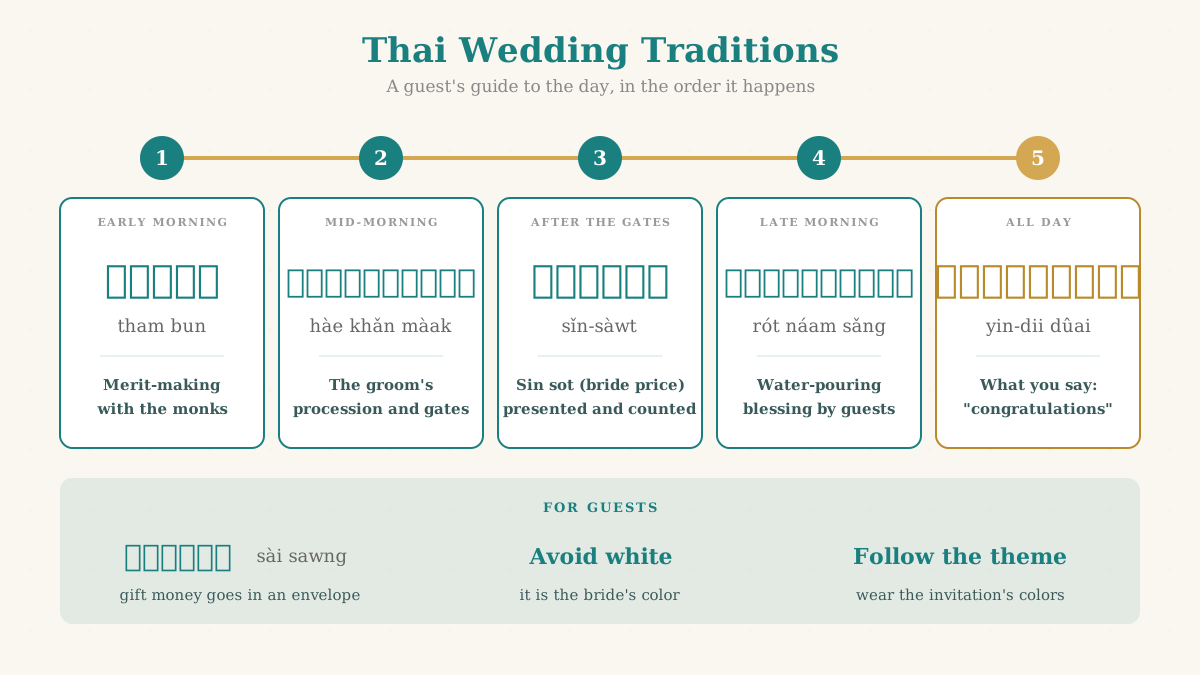
If you’ve been invited to a Thai wedding, the invitation probably didn’t come with instructions. That’s the gap this guide fills. A traditional Thai wedding runs on a structure most foreign guests have never seen — it starts soon after sunrise, involves Buddhist monks before it involves a dance floor, and has its own etiquette around gifts, clothing, and what to say. None of it is complicated once you know it. All of it is easy to get wrong if nobody tells you first.
This is the guest’s version: what happens, what you wear, how much you give, and the phrases that let you congratulate the couple like you mean it — not just smile and nod through the parts in Thai.
A Thai Wedding Starts Hours Before You Think
The word for wedding is งานแต่งงาน(ngaan dtàeng-ngaan) — literally “the marrying event.” แต่งงาน(dtàeng-ngaan) is the verb on its own. If you only remember one pair of words, make it these two.
In this format the day begins early — often around 7:00, at a time chosen as auspicious, the ฤกษ์(rôek) — with a Buddhist merit-making ceremony at the bride’s home or a rented venue. The couple offers food to a group of monks (often nine), an act called ใส่บาตร(sài bàat). The monks chant blessings while a sacred white thread, สายสิญจน์(sǎai sǐn), passes from hand to hand along their row. The water they bless during the chanting is the water that fills the conch shell later in the day. This part is called ทำบุญ(tham bun), and it’s the spiritual foundation the rest of the day builds on, not a formality tacked onto a “real” ceremony later.
If you’re invited to this morning portion specifically, arrive on time. A monk ceremony runs on the monks’ schedule, and latecomers miss the chanting entirely. If your invitation is only for the reception, you’re being invited to the evening portion instead, which is fine and normal — not every guest attends every stage.
The Khan Mak Procession and the Silver and Gold Gates
After the monks comes the loudest part of the morning: แห่ขันหมาก(hàe khǎn màak). The groom walks to the bride’s house with his family and friends, who carry trays holding the sin sot, the rings, betel nut, and other auspicious gifts. Expect drumming, singing, and cheering. If you came with the groom’s side, you may be handed a tray and asked to walk with them — say yes.
At the bride’s house the procession meets the ประตูเงินประตูทอง(bprà-dtuu ngoen bprà-dtuu thawng). These “gates” are silver and gold belts or chains that the bride’s relatives and friends hold across the groom’s path. To pass each one, the groom or an elder from his side hands over an envelope of money as a toll. The gatekeepers tease him, tell him it isn’t enough, or set him a silly task first, and the toll rises as he gets closer to the bride. It’s a game, and everyone watching is supposed to laugh.
Once the groom is through, the trays are set out, both sets of parents and the senior relatives sit down, and the sin sot is presented and counted in front of them. The couple then exchanges rings and pays respect to the elders on both sides. As a guest you watch all of this; nobody expects you to do anything except enjoy it.
The Water-Pouring Ceremony: Rod Nam Sang
The ceremony guests take part in — and the one worth understanding before you arrive — is รดน้ำสังข์(rót náam sǎng). The bride and groom kneel side by side with their hands pressed together and held out in front of them. Each wears a loop of blessed white thread on the head, and in the traditional form a strand joins the two loops: มงคลแฝด(mong-khon fàet). An elder usually places the loops, not a monk. Monks avoid physical contact with women, so if a monk takes part he places the groom’s loop and hands the bride’s to the groom or an elder.
Guests line up in order of seniority — parents and the most senior relatives first, then other family, then friends — and each pours a small stream of blessed water from a conch shell over the hands of the bride and the groom in turn, offering a wish as they do. By older custom only the couple’s elders poured; many weddings today invite every guest.
The order matters. Don’t cut the line or go ahead of someone older than you or more senior in the family — seniority here isn’t a technicality, it’s the point of the ceremony. If you’re unsure where you rank, hang back and follow whoever invited you.
Wedding vocabulary
| Thai | Romanization | Meaning |
|---|---|---|
| งานแต่งงาน | ngaan dtàeng-ngaan | wedding (the event) |
| แต่งงาน | dtàeng-ngaan | to marry, get married |
| เจ้าบ่าว | jâo bàao | groom |
| เจ้าสาว | jâo sǎao | bride |
| หมั้น | mân | engaged, to be engaged |
| แห่ขันหมาก | hàe khǎn màak | the groom’s procession |
| ประตูเงินประตูทอง | bprà-dtuu ngoen bprà-dtuu thawng | the silver and gold gates |
| สินสอด | sǐn-sàwt | bride price (often called “dowry” in English) |
| รดน้ำสังข์ | rót náam sǎng | water-pouring blessing ceremony |
| มงคลแฝด | mong-khon fàet | twin head loops of blessed thread |
| ทำบุญ | tham bun | to make merit |
| ยินดีด้วย | yin-dii dûai | congratulations |
| ซองงานแต่ง | sawng ngaan dtàeng | wedding gift envelope |
| ใส่ซอง | sài sawng | to give money in an envelope |
Sin Sot: The Bride Price, Explained
Before the wedding day, the two families agree on the sin sot — สินสอด(sǐn-sàwt). The groom’s family presents cash, and often gold, to the bride’s family, as a gesture of gratitude for raising her and a sign the groom can provide for the marriage. On the wedding day it arrives on the khan mak trays and is laid out on a cloth, sometimes scattered with puffed rice and flowers, and counted in front of both families.
For many families today, especially in the cities, the sin sot is largely symbolic. The bride’s parents often hand some or all of it back to the couple after the wedding, and some couples skip it altogether.
As a guest, sin sot isn’t something you’ll be asked about or involved in — it’s a family matter settled beforehand. It’s useful to recognize the word and the tray of cash and gold when you see it, so you understand what you’re watching and don’t mistake it for a gift table.
What to Wear as a Guest
Thai wedding dress code runs formal and modest. A collared shirt or blouse with slacks or a modest dress works for most weddings; a full suit or formal Thai dress is appropriate for a larger or more traditional event. When in doubt, dress a notch more formal than you would for an equivalent wedding back home.
Four rules matter more than the rest:
Check the invitation for a color theme. Many Thai couples set one (ธีมสี(thiim sǐi)) and print it on the invitation. If yours has one, it overrides everything below.
Avoid white and cream. Those are the bride’s colors. The general rule is the same as anywhere: don’t wear anything that could upstage her.
Be careful with black. Black is the color of funerals and mourning in Thailand, and older or more traditional families read it as inauspicious at a wedding. Leave it at home for a morning ceremony and for any family you don’t know well. At evening hotel receptions in the city, black is now common and some couples even choose dark themes, so follow the invitation or ask.
Cover shoulders and knees. For the morning merit-making portion, dress the way you would for a Thai temple visit — modest, covered, nothing sheer. The evening reception tends to be a little more relaxed.
Gift Money: How Much to Give and How to Give It
Thai wedding gifts are almost always cash, not registry items — placed inside an envelope, ซองงานแต่ง(sawng ngaan dtàeng), and handed over at a registration table when you arrive. The verb is ใส่ซอง(sài sawng), literally “to put in the envelope.” A common habit is to reuse the envelope your invitation came in; if you don’t have it, any clean envelope with your name written on it works.
There is no fixed rule on the amount, and Thai advice columns say so themselves. As typical figures in 2026, not rules:
- A restaurant or other modest venue: 500 to 1,000 baht
- A four- or five-star hotel: 1,500 to 2,000 baht or more, because the usual guideline is not to give less than your seat costs the couple
- Colleagues and friends you aren’t close to: 500 to 1,000 baht
- Close friends and close relatives: 2,000 to 5,000 baht
- Bringing a partner: give more — some guides say double
Outside the big cities, and at home weddings, amounts tend to sit at the lower end. If you’re unsure, ask a friend in the same circle what’s typical — it’s a normal question. Families do keep track of what’s given, both to gauge closeness and to reciprocate at future events, so a 500-baht envelope at a five-star hotel reads worse than most guests expect.
Phrases You’ll Actually Use as a Guest
You don’t need fluent Thai to be a good wedding guest — you need a handful of phrases said warmly, at the right moment.
Congratulating the couple. ยินดีด้วย(yin-dii dûai) is the core phrase — short and understood by everyone. Add a polite ending to make it ยินดีด้วยนะครับ/คะ(yin-dii dûai ná khráp/khá). For the couple’s parents, older relatives, or a written card, use the formal ขอแสดงความยินดีด้วย(khǎw sà-daeng khwaam yin-dii dûai). For something warmer, ขอให้มีความสุขมากๆ นะครับ/คะ(khǎw hâi mii khwaam sùk mâak mâak ná khráp/khá) adds real feeling without needing a long speech.
While pouring water at rod nam sang. You don’t need scripted words — a short, sincere wish said quietly as you pour is normal. Something as simple as ขอให้รักกันตลอดไป(khǎw hâi rák gan dtà-làwt bpai) fits the moment. Blessings like this traditionally flow from older to younger, so if you’re younger than the couple, a plain yin-dii dûai with the polite ending is enough.
Meeting the couple’s family. A polite สวัสดีครับ/ค่ะ(sà-wàt-dii khráp/khâ) with a wai to anyone clearly older than you goes a long way — weddings are one of the most family-dense events you’ll attend in Thailand, and showing respect to parents and grandparents matters as much as anything you say to the couple.
Complimenting the day. สวยมาก(sǔay mâak) works for the venue, the bride’s outfit, and the flowers. Thai hosts put enormous effort into wedding presentation, and noticing it out loud is always well received.
The toast at the reception. When the host calls the toast, the whole room raises a glass and shouts ไชโย(chai-yoo), usually three times. Join in.
A Quick Timeline, If You’re Attending the Full Day
Not every wedding follows this exactly — some families hold the procession before the monks arrive, and many skip steps — but it’s the common shape of the central-Thai format:
- Early morning (from about 7:00 AM) — the monks: chanting, the food offering, merit-making. The monks are offered their meal before noon
- Mid-morning — the khan mak procession and the silver and gold gates
- Straight after the gates — the sin sot (bride price) is presented and counted, the couple exchanges rings and pays respect to the elders
- Late morning — rod nam sang, the water-pouring blessing. At hotel weddings this often moves to the late afternoon, straight before the reception
- Lunch — guests eat once the morning rites are done and the monks have finished their meal
- Evening — the reception: dinner, speeches, the toast, music, and the part that looks most like a Western wedding party
If your invitation only mentions a single time, it’s usually for the reception — arrive at the stated time and you won’t have missed anything you were expected to attend.
Frequently Asked Questions
What should I wear to a Thai wedding?
Dress modestly and formally, and follow the color theme if the invitation names one. Avoid white and cream, which are the bride’s colors. Avoid black for a morning ceremony and with traditional families, who associate it with mourning; at evening hotel receptions in the city it is now common. Cover your shoulders and knees for the morning ceremony. When in doubt, ask whoever invited you.
How much money should I give at a Thai wedding?
There is no fixed rule. Typical amounts in 2026 are 500 to 1,000 baht at a restaurant or modest venue and 1,500 to 2,000 baht or more at a four- or five-star hotel. Close friends and relatives typically give 2,000 to 5,000 baht, and guests who bring a partner give more. Put the cash in an envelope with your name on it and hand it over at the registration table. Ask a friend in the same circle if you’re unsure.
Who pays for a Thai wedding?
Costs are typically shared, but not evenly. The groom’s family traditionally gives the sin sot (bride price) to the bride’s family, though it is often symbolic and the bride’s parents often return it to the couple. Both families split ceremony and reception costs based on what each can afford and how large a wedding they want. There’s no single fixed rule — the two families settle it privately.
How much does a Thai wedding cost?
Costs vary enormously by region, venue, and family expectations, from a modest ceremony at home to a large hotel reception that costs many times more. Guest gift money helps offset the cost of the reception, which is why “don’t give less than your seat costs” is common advice among Thais.
What is rod nam sang?
Rod nam sang is the water-pouring blessing in a traditional central-Thai wedding. The couple kneels side by side wearing loops of blessed thread on their heads, and guests pour water from a conch shell over their hands in order of seniority — elders and immediate family first — while offering a wish for the marriage. It’s usually the ceremony non-Thai guests are most directly invited to take part in.
Show Up Ready, Not Just Polite
A Thai wedding rewards guests who understand the shape of the day — when to arrive, what the procession and the water ceremony mean, what to put in the envelope, and how to say something warmer than a nodded smile when you congratulate the couple. None of it requires fluency. It requires a handful of phrases, said with the right tone, at the right moment.
Related reading: How to Say Sweetheart in Thai: ใจ Love Words for Romance | Thai Politeness: Why ‘Eat’ Has 5 Different Words | Thai for Expats: Workplace and Daily Life Vocabulary | learning Thai as an expat | Learn Thai for your partner’s family
Short sessions you can do before you fly or from your hotel room. Start with 30 free phrases.
Start free: 30 phrasesClear Thai audio at natural and slow speed · Polite ครับ/ค่ะ in your form · Paced to your trip date