
Thai Tone Rules — Predict Any Syllable From How It's Written
Thai writes tone into the writing itself. Once you know the four inputs — consonant class, tone mark, vowel length, live or dead — you can call the tone of any syllable from the page.
Why most learners give up on tone rules
Open any beginner Thai textbook and you'll find the same thing: a table. Mid class plus máai èek equals low tone. High class plus máai èek equals low tone. Low class plus máai èek equals falling tone. Twenty-odd rows, always with a cheerful note that says "memorise this and you'll be reading in no time."
Almost nobody memorises that table. The handful who do forget most of it a week later, because a 24-cell lookup grid is exactly the kind of thing your brain throws away when it's not under daily pressure to use it.
Here's the thing the table hides: it isn't 24 facts. It's one small system that produces 24 outputs. Learn the system and the table builds itself, every time you need it, from the script in front of you. That's what this page is about: learning Thai tones as a system you can read, not a grid to memorise.
Prefer it as a standalone reference outside the Read Thai course? See Thai tone rules explained.
The four inputs that determine tone
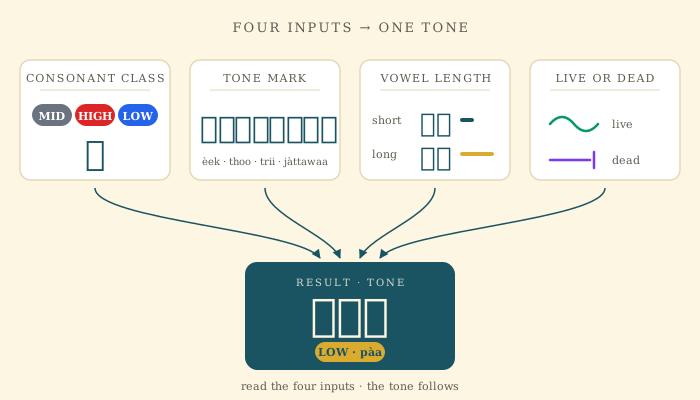
Every Thai syllable has a tone. To predict it, you only need to pay attention to four pieces of information you can read directly off the page:
- The class of the initial consonant — mid, high, or low.
- The tone mark, if any — máai èek, máai thoo, máai trii, máai jàttawaa, or none.
- The length of the vowel — short or long.
- Whether the syllable is live or dead — decided by the final sound.
Given these four inputs, the tone is deterministic. Not "usually" or "most of the time" — deterministic. The same four inputs always produce the same tone. About 95% of Thai syllables follow the rules cleanly; the rest are loanwords and a small set of irregulars that you learn one at a time, like you learn "though" and "through" in English.
The rest of this page walks through each input. By the end, you'll be able to point at a Thai syllable you've never seen before and call its correct tone.
Input 1 — Consonant classes
Thai's 44 consonants are sorted into three classes: mid (9 letters), high (11 letters), and low (24 letters). The classes don't change how the letter sounds — ค and ข both make a "kh" sound — they change how the letter behaves in the tone calculation.
The mid class is the smallest and easiest to learn: ก จ ด ต ฎ ฏ บ ป อ. Stops and unaspirated sounds, mostly. Several of these are the most common letters in Thai, so the mid class punches well above its weight.
The high class is the next group: ข ฉ ฐ ถ ผ ฝ ศ ษ ส ห ฃ. Aspirated stops and fricatives. The one that matters most early on is ห — the silent leading "h" that turns a low-class consonant into a high-class syllable for tone purposes. You'll see it constantly.
Everything else is low class — all 24 of them. Low-class consonants come in a useful pairing with the high class: most low-class sounds have a high-class twin (low ค pairs with high ข; low ช pairs with high ฉ; and so on). The pairing matters because the silent ห trick lets you "borrow" the high-class tone behaviour for a low-class sound when you need it.
For the complete list of all 44 consonants sorted by class, see the Thai alphabet chart.
Input 2 — Tone marks
Thai has four tone marks. They sit above the initial consonant of the syllable:
- Máai èek ◌่ — a small vertical stroke.
- Máai thoo ◌้ — looks like a small "2" or curl.
- Máai trii ◌๊ — a small "+" or cross.
- Máai jàttawaa ◌๋ — a small "x" or plus-with-a-dot.
Máai trii and máai jàttawaa are rare — you'll mostly see them in loanwords and onomatopoeia. The two workhorses are máai èek and máai thoo, which appear constantly.
Here's the part textbooks bury: the same mark produces different tones over different classes. Máai èek over a mid-class consonant gives a low tone. Máai èek over a high-class consonant also gives a low tone. But máai èek over a low-class consonant gives a falling tone. Same mark, three classes, two different tones.
For example: ป่า (pàa, "forest") uses mid-class ป with máai èek — low tone. ค่า (khâa, "value") uses low-class ค with the same máai èek — falling tone. The mark didn't change. The class did. That's the entire game.
Input 3 — Vowel length
Thai vowels come in short/long pairs. The two members of a pair sound similar but aren't the same vowel — อะ (short "a") is different from อา (long "a"), and Thai listeners hear them as distinct sounds the way English speakers hear "bit" and "beet" as distinct.
Length matters for tone because vowel length is one of the things that decides whether a syllable is live or dead — the fourth input, which we'll cover next. A short vowel ending a syllable with no final consonant gives you a dead syllable; a long vowel ending the same way gives you a live syllable. Same initial consonant, no tone mark either way, but the tone comes out different. มา (maa, "come") is mid-toned; มะ- as the first part of มะนาว (má-naao, "lime") is high-toned. The only difference is vowel length.
Input 4 — Live vs dead syllables
A syllable is live if it ends in either a long vowel or a sonorant final consonant — the sonorants are m, n, ng, y, and w. Live syllables feel like they could be sustained; they ring out.
A syllable is dead if it ends in either a short vowel (with no final consonant) or a stop final consonant — the stops are p, t, and k. Dead syllables stop short. Your mouth closes; there's nowhere for the sound to go.
A few quick examples:
- มา (maa, "come") — long vowel, no final. Live.
- ขา (khǎa, "leg") — long vowel, no final. Live.
- นก (nók, "bird") — short vowel, "k" stop final. Dead.
- จะ (jà, future marker) — short vowel, no final. Dead.
- ยาม (yaam, "guard") — long vowel, "m" sonorant. Live.
The reason live and dead matter is that, with no tone mark in play, the default tone of a syllable is decided by class plus live/dead alone. A mid-class live syllable defaults to mid tone. A mid-class dead syllable defaults to low tone. A high-class live syllable defaults to rising tone. And so on. This is why an unmarked Thai word still has a definite tone — the script tells you which one by exposing the class and the live/dead status.
Putting it together — a worked example
Let's take ภาษา (phaa-sǎa, "language"). Two syllables. Let's call the tones from the script alone, without looking them up.
Syllable 1 — ภา: The initial is ภ, which is low class. The vowel is long (า). There's no final consonant and no tone mark. Long vowel and no final means the syllable is live. Low class, live, no mark — that defaults to mid tone. phaa.
Syllable 2 — ษา: The initial is ษ, which is high class. The vowel is again long, no final, no mark. High class, live, no mark — that defaults to rising tone. sǎa.
Put them together: phaa-sǎa. Mid tone on the first syllable, rising tone on the second. We didn't memorise the word. We didn't memorise a tone table. We read the four inputs and the system did the rest.
Do this fifty times and it stops feeling like calculation. The class of a consonant becomes a property of the letter itself — you don't think about it; you just see it.
One caveat: the rules give you the tone on paper, but they won't train your ear. Keep listening to Thai as you read — speakers, podcasts, the app's audio — so what you hear confirms what the script already told you.
Want this as a skill, not a reference?
The Read Thai course drills the tone-rule system across modules 4–6 — until you predict tones automatically, without consulting any table.
Start reading Thai today
Start Read Thai free →First 3 modules free — no card, and they don't expire.
Where tone rules break — and why that's OK
The system covers most of the language. The other ~5% is mostly:
- Loanwords from English, Sanskrit, and Khmer that don't follow Thai phonotactics — sometimes the tone shown in writing isn't the tone Thai speakers actually use.
- The silent ห, which pulls a low-class word into the high-class tone column. This isn't really an exception — it's a rule on top of the rules — but it surprises learners the first time they meet it.
- A handful of irregular words where the written tone and the spoken tone diverge for historical reasons. Native readers know these by heart.
For a deeper linguistic treatment, the Wikipedia article on the Thai script covers the full tone tables and the historical reasons the system looks the way it does. The Read Thai course covers the irregulars in context, one at a time, where they actually appear in real words — not as a list to memorise upfront.
Common questions about Thai tone rules
- Do I need to memorize all 44 consonants to use tone rules?
- No — but you do need to know which class each consonant belongs to: mid, high, or low. Once you know the class of a syllable's initial consonant, you only need three more pieces of information (tone mark if any, vowel length, and whether the syllable is live or dead) to predict its tone.
- What's the difference between mid, high, and low class consonants?
- The classes are grammatical groupings, not pronunciation differences. They affect how the tone of a syllable is calculated. Mid-class consonants (9 letters: ก, จ, ฎ, ฏ, ด, ต, บ, ป, อ) follow one set of rules; high-class (11 letters: ข, ฃ, ฉ, ฐ, ถ, ผ, ฝ, ศ, ษ, ส, ห) follow another; low-class (the remaining 24) follow a third. The Read Thai course teaches each class in the order you'll encounter them.
- What are live and dead syllables?
- A "live" syllable ends in a long vowel or a sonorant consonant (m, n, ng, y, w). A "dead" syllable ends in a short vowel or a stop consonant (p, t, k). Whether a syllable is live or dead is one of the four inputs that determines its tone.
- How do tone marks change the tone?
- Thai has four tone marks: máai èek (◌่), máai thoo (◌้), máai trii (◌๊), and máai jàttawaa (◌๋). The mark "overrides" the default tone for the syllable, but the resulting tone depends on the consonant class. The same mark over a high-class consonant produces a different tone than over a low-class consonant.
- Can I learn tone rules without learning to read?
- In theory yes — but they're much easier to learn alongside reading, because reading gives you immediate practice predicting tones from script. The Read Thai course teaches the rules in context, not as an abstract memorization task.
- How long does it take to actually use the tone rules in real reading?
- Most learners can predict tones reliably within 3–4 weeks of consistent practice. The first weeks feel slow because you're consciously walking through the rules; eventually it becomes automatic, like reading English vowels without thinking about phonics.
Once tone rules click, every Thai word you meet has somewhere to land.
Start reading Thai today
Start Read Thai (free) →First 3 modules free — no card, and they don't expire.