
Bangkok's Full Name: What Krung Thep Maha Nakhon Means
Bangkok's full name is the world's longest place name. See what Krung Thep Maha Nakhon means, phrase by phrase, and what Thais say instead.
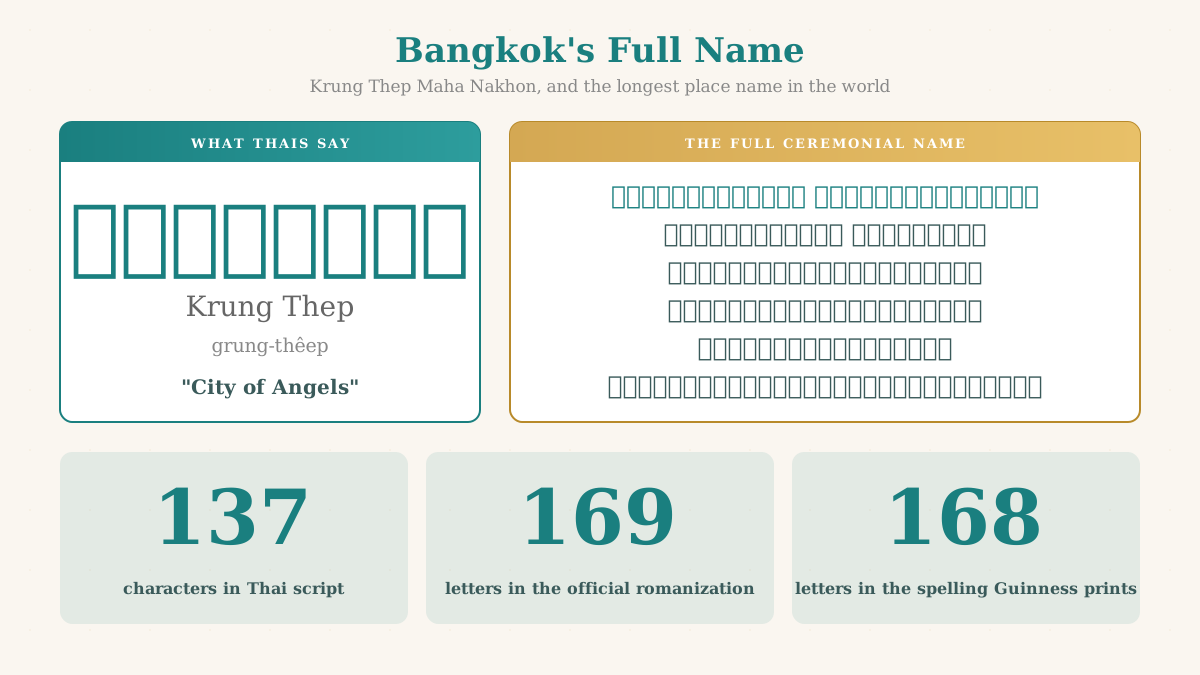
Ask a Thai person for Bangkok’s full name and most will laugh before they answer, because they know exactly what’s coming. The city’s real, official name isn’t “Bangkok” — it’s a long Pali-and-Sanskrit ceremonial title that Guinness World Records lists as the longest place name on Earth, and even Thai people can’t recite the whole thing from memory. This guide breaks Bangkok’s full name into the phrases that make it up, explains what each one means, and shows you what Thais actually say instead — which, handily, is a word you’ll want to know anyway: กรุงเทพ(grung-thêep).
Bangkok’s Full Name at a Glance
Bangkok’s complete ceremonial name, in Thai script, is:
Krung Thep Maha Nakhon Amon Rattanakosin Mahintharayutthaya Maha Dilok Phop Noppharat Ratchathani Burirom Udom Ratchaniwet Maha Sathan Amon Phiman Awatan Sathit Sakkathattiya Witsanukam Prasitกรุงเทพมหานคร อมรรัตนโกสินทร์ มหินทรายุธยา มหาดิลกภพ นพรัตนราชธานีบูรีรมย์ อุดมราชนิเวศน์มหาสถาน อมรพิมานอวตารสถิต สักกะทัตติยวิษณุกรรมประสิทธิ์Bangkok's full ceremonial nameIn one sentence, it means: the great city of angels, the immortal city of Indra’s jewel, great Indra’s unconquerable city, the grand realm rich in nine gems, home to the royal palace, dwelling place of reincarnated gods, given by Indra and built by the divine architect Vishvakarman (Thai: Witsanukam).
Syllable by syllable, it sounds like: grung-thêep má-hǎa ná-khawn / à-mawn rát-dtà-ná-goo-sǐn / má-hǐn-thá-raa-yút-thá-yaa / má-hǎa dì-lòk phóp / nóp-phá-rát râat-chá-thaa-nii buu-rii-rom / ù-dom râat-chá-ní-wêet má-hǎa sà-thǎan / à-mawn phí-maan à-wá-dtaan sà-thìt / sàk-gà-thát-dtì-yá wít-sà-nú-gam bprà-sìt.
Day to day, you’ll see it written as just the first phrase, กรุงเทพมหานคร(grung-thêep má-hǎa ná-khawn), on vehicle number plates, addresses and official forms, or as the abbreviation กทม.(gaw thaw maw).
A note on spelling: this post writes the name the way maps and street signs romanize it (Krung Thep Maha Nakhon) and shows how it’s pronounced in Jam Kham’s romanization, with tone marks (grung-thêep má-hǎa ná-khawn).
Krung Thep, Not Bangkok: What Thais Actually Say
Thais rarely call this city “Bangkok” when they’re speaking Thai. Ask for directions, book a bus ticket, or watch the evening news, and you’ll hear one word: grung-thêepกรุงเทพCity of Angels.
Break it apart and it’s two loanwords doing a lot of work. กรุง(grung) comes from Khmer, borrowed into Thai centuries ago. เทพ(thêep) comes from Pali and Sanskrit deva, the same root that gives English words like “divine.” Put together, Krung Thep means “City of Angels” — which is also, not coincidentally, the epithet people give Los Angeles, on the opposite side of the Pacific.
In writing, you’ll almost always see it as กรุงเทพฯ(grung-thêep), with a small hook after the last letter. That mark is called bpai-yaan-náwiไปยาลน้อยthe little abbreviation mark, and it’s one of Thai’s few dedicated punctuation symbols. The mark itself has no sound. Formally it tells the reader to say the longer form, กรุงเทพมหานคร; in everyday speech people just say grung-thêep. You can’t stick it onto just any shortened word; it only attaches to specific, fixed expressions that Thais have agreed to abbreviate this way, and Krung Thep is the most famous one in the country.
So Why Does English Still Say “Bangkok”?
Here’s the twist: “Bangkok” isn’t a mistranslation of Krung Thep — it’s actually the older name, and it refers to a different place. Before 1782, a small settlement already sat on the west bank of the Chao Phraya River, roughly where Thonburi is today. Thai place names starting with บาง(baang) are common all over central Thailand — you’ll spot the same prefix on half the districts and sois in the city — and this particular บาง likely came from Bang Makok (บางมะกอก), named for the makok trees that grew along the water and bear an olive-like fruit, or possibly Bang Ko (บางเกาะ), “village on the island.” European traders sailing up the river in the 1600s and 1700s knew the area by that riverside name long before it became a capital, and the name simply stuck in foreign languages even after King Rama I moved the royal capital across the river in 1782 and gave it an early form of its grand Thai title.
So for more than two centuries, Thailand has run on two names in parallel: Krung Thep at home, Bangkok abroad. In February 2022, the Cabinet approved an Office of the Royal Society proposal to update the punctuation of the city’s official bilingual listing — from “Krung Thep Maha Nakhon; Bangkok” to “Krung Thep Maha Nakhon (Bangkok)” — and international headlines briefly ran with “Bangkok renamed.” The Office of the Royal Society then clarified publicly: both names remain valid, nothing was renamed, and English speakers have no obligation to switch. If you’ve seen that headline resurface, now you know the real story.
How Many Letters? 168, 169, 137 or 111
The number depends on which alphabet you count in, and on whose spelling.
- 168 is the Guinness World Records figure. Guinness lists the name as the longest place name in the world and describes it, “in its most scholarly transliteration,” as “the 168-letter official name for Bangkok.” That counts Roman letters in the spelling Guinness prints, not Thai characters.
- 169 is the count in the Royal Thai General System, Thailand’s official romanization and the spelling this post uses. It has one letter more because it writes Mahintharayutthaya where Guinness prints mahintharaayuthaya.
- 137 is the count in Thai script, the way the name is written above: every consonant, vowel and mark, spaces left out.
- 111 also comes from Guinness, which prints a second string it calls “the official short version.” Its wording differs from the name above: it has bowon where today’s name has amon, the word King Mongkut replaced (more on that below).
Even most Thais have only ever memorized the first phrase, Krung Thep Maha Nakhon, and maybe a few syllables past it. Reciting the entire thing from memory is a party trick, not an expectation.
What It Actually Means, Phrase by Phrase
The name reads less like an address and more like a blessing — a string of honorifics stacked one after another, drawn almost entirely from Pali and Sanskrit, the languages Thai borrows from for anything formal, religious, or royal. Here’s how the widely published breakdown splits it into eight chantable phrases:
Bangkok's full name, phrase by phrase
| Thai phrase | Romanization | What it means |
|---|---|---|
| กรุงเทพมหานคร | Krung Thep Maha Nakhon | Great city of angels |
| อมรรัตนโกสินทร์ | Amon Rattanakosin | The immortal city of Indra’s jewel — the Emerald Buddha (Rattanakosin also names the founding era) |
| มหินทรายุธยา | Mahintharayutthaya | Great Indra’s unconquerable city — echoing Ayutthaya, Siam’s former capital |
| มหาดิลกภพ | Maha Dilok Phop | The grand and prominent realm |
| นพรัตนราชธานีบูรีรมย์ | Noppharat Ratchathani Burirom | The pleasant royal capital, rich with nine gems |
| อุดมราชนิเวศน์มหาสถาน | Udom Ratchaniwet Maha Sathan | The royal residence and grand palace |
| อมรพิมานอวตารสถิต | Amon Phiman Awatan Sathit | The divine, celestial home of a reincarnated deity |
| สักกะทัตติยวิษณุกรรมประสิทธิ์ | Sakkathattiya Witsanukam Prasit | A city given by Indra (Sakka is his Pali name) and built by Vishvakarman (Thai: Witsanukam), the divine architect |
String all eight together and you get the one-sentence translation at the top of this post. It’s less a name than a compressed prayer for the city’s fortune — which is exactly what it was designed to be.
Where the Name Came From
When King Rama I founded the new capital in 1782, moving it across the Chao Phraya from Thonburi, giving it a grand, auspicious name was standard practice for a new royal seat — Ayutthaya, the capital before it, carried its own long ceremonial title too. The name used today took shape in stages: Thai sources record a shorter name under Rama I, a revision under King Nangklao (Rama III) that opens with the words Krung Thep Maha Nakhon, and the settled form under King Mongkut (Rama IV) in the mid-1800s, who changed two of its words and extended it. That’s why the name references Ayutthaya directly (Mahintharayutthaya) — it’s a deliberate link between the new capital and the old one, a claim of continuity for a kingdom that had lost its previous capital to the Burmese in 1767.
The heavy Pali and Sanskrit vocabulary isn’t unique to Bangkok’s name — it’s the same layer of borrowed, formal language you’ll find in Thai royal titles, temple names, and religious vocabulary generally. If that split between “everyday Thai” and “formal, Sanskrit-flavored Thai” is new to you, our guide to Thai language origins covers where each layer of the language actually came from.
The Song That Actually Teaches Thais This Name
If you ask a Thai person how they know the full name at all, many won’t say “school.” They’ll name a song. In 1989, the rock duo Asanee-Wasan released a track whose lyrics are the city’s full name set to music, repeated as the hook. It became a hit, and decades later it’s still how many Thais learned the name. It’s worth a search on YouTube if you want to hear the whole thing sung at speed; you’ll notice even the singers treat it as one long rhythmic chant rather than a sentence with real pauses.
Where You’ll Actually Run Into the Full Name
You won’t need it to get around, but it does turn up: the full name is displayed on a sign in front of Bangkok City Hall, and tour guides like to quote it outside the Grand Palace. If you’re the kind of traveler who likes recognizing what you’re looking at rather than just walking past it, that’s exactly the payoff of learning to read Thai script at all — the same 44 consonants and towering vowel combinations that make up this name are the ones on every street sign, menu, and BTS station between here and Chiang Mai.
Frequently Asked Questions
What is the full name of Bangkok?
Bangkok’s full ceremonial name is Krung Thep Maha Nakhon Amon Rattanakosin Mahintharayutthaya Maha Dilok Phop Noppharat Ratchathani Burirom Udom Ratchaniwet Maha Sathan Amon Phiman Awatan Sathit Sakkathattiya Witsanukam Prasit. Guinness World Records lists it as the longest place name in the world, at 168 letters in the romanized spelling Guinness prints; it is 169 letters in Thailand’s official romanization and 137 characters in Thai script. In daily life, everyone just says Krung Thep.
What does Bangkok’s full name mean?
Roughly: “the great city of angels, the immortal city of Indra’s jewel, great Indra’s unconquerable city, the grand realm rich in nine gems, home to the royal palace, dwelling place of reincarnated gods, given by Indra and built by the divine architect Vishvakarman (Thai: Witsanukam).” It’s a string of Pali- and Sanskrit-derived honorifics rather than a literal description, composed to bless the capital.
How do you pronounce Bangkok’s full name?
Most people don’t attempt the whole name — even Thais typically stop after the first phrase, Krung Thep Maha Nakhon (grung-thêep má-hǎa ná-khawn). The everyday short form, กรุงเทพฯ, is pronounced grung-thêep, with a falling tone on thêep.
Why is Bangkok called Bangkok in English?
“Bangkok” is actually the name of the riverside village that stood on the site before 1782, likely from บางมะกอก (Bang Makok, “olive-tree village”) or บางเกาะ (Bang Ko, “island village”). European traders knew the area by that name well before it became the royal capital, and the name simply stuck internationally even after Thailand adopted “Krung Thep” domestically.
What does Krung Thep mean?
Krung Thep (กรุงเทพ) means “City of Angels.” Krung comes from Khmer, meaning “capital” or “royal city,” and thep comes from Pali/Sanskrit deva, meaning “deity” or “angel.” It’s the short form of Bangkok’s full ceremonial name and the word Thais actually use day to day.
One Name to Recognize, Not to Memorize
You don’t need to recite the full name to get around Bangkok — you need กรุงเทพฯ, a handful of essential phrases, and maybe this story to tell at dinner. But if a name this dense and this old doesn’t intimidate you, reading the script it’s written in shouldn’t either. It’s built from the same letters as everything else you’ll see on a Bangkok street.
Read Thai, Jam Kham’s script course, teaches those letters the way this article just handled the name — one recognizable chunk at a time, with the consonant classes and tone rules that tell you how a word sounds. You read a real Thai word by the third card, and it’s free to start: start Read Thai →
Related reading: Bangkok First-Timer’s Language Guide | Thai Language Origins: 3 Languages in One | Thailand Travel Guide
See how Thai reading actually works
Sound out your first Thai word →No account, no card — just the alphabet.
Start reading Thai today
Start the reading course →First 3 modules free — no card, and they don't expire.