
How to Read Thai Numbers ๑๒๓ (Menus & Bills)
Thai numerals turn up on dual-priced menus, lottery tickets, and forms. Learn all ten Thai digits in minutes—and where you'll actually need them.
You’re at a temple in Chiang Mai. The sign at the entrance lists two prices: one in the numbers you know, ฿100, and one written in symbols that look like decorative squiggles—๒๐. The squiggles say 20. That’s the local price, in baht, and it’s a fifth of what the sign is quietly charging you. Learning how to read Thai numbers is the difference between noticing that gap and walking past it.
Thai numerals are the easiest thing to read in the whole writing system. There are exactly ten of them, they map one-to-one onto the digits 0 through 9, and—unlike Thai letters—there are no tone rules or vowel placements to worry about. You’re matching ten shapes to ten values, and most people have it down in a single sitting.
The Ten Thai Digits
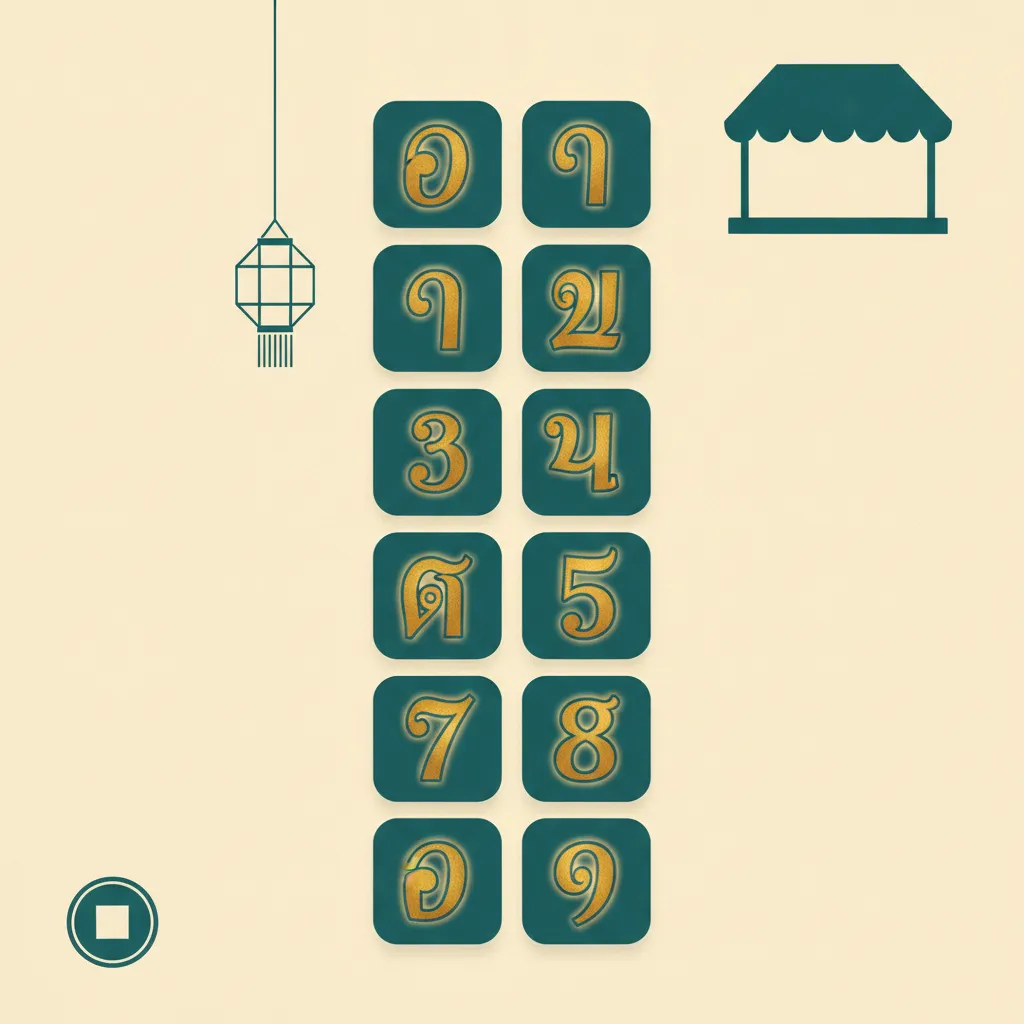
Here are all ten, with their value, the Thai number word, and a mnemonic to hang each shape on. Learn the shape first; the word can wait. Reading numerals is visual recognition, nothing more.
The Thai Numerals (๐–๙)
| Thai | Value | Number word (sound) | Hook for the shape |
|---|---|---|---|
| ๐ | 0 | ศูนย์(sǔun) | A small circle—same idea as our 0 |
| ๑ | 1 | หนึ่ง(nèung) | A single stroke with a curl on top |
| ๒ | 2 | สอง(sǎwng) | Looks like a cursive lowercase b |
| ๓ | 3 | สาม(sǎam) | A loop with a tail—like a backwards m on its side |
| ๔ | 4 | สี่(sìi) | A spiral, like a tiny seashell |
| ๕ | 5 | ห้า(hâa) | A circle sitting on a wavy base |
| ๖ | 6 | หก(hòk) | Like a lowercase b leaning back |
| ๗ | 7 | เจ็ด(jèt) | A hook—think of our 7 wearing a hat |
| ๘ | 8 | แปด(bpàet) | Two stacked loops, like our 8 |
| ๙ | 9 | เก้า(gâo) | A loop with a tail curling down-right |
Two pairs trip people up. ๔ (4) and ๕ (5) are the most often confused—๔ spirals inward like a shell, ๕ has an open circle on top. And ๒ (2) and ๖ (6) are near-mirror images, so notice which way the belly faces.
The place-value system is identical to the one you already use. Numbers run left to right, biggest place first, so ๒๐ is 20, ๑๕๐ is 150, and ๒๕๖๗ is 2567—which, in the Thai Buddhist calendar, is the year 2024. There’s no new arithmetic here. If you can read 150, you can read ๑๕๐ the moment you know the shapes.
Once those ten shapes click, you’ve started reading Thai script—the numerals share strokes and loops with the letters, so your eye is already warming up for the alphabet. The natural next step is to read your first real Thai word, no account needed. The same shape-to-sound logic that gets you from ๐ to ๙ is what the Read Thai course uses to carry you from the digits to real words.
Where You’ll Actually See Them
Thailand switched to Arabic numerals (0–9) for most everyday use decades ago, so you won’t see Thai digits on every price tag. But they persist in specific places—and those places tend to be exactly where reading them pays off.
Dual pricing
This is the one that matters most. Some attractions, national parks, and temples post two prices: a higher one for foreigners in Arabic numerals, and a lower local price in Thai numerals. The local rate isn’t a secret—it’s printed right there—it’s just written in a script the average visitor can’t read. ห้าสิบบาท(hâa sìp bàat) at ๕๐ next to a ฿200 foreigner sign is a common sight. You can’t always pay the local rate as a tourist, but you can at least see the gap, ask about it, and decide whether a place is worth it.
Lottery tickets
The government lottery (สลากกินแบ่ง(sà-làak gin bàeng)) is a national fixture, drawn on the 1st and 16th of each month. Ticket numbers and winning numbers are routinely shown in Thai numerals. If you ever buy one—or just want to follow the draw in a local paper—the digits are non-negotiable.
Addresses and house numbers
Older buildings, especially outside the big tourist zones, often have their house and soi (lane) numbers painted in Thai numerals. ซอย(sawy) ๗ is Soi 7. When you’re trying to find a guesthouse down an unmarked lane and the only number on the wall is ๑๑/๒, knowing it reads “11/2” saves a wrong turn.
Traditional and local restaurants
The more local the place, the more likely the handwritten menu, the table numbers, or the prices use Thai digits. Tourist-strip restaurants almost never do; the family noodle shop with three plastic stools sometimes does. It’s a small reading test that often signals you’ve found somewhere good.
Why Dual-Pricing Literacy Saves Money
The case for spending ten minutes on this is simple. Dual pricing is widespread at government-run attractions—national parks, major temples, museums—and the price difference is rarely small. Foreigner rates of five to ten times the local price are common at the headline sites.
Reading the Thai numeral doesn’t automatically get you the local rate; many places enforce the tourist price for non-residents, and that’s their right. What it gets you is information. You can see what locals pay, weigh whether the gap is fair for what’s on offer, and skip the spots that feel like pure markup in favor of the ones that don’t. Expats with long-stay visas or work permits can often pay the local rate by showing ID—but only if they noticed the local price existed in the first place. The ten shapes above are what turn an invisible second price into a visible one.
It also removes a daily friction. Squinting at a number you can’t parse, handing over whatever bill they point at, wondering if you read the total right—that goes away once ๐ through ๙ are automatic.
Quick Quiz: Can You Read These?
You just learned the ten shapes. Tap the right number for each — this is the exact recognition you’ll use on a menu or a temple sign.
Question 1 of 5
What number is this?
๕๐
๑๐๐
๗๗
๒๕๖๗
๔๒๐
— you just read Thai numerals straight off the script. That's real Thai writing, learned in one sitting.
The letters work the same way
You read the numerals by shape. The 44 letters are the same skill — plus the tone rule that tells you how to say each one. It's not memorizing combinations: two consonants, two vowels, and you're reading real words, learned in the order you meet them on signs.
Start the reading course →First 3 modules free — no card, and they don't expire.
If those came easily, the rest of the alphabet works the same way: shape-to-sound matching, learned in a sensible order. The numerals are just the start.
From Numbers to Words
Reading ๒๐ on a temple sign is useful on its own. It also shows you how the whole script works: match a shape to a value, build up from there. Once you can read the digits, reading the words on that same sign is a shorter leap than it looks.
When you want to take that step, try your first Thai characters free, no account needed—the same recognition skill, applied to letters. From there, the Read Thai course teaches every character in the order you actually meet it on signs and menus, with the tone rule behind each one, so you break free of romanization and read real Thai. If you’d rather pick which letters to tackle first, our guide on which Thai letters to learn first starts you on the highest-frequency ones, and the Thai numbers reference covers the spoken counting system when you’re ready for it.
Not ready to start? Grab the one-page Thai script cheatsheet and keep the numerals handy for your next trip.
Start reading Thai today
Thai numerals are the easiest on-ramp into Thai script — ten shapes, no tone rules, one sitting. The alphabet works the same way: every letter in the order you meet it on signs and menus, with the tone rule behind each. First three modules free — no card.
Start the reading course →First 3 modules free — no card, and they don't expire.
Frequently Asked Questions
Do Thai people still use Thai numerals?
Yes, but selectively. Most everyday prices, phone numbers, and digital displays use Arabic numerals (0–9), which Thailand adopted for general use long ago. Thai numerals (๐–๙) persist on official documents, dual-priced signs at government attractions, lottery tickets, older addresses, Buddhist-Era dates, and many traditional or handwritten contexts. You’ll see them often enough that the ten minutes it takes to learn them pays off.
How many Thai numbers do I need to learn to read prices?
Just ten symbols: ๐๑๒๓๔๕๖๗๘๙, matching 0 through 9. Thai uses the same place-value system you already know, so once you recognize the ten digits you can read any number—๑๕๐ is 150, ๒,๐๐๐ is 2,000. There’s no extra math to learn, only the ten shapes.
What is dual pricing in Thailand?
Dual pricing is the practice—common at government-run parks, temples, and museums—of charging foreigners a higher entry fee than Thai nationals. The foreigner price is often shown in Arabic numerals while the lower local price is written in Thai numerals, which most visitors can’t read. Learning the Thai digits lets you see both prices and decide whether a site is worth it.
Why is the Thai year different from the Western year?
Thailand uses the Buddhist Era (BE) calendar, which runs 543 years ahead of the Common Era (CE). So 2024 CE is written as ๒๕๖๗ (2567) BE. On Thai forms, signs, and newspapers, years appear in BE and frequently in Thai numerals—subtract 543 to get the Western year.