
Thai Coins and Banknotes: How to Read Thai Money
Tell Thai coins and banknotes apart on sight, read the Thai numerals printed on them, and learn the words Thais use for coin, note and change.
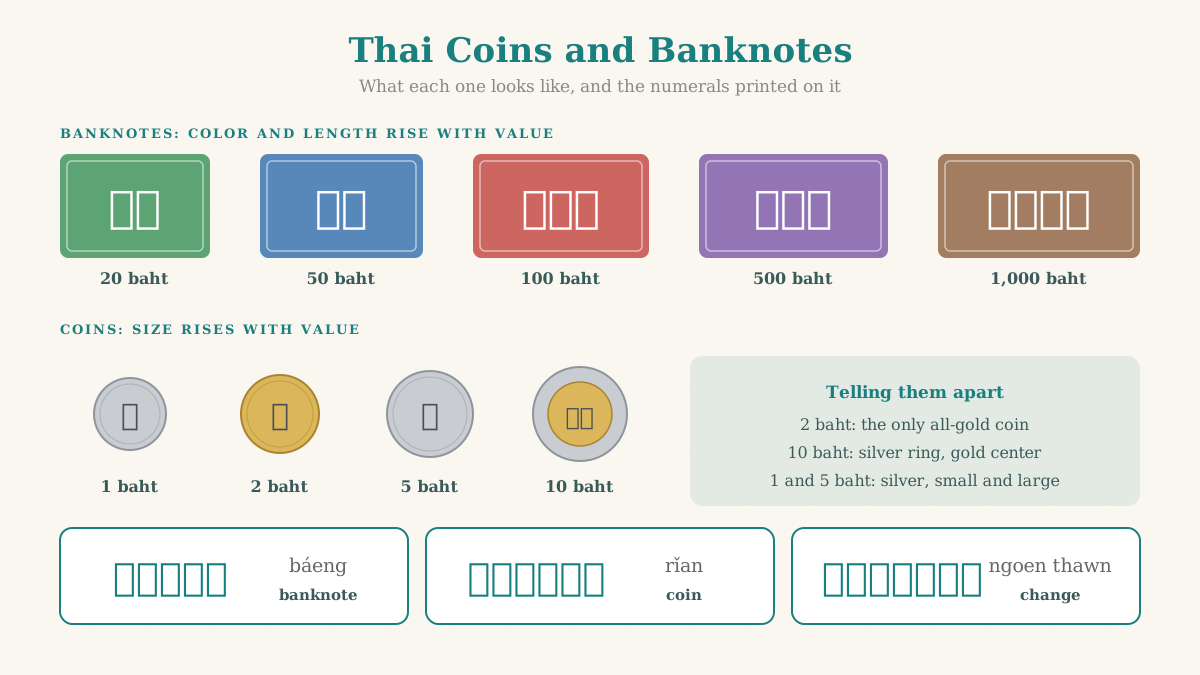
You’ve learned to say Thai numbers. Then a vendor hands you change and you’re holding a fistful of Thai coins and small notes, unsure which coin is 1 baht and which is 2, or whether that note is a 20 or a 50. Saying numbers and recognizing money are different skills. This guide covers the six coins and five banknotes you’ll handle, how to read the Thai printed on them, and the words Thais use for coin, note, and change.
Reading Thai Coins at a Glance
Six denominations show up in daily change. The two satang coins are the rarest: most prices are whole baht, so you’ll meet them mainly at supermarkets and chain stores.
The six coins in circulation
| Coin | Color | Size | How to spot it |
|---|---|---|---|
| 25 satang | Copper-colored (newer) or brass-colored (older) | Small | Rare outside supermarkets; marked ๒๕ สตางค์ |
| 50 satang | Copper-colored (newer) or brass-colored (older) | Small | Same use; marked ๕๐ สตางค์ |
| 1 baht | Silver-colored | 20 mm | The small plain silver coin |
| 2 baht | Gold-colored (2005 to 2007 coins are silver-colored) | 21.75 mm, slightly wider than 1 baht | Gold, all one color |
| 5 baht | Silver-colored | 24 mm | The biggest all-silver coin |
| 10 baht | Two-tone: silver-colored outer ring, gold-colored center | 26 mm, the largest and heaviest | Looks like a 2-euro coin |
The 1-baht and 2-baht coins are the pair people mix up first. When the 2-baht coin came back in 2005 it was silver-colored and only a little wider than the 1-baht coin. In 2008 the Treasury Department, which runs the Royal Thai Mint, said the redesigned coin would be gold-colored so people could tell it from the 1-baht coin more easily. So a small coin that is gold all the way through is 2 baht. Silver-colored 2-baht coins from 2005 to 2007 can still turn up, so if two silver coins look alike, read the number: ๑ is 1 and ๒ is 2.
The 10-baht coin needs no trick. Its silver-colored ring around a gold-colored center makes it the fastest coin in Thailand to pick out.
Reading Thai Banknotes at a Glance
Banknotes are easier, because each value has its own color and its own length. The current notes (Series 17, issued from 2018) kept the colors and sizes of the series before them, so the same check works on older notes.
The five banknotes in circulation
| Value | Color | Length | Material (2026) |
|---|---|---|---|
| 20 baht | Green | 138 mm | Polymer |
| 50 baht | Blue | 144 mm | Polymer (paper ones still circulate) |
| 100 baht | Red | 150 mm | Polymer (paper ones still circulate) |
| 500 baht | Purple | 156 mm | Paper |
| 1,000 baht | Brown | 162 mm | Paper |
Every note is 72 mm tall and each step up in value adds 6 mm of length, so a 1,000-baht note is visibly longer than a 20 when you lay them together. Color is the faster check in a dim taxi or a crowded market. The printed number confirms it.
The Thai Numerals and Words Printed on Money
Thai money prints each value twice: once in the Arabic numerals you know and once in Thai numerals. You can pay for a whole trip without the Thai set, but it is the easiest Thai reading practice you’ll ever carry around, because every note and coin uses the same four digit shapes: ๐ (0), ๑ (1), ๒ (2), and ๕ (5).
Thai numerals on banknotes
| Printed | Value | Thai word | Romanization |
|---|---|---|---|
| ๒๐ | 20 | ยี่สิบ | yîi sìp |
| ๕๐ | 50 | ห้าสิบ | hâa sìp |
| ๑๐๐ | 100 | หนึ่งร้อย | nèung ráwi |
| ๕๐๐ | 500 | ห้าร้อย | hâa ráwi |
| ๑๐๐๐ | 1,000 | หนึ่งพัน | nèung phan |
Coins add the unit in Thai script. A 5-baht coin reads ๕ บาท 5: the Thai numeral, the word บาท(bàat), then the Arabic numeral. The two small coins read ๒๕ สตางค์ and ๕๐ สตางค์, with สตางค์(sà-dtaang) in place of baht. Coins also carry the country name, ประเทศไทย(bprà-thêet thai), and the letters พ.ศ. followed by the year they were minted. That year is in the Buddhist Era, which runs 543 years ahead of the Western calendar.
All ten numerals, with menus and bills to practice on, are in How to Read Thai Numbers ๑๒๓ (Menus & Bills).
Rama IX or Rama X? Two Series in One Wallet
Thai coins and notes carry a king’s portrait on the front. Money issued since 2018 shows King Maha Vajiralongkorn (Rama X). Older coins and notes show King Bhumibol Adulyadej (Rama IX), and plenty of them are still in circulation. The Bank of Thailand states that earlier banknote series remain legal tender, and the Treasury Department issued the 2018 coins to be used alongside the older ones.
The back tells you the series at a glance.
Banknotes. Current notes show two kings of the Chakri dynasty on the back, in order of reign:
- 20 baht: Rama I and Rama II
- 50 baht: Rama III and Rama IV
- 100 baht: Rama V and Rama VI
- 500 baht: Rama VII and Rama VIII
- 1,000 baht: Rama IX and Rama X
The Rama IX notes you are most likely to meet (Series 16) show a statue or monument of an earlier Thai king on the back, such as King Ramkhamhaeng on the 20 and King Chulalongkorn (Rama V) on the 1,000.
Coins. Coins minted since 2018 have Rama X on the front and his royal cypher, the letters วปร under a crown, on the back. The front also reads รัชกาลที่ ๑๐, “the tenth reign”. The older Rama IX coins show a temple on the back instead:
- 25 satang: Wat Phra Mahathat, Nakhon Si Thammarat
- 50 satang: Wat Phra That Doi Suthep, Chiang Mai
- 1 baht: Wat Phra Kaew, Bangkok
- 2 baht: the Golden Mount at Wat Saket, Bangkok
- 5 baht: Wat Benchamabophit, Bangkok
- 10 baht: Wat Arun, Bangkok
So a coin with a temple on the back has Rama IX on the front, and a coin with the cypher has Rama X.
A 2026 update: the 20-baht note has been polymer since March 24, 2022, and polymer 50-baht and 100-baht notes followed on November 21, 2025, with the same design as the paper ones. The Bank of Thailand says polymer resists moisture and dirt and lasts about four times as long as paper. If your 50 or 100 feels smooth and plasticky, it is the current note. The paper versions are still legal tender.
The Words for Money You Need
Numbers get you through a purchase. These words cover everything around the numbers.
Money vocabulary beyond the numbers
| Thai | Romanization | Meaning |
|---|---|---|
| เหรียญ | rǐan | Coin; also the word you count coins with |
| แบงก์ | báeng | Banknote (everyday word) |
| ธนบัตร | thá-ná-bàt | Banknote (formal: signs, news, the bank) |
| ใบ | bai | Classifier for banknotes: แบงก์ 2 ใบ = two notes |
| เงินทอน | ngoen thawn | Change (money returned to you) |
| แบงก์ย่อย | báeng yâwi | Small notes |
| เศษสตางค์ | sèet sà-dtaang | Loose change, small coins |
| ตังค์ | dtang | Money (casual, short for สตางค์) |
แบงก์(báeng) comes from English “bank note”. The spelling carries no tone mark, so the tone rules predict a mid tone, but in speech the word takes a high tone, as many English loanwords do. On signs and in the news you’ll see the formal word instead: ธนบัตร(thá-ná-bàt).
Thais name a note by its number: แบงก์ยี่สิบ(báeng yîi sìp), แบงก์ร้อย(báeng ráwi), แบงก์พัน(báeng phan). Now and then you’ll hear a color in place of the number, such as แบงก์แดง(báeng daeng) or แบงก์ม่วง(báeng mûang), but the number is the default and the one to learn. To count notes, add the classifier ใบ(bai): แบงก์ร้อยสองใบ(báeng ráwi sǎwng bai). Thai Classifiers: The 20 You Actually Need explains the pattern.
Coins work the same way. Put the number after เหรียญ(rǐan): เหรียญสิบ(rǐan sìp), เหรียญห้า(rǐan hâa), เหรียญบาท(rǐan bàat). The word is its own classifier, so three coins is สามเหรียญ(sǎam rǐan) and three 5-baht coins is เหรียญห้าสามเหรียญ(rǐan hâa sǎam rǐan).
sà-dtaangสตางค์satang; also money in generalสตางค์(sà-dtaang) names the hundredth of a baht, but it also means money in general. ไม่มีสตางค์(mâi mii sà-dtaang) has nothing to do with satang coins. In casual speech the word shrinks to ตังค์(dtang), and ไม่มีตังค์(mâi mii dtang) is the version you’ll hear most.
A 1,000-baht note is awkward at a street stall or in a taxi. Ask for small notes before you need them:
mii báeng yâwi mǎiมีแบงก์ย่อยไหมDo you have small notes?To get a big note broken, ask แตกแบงก์พันได้ไหม(dtàek báeng phan dâai mǎi). Add ครับ(khráp) or คะ(khá) at the end.
What ถ้วน Means on a Receipt
One written habit is worth knowing before you read a Thai receipt, invoice, or cheque. When an amount is spelled out in words, Thai adds ถ้วน(thûan) after it: ห้าสิบบาทถ้วน(hâa sìp bàat thûan) means fifty baht and no satang. It says nothing about change. Hand over a 100 for a bill of ห้าสิบบาทถ้วน and you still get 50 back. Price tags often show the same idea as a dash after the number: “50.-” in place of “50.00”.
Cashiers don’t say ถ้วน aloud; they say the number and บาท. If you already know how Thai numbers work past 1,000 for rent and salary figures, prices follow the same pattern at a smaller scale.
Common Mistakes
Trusting color alone for 1 baht and 2 baht. Gold means 2 baht, but silver does not always mean 1 baht: silver-colored 2-baht coins from 2005 to 2007 can still turn up. When two silver coins look alike, read ๑ or ๒ on the back.
Treating a polymer note as fake because it feels like plastic. The 20-, 50-, and 100-baht notes are now issued in polymer. A smooth, plasticky 50 or 100 is current money.
Refusing a coin or note because the portrait is different. Rama IX coins and notes are older, not invalid. Shops take both series.
Stopping a rolling coin with your foot. It is a reflex in many countries. In Thailand, pick the coin up by hand.
Confusing เงินทอน with money in general. เงิน(ngoen) alone means money. เงินทอน(ngoen thawn) means the money handed back to you after you pay. The loose coins in your pocket are เศษสตางค์(sèet sà-dtaang).
Frequently Asked Questions
What are Thai coins made of?
None contain precious metal. Current 1-baht coins are nickel-plated steel, 5-baht coins are cupronickel over a copper core, and the gold-colored 2-baht coin is aluminium bronze. The 10-baht coin is bi-metallic: a silver-colored cupronickel outer ring around a gold-colored aluminium bronze center. Newer 25- and 50-satang coins are copper-plated steel, and older ones are brass-colored aluminium bronze.
How do I tell a 1-baht coin from a 2-baht coin?
Check the color first. Since the 2008 redesign the 2-baht coin is gold-colored, and the 1-baht coin is silver-colored. The Treasury Department said in 2008 that it chose gold so people could tell the two apart more easily. Silver-colored 2-baht coins from 2005 to 2007 can still turn up, so if two silver coins look alike, read the number: ๑ is 1 and ๒ is 2. The 2-baht coin is also slightly wider.
What’s pictured on the back of Thai coins and banknotes?
It depends on the series. Current banknotes, issued from 2018, show two kings of the Chakri dynasty in order of reign: Rama I and II on the 20, Rama III and IV on the 50, Rama V and VI on the 100, Rama VII and VIII on the 500, and Rama IX and Rama X on the 1,000. Coins minted since 2018 show King Rama X’s royal cypher under a crown. Older coins with King Rama IX on the front show a temple on the back, such as Wat Arun on the 10-baht coin and the Golden Mount at Wat Saket on the 2-baht coin.
How can I quickly tell Thai banknotes apart?
Color is the fastest check: 20 baht is green, 50 is blue, 100 is red, 500 is purple, and 1,000 is brown. Notes also get longer as the value rises, from 138 mm for the 20 to 162 mm for the 1,000. To confirm, read the number, which is printed in both Arabic and Thai numerals (๒๐, ๕๐, ๑๐๐, ๕๐๐, ๑๐๐๐). In speech, Thais usually name a note by its number, such as แบงก์ร้อย for a 100-baht note.
Are older Thai coins and notes with King Rama IX still valid?
Yes. The Bank of Thailand states that earlier banknote series remain legal tender, and the coins issued in 2018 with King Rama X’s portrait are used alongside the older King Rama IX coins. You will get both in change, and shops accept both.
Why do some Thai banknotes feel like plastic?
Thailand has moved its most-used banknotes to polymer. The 20-baht note switched on March 24, 2022, and polymer 50-baht and 100-baht notes followed on November 21, 2025. They keep the same design as the paper notes. The Bank of Thailand says polymer resists moisture and dirt and lasts about four times as long as paper.
Recognize It, Then Say It
Recognizing a coin or a note on sight is what makes paying feel routine. It comes from repetition, the same way it did with the money you grew up with: you stopped reading the number on a coin years ago. A week of handling baht, checking ๒๐ against 20 and ๑๐๐ against 100, gets you most of the way.
The spoken half takes longer, because a cashier naming a price or a friend asking to borrow ร้อยนึง(ráwi neung) won’t wait for you to translate. Speak Thai drills phrases like these with natural-speed and slowed audio. See how Jam Kham works for travelers.
Related reading: How to Read Thai Numbers ๑๒๓ (Menus & Bills) | How to Bargain in Thai: A Step-by-Step Market Guide | Big Numbers in Thai: Rent, Salaries, and Phone Numbers | Thai Numbers for Travelers
See how Thai reading actually works
Sound out your first Thai word →No account, no card — just the alphabet.
Start reading Thai today
Start the reading course →First 3 modules free — no card, and they don't expire.