
Thai Classifiers: The 20 You Actually Need
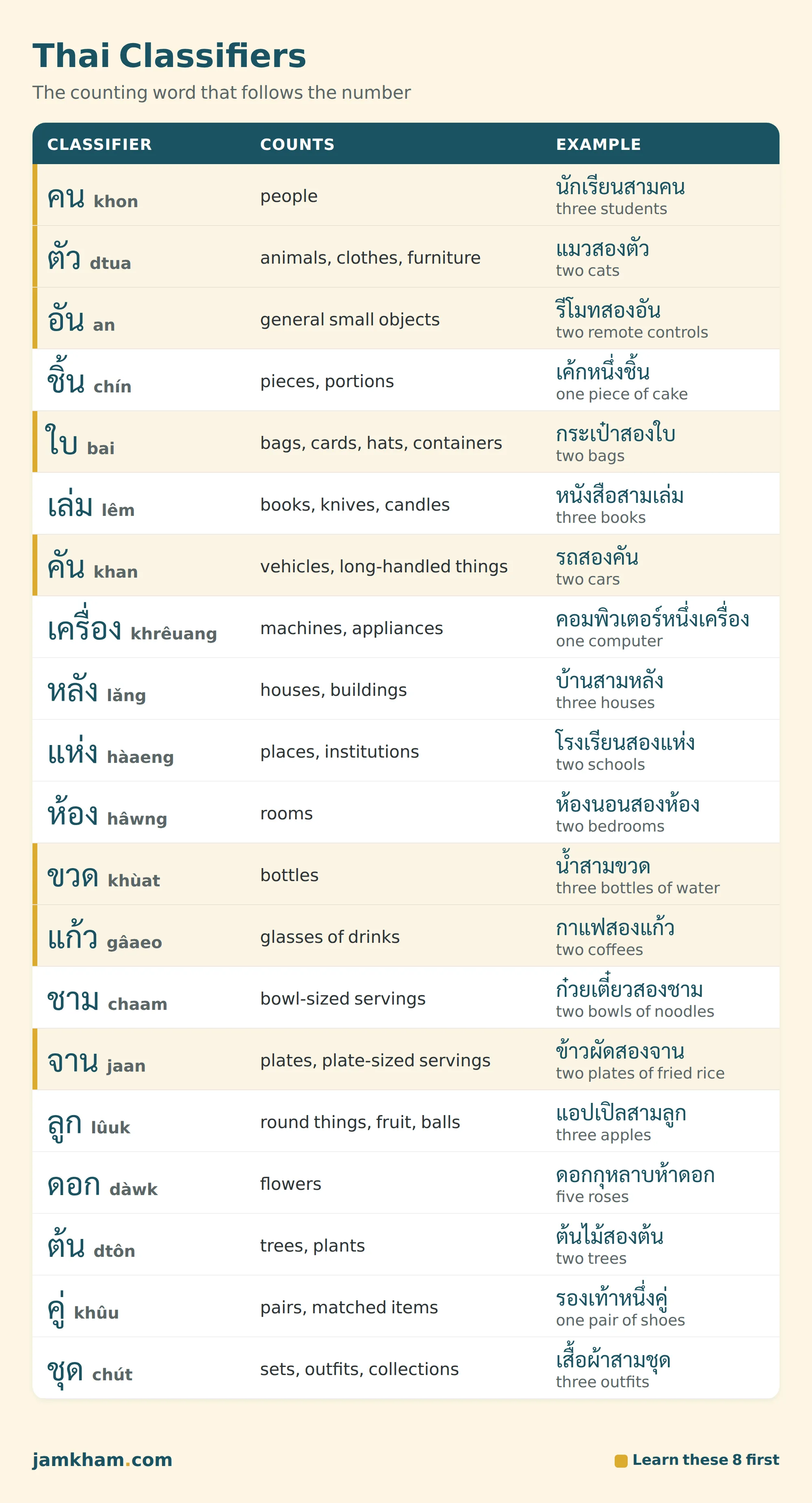
Thai classifiers are the counting words that follow a number. Here are the 20 that cover most everyday situations, plus the pattern and the fallbacks.
You order two coffees in Thai, and it comes out as กาแฟสอง(gaa-fae sǎwng). The barista waits. Something is missing, and you can hear that it is missing, but you have no idea what.
The missing word is a classifier. Thai will not let a number sit next to a noun on its own — there has to be a counting word in between, and which one you use depends on what you are counting. Coffee in a glass takes แก้ว(gâeo). Coffee in a packet takes ซอง(sawng). Coffee as a plant takes ต้น(dtôn).
This is the part of Thai grammar that has no English parallel, which is why it feels arbitrary for the first week and obvious after the first month. This guide covers the pattern, the 20 classifiers that do most of the work, the specific ones people search for most, and what to say when you forget.
If you are still working on the numbers themselves, start with how to read Thai numbers — classifiers only make sense once counting is automatic.
What Is a Classifier in Thai?
A Thai classifier (ลักษณนาม(lák-sà-nà-naam)) is a counting word that goes after the number when you quantify a noun. English has a few of these — “three sheets of paper”, “two head of cattle”, “a pair of shoes” — but they are optional decoration. In Thai they are compulsory for almost every countable noun.
The reason is structural. Thai nouns do not mark plural. หนังสือ(nǎng-sěu) is both “book” and “books”, and the word never changes. The classifier is what makes an uncounted mass into countable units.
Practically, that means classifiers show up constantly: ordering food, buying tickets, asking a price, telling a taxi how many people are getting in. There is no way to route around them, which is why they are worth front-loading in your Thai language learning plan rather than saving for “grammar later”.
The Counting Pattern
The default order is:
Noun + Number + Classifier
maeo sǎwng dtuaแมวสองตัวtwo catsRead literally, that is “cat two dtua”. The noun comes first, the number second, the classifier last. Once you have that shape, most of the work is vocabulary.
Two patterns break the default, and both are common enough that you will hear them on day one.
Counting one thing
With the number one, the natural order flips: Noun + Classifier + หนึ่ง(nèung).
bia khùat nèungเบียร์ขวดหนึ่งone bottle of beerbia nèung khùatเบียร์หนึ่งขวดone bottle of beer (also correct) is grammatical and everyone understands it, but it sounds slightly more formal or emphatic — closer to “one single bottle”. In a bar, use the first one.
Two things to expect. In speech, หนึ่ง(nèung) almost always reduces to นึง(neung) — เบียร์ขวดนึง(bia khùat neung) is what you will actually hear. And you will still see Number + Classifier order in written Thai, on menus, and in set phrases, so both orders appear in the tables below.
Pointing at something
When you say “this one” or “that one”, the number drops out: Noun + Classifier + นี้(níi) / นั้น(nán).
sêua dtua níiเสื้อตัวนี้this shirt bâan lǎng nánบ้านหลังนั้นthat houseIf you do need a number as well, it goes back in its usual slot: เสื้อสองตัวนี้(sêua sǎwng dtua níi).
This is the single most useful classifier pattern for travellers, because it turns pointing into a sentence. Combine it with market and shopping phrases and you can buy almost anything.
Asking how many
To ask “how many”, put กี่(gìi) in the number’s slot and keep the classifier: Noun + กี่ + Classifier.
mii nǎng-sěu gìi lêmมีหนังสือกี่เล่มhow many books are there?The answer reuses the same classifier — สามเล่ม(sǎam lêm). At a market stall you will hear the short version aimed at you: เอากี่ลูก(ao gìi lûuk).
20 Thai Classifiers You’ll Actually Use
These 20 cover the overwhelming majority of everyday situations. If you are packing for a trip, the eight that earn their place first are คน(khon), ตัว(dtua), อัน(an), ใบ(bai), คัน(khan), ขวด(khùat), จาน(jaan), and แก้ว(gâeo). The rest fill in as you meet them.
| Classifier | Romanization | Commonly used for | Example |
|---|---|---|---|
| คน | khon | people | นักเรียนสามคน — three students |
| ตัว | dtua | animals, clothing, furniture, letters | แมวสองตัว — two cats |
| อัน | an | general small objects, miscellaneous items | รีโมทสองอัน — two remote controls |
| ชิ้น | chín | pieces, portions, individual items | เค้กหนึ่งชิ้น — one piece of cake |
| ใบ | bai | flat or container-like things: leaves, cards, bags, hats | กระเป๋าสองใบ — two bags |
| เล่ม | lêm | books, notebooks, knives, candles | หนังสือสามเล่ม — three books |
| คัน | khan | vehicles and long-handled objects | รถสองคัน — two cars |
| เครื่อง | khrêuang | machines, appliances, electronic devices | คอมพิวเตอร์หนึ่งเครื่อง — one computer |
| หลัง | lǎng | houses and buildings | บ้านสามหลัง — three houses |
| แห่ง | hàeng | places, institutions, locations | โรงเรียนสองแห่ง — two schools |
| ห้อง | hâwng | rooms | ห้องนอนสองห้อง — two bedrooms |
| ขวด | khùat | bottles and bottled products | น้ำสามขวด — three bottles of water |
| แก้ว | gâeo | glasses or cups of drinks | กาแฟสองแก้ว — two cups of coffee |
| ชาม | chaam | bowl-sized servings of food | ก๋วยเตี๋ยวสองชาม — two bowls of noodles |
| จาน | jaan | plates or plate-sized servings | ข้าวผัดสองจาน — two plates of fried rice |
| ลูก | lûuk | round objects, fruit, balls | แอปเปิลสามลูก — three apples |
| ดอก | dàwk | flowers | ดอกกุหลาบห้าดอก — five roses |
| ต้น | dtôn | trees and plants | ต้นไม้สองต้น — two trees |
| คู่ | khûu | pairs, couples, matched items | รองเท้าหนึ่งคู่ — one pair of shoes |
| ชุด | chút | sets, outfits, collections | เสื้อผ้าสามชุด — three outfits |

How Thai Classifiers Group the World
Once you have a couple of dozen in your head, the system stops looking like a random list and starts looking like three overlapping groups.
General-purpose classifiers
อัน(an) is the one that catches everything else. Keys, remote controls, tools, oddly shaped souvenirs, anything you can hold in one hand and cannot categorise fast enough. Native speakers reach for it too, so using it is not a foreigner tell.
ชิ้น(chín) plays a similar role for anything cut from a larger whole: a slice of cake, a piece of chicken, a fragment of something broken.
Shape and category classifiers
Most of the list groups nouns by a physical property rather than a semantic one, which is why the categories look strange until you see the shape behind them.
- คัน(khan) is not really “vehicles” — it is things with a shaft or handle. That is why cars, motorbikes, umbrellas, spoons, and fishing rods all share it.
- ใบ(bai) started as “leaf” and grew to cover things that are flat or leaf-like or hold something: paper, tickets, bank cards, bags, hats, plates as objects.
- เล่ม(lêm) covers books, knives, and candles, which sounds like nonsense until you picture the shape: a slim thing with a spine or a blade.
- ลูก(lûuk) is roundness — fruit, balls, mountains, hills.
Nouns that classify themselves
A handful of nouns act as their own classifier, so the word appears twice.
hâwng-nawn sǎwng hâwngห้องนอนสองห้องtwo bedroomsThis looks like a mistake to English speakers and it is not. Rooms, trees (ต้น(dtôn)), and people (คนสองคน(khon sǎwng khon)) all work this way. When you are unsure whether a noun has its own classifier, repeating the noun is a decent guess.
Units of measure and time go one step further and skip the classifier entirely, taking the number directly: สามวัน(sǎam wan), สองชั่วโมง(sǎwng chûa-mong), ห้ากิโล(hâa gi-loh), สิบบาท(sìp bàat). The unit is already doing the classifier’s job, so วันสามวัน(wan sǎam wan) is wrong. Travellers hit บาท(bàat) and วัน(wan) long before they hit most of the table above.
See how Thai reading actually works
Classifiers stick faster once you can read them. Sound out your first Thai word in about a minute — no account, no card.
Sound out your first Thai word →No account, no card — just the alphabet.
Which Classifier for…?
The questions people actually search for, answered directly.
Bowls. Three answers, depending on what you mean. A bowl-sized serving of food takes ชาม(chaam) — ก๋วยเตี๋ยวสองชาม(gǔay-dtǐao sǎwng chaam), which is what you say at a noodle stall. A smaller, cup-sized serving takes ถ้วย(thûai) — ข้าวต้มหนึ่งถ้วย(khâao-dtôm nèung thûai), and the same word covers desserts, dipping sauce, and hot drinks. The physical bowl as an object takes ใบ(bai) — ชามสองใบ(chaam sǎwng bai).
The same split applies to coffee: กาแฟสองแก้ว(gaa-fae sǎwng gâeo) for the glass it comes in, กาแฟสองถ้วย(gaa-fae sǎwng thûai) for a hot cup.
Cars. คัน(khan) — รถสองคัน(rót sǎwng khan). Same for motorbikes, bicycles, and taxis.
Eggs. ฟอง(fawng) — ไข่สามฟอง(khài sǎam fawng). It sits in the second table below rather than the core 20, but it is worth memorising early because you will use it at every breakfast stall.
Scoops. Scoops of ice cream take ลูก(lûuk) — ไอศกรีมสองลูก(ai-sà-griim sǎwng lûuk). A spoonful of something is ช้อน(cháwn).
Trees. ต้น(dtôn) — ต้นไม้สองต้น(dtôn-máai sǎwng dtôn). Also covers potted plants and shrubs.
Hats. ใบ(bai) — หมวกสองใบ(mùak sǎwng bai). Hats sit in the “container” branch of ใบ(bai), alongside bags and cups.
Tubes. หลอด(làwt) — ยาสีฟันหนึ่งหลอด(yaa-sǐi-fan nèung làwt). Also drinking straws, which are themselves called หลอด(làwt).
Thirteen More Worth Knowing
Once the core 20 are solid, these are the ones that come up next. The last two count things that are not objects at all.
| Classifier | Romanization | Used for | Example |
|---|---|---|---|
| ที่ | thîi | servings, orders, seats | ข้าวผัดสองที่ — two orders of fried rice |
| ฟอง | fawng | eggs | ไข่สามฟอง — three eggs |
| ถ้วย | thûai | cup-sized servings: soup, dessert, hot drinks | ข้าวต้มหนึ่งถ้วย — one cup of rice porridge |
| หลอด | làwt | tubes, straws | ยาสีฟันหนึ่งหลอด — one tube of toothpaste |
| แผ่น | phàen | flat sheets: paper, CDs, tiles | กระดาษสองแผ่น — two sheets of paper |
| ผืน | phěun | cloth: towels, blankets, mats | ผ้าเช็ดตัวสองผืน — two towels |
| ดวง | duang | stamps, stars, lights, hearts | แสตมป์สามดวง — three stamps |
| ก้อน | gâwn | lumps: ice, sugar, rocks, soap | น้ำแข็งสองก้อน — two ice cubes |
| ซอง | sawng | envelopes, sachets, packets | ยาสองซอง — two sachets of medicine |
| ท่าน | thâan | people you are showing respect to | ผู้ใหญ่สองท่าน — two senior people |
| องค์ | ong | Buddha images, sacred objects, revered monks | พระพุทธรูปหนึ่งองค์ — one Buddha image |
| ฉบับ | chà-bàp | documents, letters, newspapers | จดหมายสองฉบับ — two letters |
| ครั้ง | khráng | times, occurrences — for actions, not objects | ไปสามครั้ง — went three times |
What Happens If You Get It Wrong
You get understood. That is the honest answer, and it is worth internalising early, because fear of classifier errors keeps people silent far longer than the errors themselves cost them.
The number and the noun already carry the meaning. If you say กาแฟสองอัน(gaa-fae sǎwng an), you will get two coffees. It sounds off — roughly like “two of coffee” in English — but nobody is confused.
Three fallbacks, in order of usefulness:
- Use อัน(an). It is the accepted catch-all for small objects and no one will hold it against you.
- Repeat the noun. If a noun is its own classifier you are correct, and if it is not you are close enough to be understood.
- Point and say the number. เอาสองอัน(ao sǎwng an) plus a gesture works everywhere, and it reinforces fallback #1 at the same time.
How to Actually Learn Them
Classifier lists are easy to read and hard to retain, because reading a table is recognition and using a classifier is production. You do not need to recognise เล่ม(lêm) — you need to produce it, unprompted, while a vendor is waiting.
Three things that work:
Learn the classifier with the noun, never separately. Store หนังสือ(nǎng-sěu) as “book → เล่ม(lêm)” from the first exposure. Retrofitting classifiers onto vocabulary you already know is roughly twice the work.
Drill noun-to-classifier as a question, not a list. “What is the classifier for a motorbike?” is a retrieval prompt. Reading a table is not. This is the active recall distinction, and for classifiers it matters more than for most vocabulary, because the whole skill is producing the right word under time pressure.
Practise in phrases with real numbers. ขอน้ำสองขวด(khǎw náam sǎwng khùat) is a sentence you will use. ขวด(khùat) in isolation is trivia. Attach every classifier to something you would actually say, ideally from ordering food or shopping, where they occur densely.
Jam Kham’s spaced repetition system treats classifier matching as its own card type for exactly this reason: nouns get drilled with a “which classifier?” prompt, separately from meaning and pronunciation, so you build the pairing as a reflex instead of a lookup.
Q&A
Question: What is a classifier in Thai?
Short answer: A counting word that goes after the number when you quantify a noun.
Thai does not attach numbers directly to nouns the way English does. Instead of “three books” you say หนังสือสามเล่ม(nǎng-sěu sǎam lêm), literally “book three lêm”, where เล่ม(lêm) is the classifier used for books.
Almost every countable Thai noun has a classifier that matches its category or shape, and roughly 20 cover most everyday conversation.
Question: What is the word order for counting in Thai?
Short answer: Noun + Number + Classifier.
แมวสองตัว(maeo sǎwng dtua) is “cat two dtua”. Two things break that order. With the number one, Thai speakers usually say Noun + Classifier + หนึ่ง(nèung), so เบียร์ขวดหนึ่ง(bia khùat nèung) is the natural way to order a beer.
And with “this” or “that”, the number drops out: Noun + Classifier + นี้(níi) / นั้น(nán), as in เสื้อตัวนี้(sêua dtua níi). If you do need a number it goes back in its usual slot — เสื้อสองตัวนี้(sêua sǎwng dtua níi).
Question: What is the classifier for eggs in Thai?
Short answer: ฟอง(fawng) — ไข่สามฟอง(khài sǎam fawng).
ฟอง(fawng) literally means “bubble” and covers eggs and bubbles — ฟองสบู่(fawng-sà-bùu) — not rounded objects generally. It is the form you will see on menus and in markets. You will occasionally hear ลูก(lûuk) or ใบ(bai) used for eggs in casual speech, and both are understood, but ฟอง(fawng) is the standard.
Question: What is the classifier for cars in Thai?
Short answer: คัน(khan) — รถสองคัน(rót sǎwng khan).
คัน(khan) covers vehicles generally, including motorbikes, bicycles, and taxis, and it also covers a surprising second group: long-handled objects. Spoons, forks, umbrellas, and fishing rods all take คัน(khan).
The shared logic is the handle or shaft, not the wheels.
Question: What is the classifier for trees in Thai?
Short answer: ต้น(dtôn) — ต้นไม้สองต้น(dtôn-máai sǎwng dtôn).
ต้น(dtôn) means “trunk” or “stalk” and covers trees, plants, and shrubs. It is one of several Thai nouns that double as their own classifier, so the word appears twice in the sentence — that repetition is correct, not a mistake.
Question: What happens if you use the wrong Thai classifier?
Short answer: You will still be understood.
Classifier errors mark you as a learner, but they rarely block meaning, because the number and the noun already carry the information. If you blank on the right one, อัน(an) is the general-purpose fallback for small objects and native speakers use it that way too. Pointing and saying the number also works.
Getting classifiers wrong is a much smaller problem than getting tones wrong.
Question: How many Thai classifiers do you need to learn?
Short answer: About 20 for everyday situations, and around 8 to get through a first trip.
คน(khon) for people, ตัว(dtua) for animals, อัน(an) for miscellaneous objects, ใบ(bai) for bags and containers, คัน(khan) for vehicles, ขวด(khùat) for bottles, จาน(jaan) for plates, and แก้ว(gâeo) for glasses will carry most restaurant, shop, and taxi conversations.
Thai has well over a hundred classifiers in total, but the long tail is specialised and you can learn it as you meet it.
Related reading: Thai Grammar Guide | How to Read Thai Numbers | Thai Language Basics
Start reading Thai today
Reading Thai turns classifiers from sounds you half-catch into words you can see on a menu. The first three modules of Read Thai are free — no card.
Start the reading course →First 3 modules free — no card, and they don't expire.