
Understanding the Basics of Thai Language
A beginner's guide to Thai: the five tones, the 44-letter script, grammar that's simpler than English, and polite phrases to start speaking with respect.

Thai runs on five tones, a 44-letter script, and grammar that’s simpler than English in almost every way that matters. Whether you’re planning a trip to Bangkok, moving to Chiang Mai for work, or just curious how the language works, this guide covers what you need to get started: the tones, the script, the grammar, and how to structure your practice so it sticks.
Can you teach yourself Thai? Yes. The unfamiliar script and the tonal system are real obstacles, but with the right approach and consistent daily practice, they’re obstacles you clear — not a wall that keeps out anyone without a gift for languages.
Why Dive Into the Language of Smiles?
Speaking even basic Thai changes how people treat you — you go from being handled like a tourist to being met as a guest who made the effort. That’s true whether you’re ordering food, negotiating a taxi fare, or greeting a neighbor. (Thailand was called Siam until 1939, which is why older grammars and phrasebooks still say “Siamese.”)
Getting there starts with the foundations: the sounds, the script, and the grammar underneath everything else you’ll learn.
Start reading Thai today
Ready to start? The Read Thai course teaches the alphabet in the order you'll actually meet it, with the tone rule behind every letter. First three modules free — no card.
Start the reading course →First 3 modules free — no card, and they don't expire.
The Tonal System: Making Music with Words
One of the biggest initial hurdles for Western speakers is adjusting to a tonal language framework. To speak accurately and be understood, you must know how to master Thai tones. Thai features five distinct tones: mid, low, falling, high, and rising. The exact same syllable spoken with a different pitch or inflection carries a completely different meaning.
Consider the classic example of the syllable “maa.” Three of its five tones land on real, everyday words:
- maa (Mid Tone): come
- mǎa (Rising Tone): dog
- máa (High Tone): horse
The low (màa) and falling (mâa) tones are just as easy to say, but they don’t map to common standalone words here — which is why this trio, not a clean five-way set, is the classic example.
If you mix up a rising tone with a high tone, you might accidentally tell someone you are riding a dog instead of a horse!
When you first begin your studies, relying on Thai phonetic transcription systems — like the Paiboon system or the Royal Thai General System of Transcription — helps a lot. These romanized systems pair English letters with visual tone marks so you can read and pronounce words correctly before you’ve learned the native script.
Tips for Practicing Tones:
- Mid Tone: Spoken in your normal, flat speaking voice.
- Low Tone: Held low and steady at the bottom of your range — flat, not falling.
- Falling Tone: Starts high and drops sharply, like a sigh.
- High Tone: Pushed up to the top of your range and held there.
- Rising Tone: Starts low and goes up, similar to asking a question in English.

Cracking the Code: The Writing System
Phonetic transcription works for your first few weeks, but you’ll want to move to the real script before long. Thai script can look intimidating at first — it’s an abugida, where consonant-vowel sequences are written as a single unit and vowels can appear above, below, before, or after the consonant they belong to — but it’s a fixed, learnable system, not an arbitrary one.
Start with a Thai consonants and vowels chart: 44 consonants, 32 vowels, and three consonant classes — high, mid, and low. Memorizing which class a letter belongs to matters because that class decides the tone rules for the word you’re reading. Thai is written left to right, but unlike English, there are no spaces between words — only between sentences or clauses.
Flashcard apps like Anki, tracing worksheets, and mnemonic books that pair a letter’s shape with a drawing all help. For a full rundown, see best resources for Thai alphabet learning.
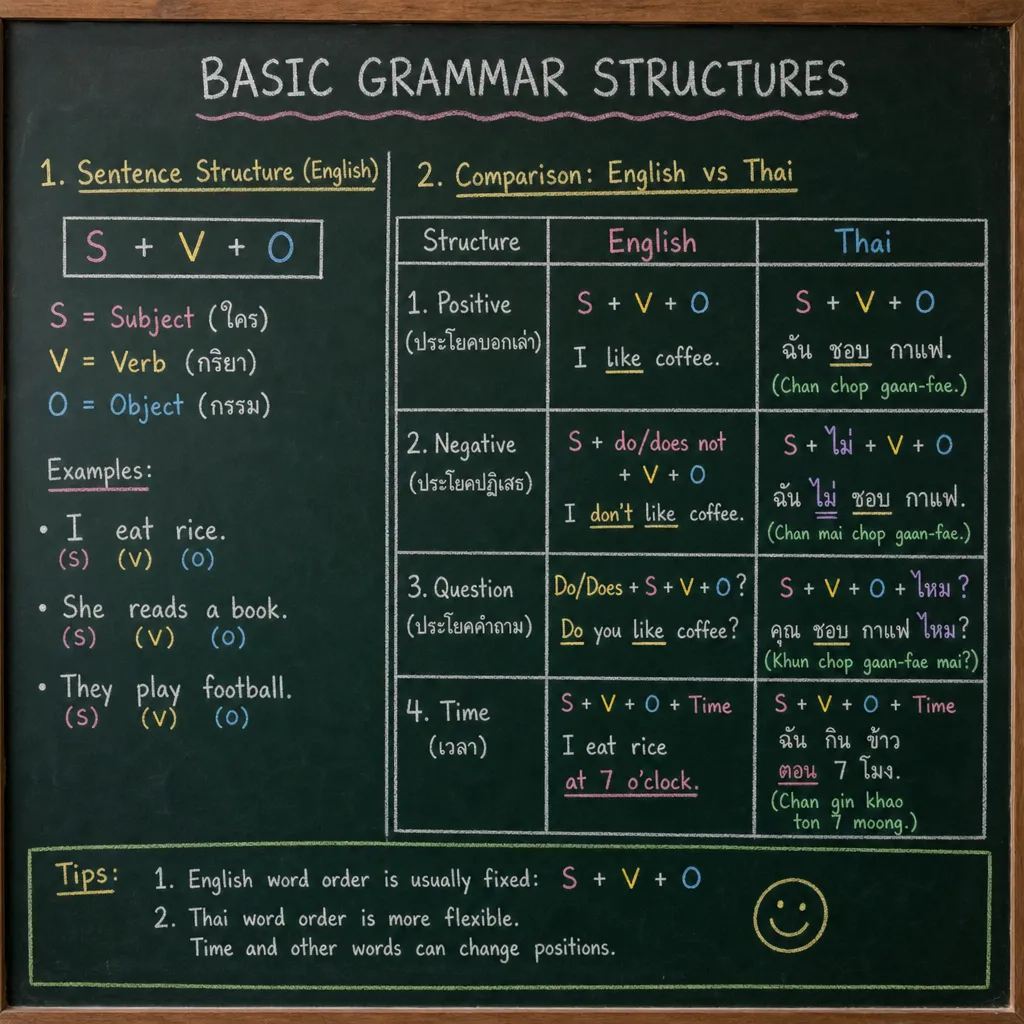
Thai Grammar: Simpler Than You Think
If the alphabet and the tones feel like enough to chew on, here’s the relief: Thai grammar is simple. Compare it to English and it’s mostly a list of things you get to skip.
- No verb conjugations: verbs never change with the subject. “I eat” is chǎn gin; “He eats” is khǎo gin. The verb gin stays the same either way.
- No tenses: there’s no past, present, or future form of a verb — you just add a time word. “I ate yesterday” is literally “I eat yesterday” (chǎn gin mûea-waan-níi).
- No articles or plurals: no “a,” “an,” or “the,” and nouns don’t take an “s” to go plural.
Word order is Subject-Verb-Object, same as English: phǒm (I — men say phǒm, women chǎn) châwp (like) maew (cats). The one flip is adjectives, which follow the noun instead of leading it — “hot tea” comes out as “tea hot” (chaa ráwn).
The one unfamiliar piece is numerical classifiers. You can’t just say “two dogs” — you need Noun + Number + Classifier: “dog two [animal classifier],” where the animal classifier is dtua, giving you mǎa sǎwng dtua. Learn the handful that cover most nouns — khon for people, bai for cups, leaves, tickets, and documents, khan for vehicles — and you’ll sound noticeably more natural.
Essential Politeness and Everyday Conversation
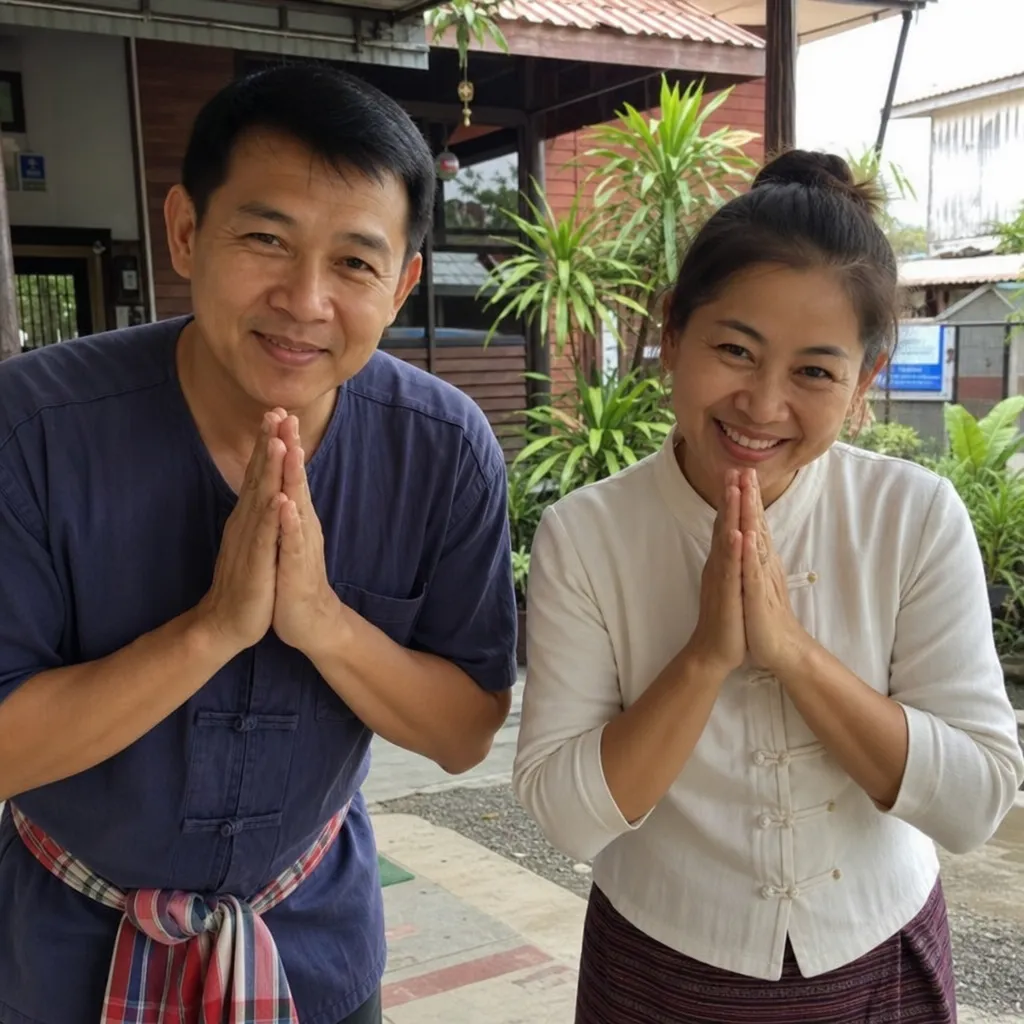
Thai culture puts real weight on respect and social hierarchy, and that shows up directly in how sentences end. See pronouncing Thai polite particles for the full system — the short version is that these tiny, untranslatable words get tacked onto the end of a sentence to soften it and show respect.
- Male speakers use khráp (often heard as “krub,” or shortened to “kap” in casual speech).
- Female speakers use khâ (falling tone for statements, high tone for questions).
- Use them consistently and you sound noticeably warmer and more respectful, even in short exchanges.
If you’re packing for a trip, a handful of phrases cover most situations — the full set is in common Thai phrases for travelers:
- Hello / goodbye: sà-wàt-dii (khráp/khâ)
- Thank you: khàwp khun (khráp/khâ)
- How much is this?: thâo rai (khráp/khâ)?
- Not spicy: mâi phèt — worth memorizing if you can’t handle Thai chilies
- Where is the restroom?: hâwng náam yùu thîi nǎi?
Once textbook phrases start feeling stiff, colloquial Thai slang and idioms is where the language gets fun. Mâi bpen rai — “no worries,” “it’s okay” — sums up a lot of the culture’s relaxed, forgiving attitude in three syllables. Sà-nùk means fun, and it does real work in daily life: if something isn’t sà-nùk, plenty of Thai people simply won’t do it. A little slang goes a long way toward sounding like you actually talk to people, not just recite a phrasebook.
See how Thai reading actually works
Want to see if it clicks before you commit? Sound out your first Thai character right now — no account, no card.
Sound out your first Thai word →No account, no card — just the alphabet.
Effective Strategies: How to Study Thai
Now that you know the mechanics, how do you actually study this so it sticks? A few strategies that hold up:
1. Consistency Over Intensity
Spending 20 to 30 minutes every single day engaging with the language is vastly superior to cramming for four hours on a Sunday. Utilize mobile language apps for vocabulary drills, but balance it by watching Thai television dramas (Lakorns) or listening to Thai pop music (T-Pop). Passive listening helps your brain get a feel for the natural rhythm and flow of the speech.
2. Consider Deep Immersion
If you have the flexibility, time, and budget, an immersion program — in Bangkok, Chiang Mai, or Phuket — can speed up progress fast. Total immersion strips away your safety net: it forces you to use the language in real time to buy groceries, haggle at the night market, and ask for directions. Surrounded by native speakers, your ear adapts faster than it ever could at home.
3. Set Measurable Goals
A concrete goal keeps motivation up when the learning curve feels steep. The CU-TFL — Chulalongkorn University’s Thai-language proficiency test for foreigners, run by its Sirindhorn Thai Language Institute — tests reading, listening, writing, and speaking. You don’t need to sit the exam to benefit from it; structuring your study around its skill areas is a reasonable way to make sure you’re not neglecting one skill for another.
4. Find a Dedicated Language Partner
Because speaking fluidly relies heavily on muscle memory in your mouth and vocal cords, find a native Thai speaker who is eager to learn English. Free language exchange platforms allow you to happily trade an hour of English conversation for an hour of Thai. This creates a perfect, low-pressure sandbox where you can practice those tricky falling and rising tones and receive immediate, gentle corrections from a native ear.

Build the Foundation, Then Keep Going
The tones and the alphabet are the hard part, and they’re hardest in the first month. The grammar is on your side after that, and so are Thai people — mispronounced tones get you corrected with a smile, not a wince, and any real effort to speak the language gets noticed.
Start with the five sounds, work through the alphabet by consonant class, and get your polite particles automatic. Everything after that — vocabulary, slang, faster reading — builds on a foundation that’s already in place.
Q&A
Question: Can I teach myself Thai?
Short answer: Yes. Anyone can learn Thai with consistent effort, the right approach, and practical resources. Start with a phonetic transcription system (e.g., Paiboon or RTGS) to get tones and pronunciation right, then transition to the Thai script. Build daily habits (20–30 minutes), balance drills with passive listening (Lakorns, T-Pop), set measurable goals (e.g., align with CU-TFL skill areas), and practice speaking with a language partner for real-time feedback.
Question: How do Thai tones work, and how can I practice them effectively?
Short answer: Thai has five tones—mid, low, falling, high, and rising—and the same syllable changes meaning with tone (e.g., “maa” can mean come, dog, or horse). Use romanized systems with tone marks early on, then train your ear and voice with these tips:
- Mid: neutral, flat voice.
- Low: deeper, slightly dropped pitch (chin down).
- Falling: start high, drop sharply (like a sigh).
- High: higher register (surprised tone).
- Rising: start low, glide up (question-like).
Consistent, mindful practice helps you avoid mix-ups like saying “riding a dog” instead of “riding a horse.”
Question: When should I switch from romanization to the Thai script, and what should I focus on first?
Short answer: Use phonetic transcription for the first few weeks, then move to the real script to progress. Begin with a full consonant and vowel chart (44 consonants, 32 vowels), and memorize each consonant’s class (High, Mid, Low) because class determines tone rules in reading. Remember that vowels can appear around the consonant (above, below, before, or after) and that Thai uses no spaces between words—only between sentences or clauses. Tools like Anki, tracing worksheets, and mnemonic books can speed up recognition.
Question: How is Thai grammar different from English?
Short answer: It’s simpler in several key ways:
- No verb conjugations: verbs don’t change with the subject (chǎn gin; khǎo gin).
- No tenses: add time words instead (“I eat yesterday” = chǎn gin mûea-waan-níi).
- No articles or plural “s.”
- Word order is Subject-Verb-Object (like English), but adjectives follow nouns (“tea hot” = chaa ráwn).
- Unique feature: numerical classifiers are required when counting (Noun + Number + Classifier), e.g., mǎa sǎwng dtua (“dog two [animal classifier]”).
Question: How do Thai polite particles work, and why should I use them?
Short answer: Polite particles soften speech and show respect—crucial in Thai culture. Male speakers use khráp (often heard as “krub” or “kap” in casual speech); female speakers use khâ (falling tone for statements, high tone for questions). Add them to the end of sentences (e.g., sà-wàt-dii khráp/khâ; khàwp khun khráp/khâ). Using these consistently makes you sound warm, respectful, and more natural in everyday conversation.
Start reading Thai today
Read Thai takes you through the script in the order you'll actually meet it, with the tone rule behind every letter and spaced-repetition review. First three modules free — no card.
Start the reading course →First 3 modules free — no card, and they don't expire.