
Big Numbers in Thai: Rent, Salaries, and Phone Numbers
Thai numbers change shape past 1,000. The หมื่น/แสน system for rent and salary, and why phone numbers and ID cards get read digit-by-digit instead.
You’ve learned Thai numbers 1 through 100. You can order food, haggle at a market, catch a taxi fare. Then your landlord quotes a deposit, a job offer names a monthly salary, or someone asks for your phone number — and the numbers you know don’t cover it. Thai numbers for rent and salary work on a different scale than market prices, and the system genuinely changes shape once you pass 1,000.
This is the layer nobody teaches alongside “how much is this souvenir.” It’s also where two completely different rules collide: one for quantities (rent, salaries, prices) and a separate, stricter one for identifiers (phone numbers, ID cards) that ignores everything you just learned about building compound numbers.
The Words English Doesn’t Have
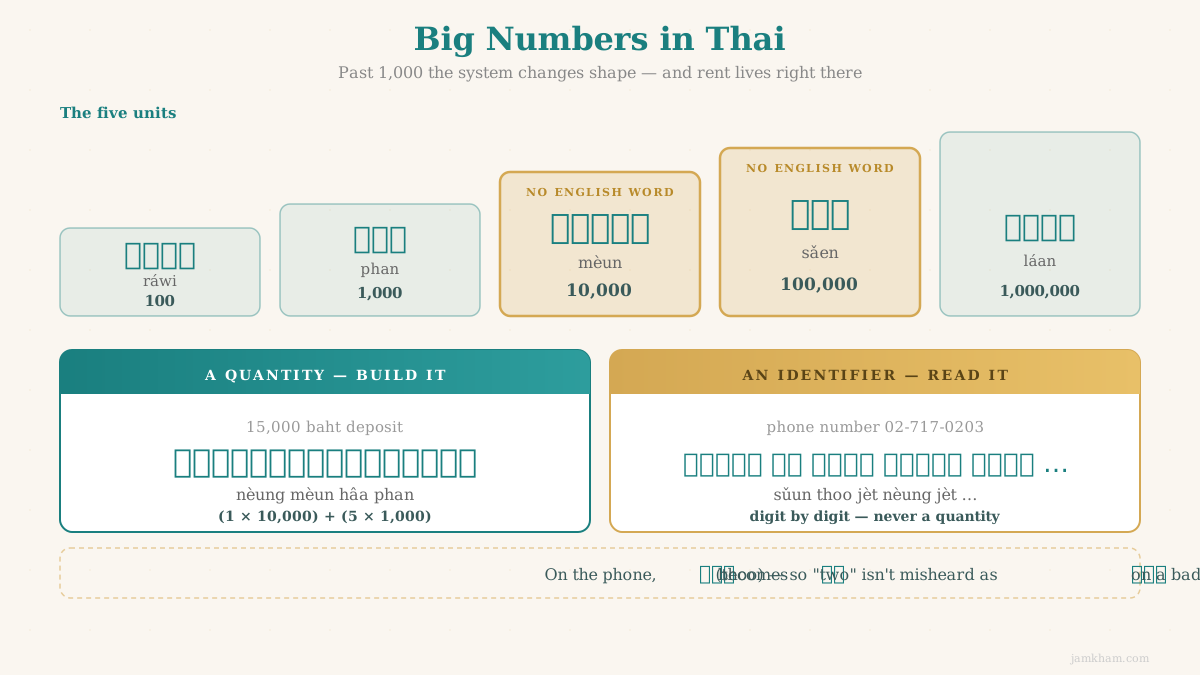
English groups large numbers by thousands: a thousand, then a thousand thousand (million), then a thousand million (billion). Thai groups by ten-thousands instead — the same logic Chinese, Japanese, and Korean use, and a real hurdle for English speakers because there’s no English word that maps directly onto “ten-thousand” or “hundred-thousand.” You have to say the whole phrase; Thai just has a word.
The five big-number units
| Value | Thai | Romanization | Tone |
|---|---|---|---|
| 100 | ร้อย | ráwi | High |
| 1,000 | พัน | phan | Mid |
| 10,000 | หมื่น | mèun | Low |
| 100,000 | แสน | sǎen | Rising |
| 1,000,000 | ล้าน | láan | High |
Notice where the pattern breaks and picks back up. Ten and a hundred multiply cleanly (สิบ(sìp), ร้อย(ráwi), พัน(phan)), the same way “ten,” “hundred,” and “thousand” do in English. Then Thai introduces two entirely new words — หมื่น(mèun) and แสน(sǎen) — before ล้าน(láan) lines back up with English “million.” That middle stretch, from 10,000 to 999,999, is exactly the range rent, deposits, and salaries live in, which is why it trips up learners who’ve only drilled market-price numbers.
Building Real Numbers: Rent, Deposits, and Salaries
The construction rule doesn’t change from what you already know: multiplier, then unit, combined left to right, largest unit first. You’re just adding two new units to the toolkit.
Worked examples: rent, deposits, and salary
| Amount | Thai | Romanization |
|---|---|---|
| 8,500 baht (rent) | แปดพันห้าร้อยบาท | bpàet phan hâa ráwi bàat |
| 15,000 baht (deposit) | หนึ่งหมื่นห้าพันบาท | nèung mèun hâa phan bàat |
| 25,000 baht (salary) | สองหมื่นห้าพันบาท | sǎwng mèun hâa phan bàat |
| 45,000 baht (salary) | สี่หมื่นห้าพันบาท | sìi mèun hâa phan bàat |
| 100,000 baht | หนึ่งแสนบาท | nèung sǎen bàat |
| 1,200,000 baht (condo) | หนึ่งล้านสองแสนบาท | nèung láan sǎwng sǎen bàat |
Read หนึ่งหมื่นห้าพันบาท(nèung mèun hâa phan bàat) literally and it’s “one-ten-thousand, five-thousand, baht” — Thai is building 15,000 as (1 × 10,000) + (5 × 1,000), the same left-to-right, largest-unit-first logic as 67 being (6 × 10) + 7. Once หมื่น(mèun) and แสน(sǎen) stop feeling like foreign concepts and start feeling like just two more units in the same system, rent conversations stop requiring a mental calculator.
If you already know the Thai classifier system, you’ll recognize the underlying logic here — Thai numbers, like classifiers, follow one small, consistent pattern that just keeps extending as the numbers get bigger. Nothing about hundreds, thousands, or ten-thousands works differently once you’ve internalized tens and units.
The Casual Shortcut: ร้อยนึง, พันนึง, หมื่นนึง
In relaxed speech, หนึ่ง(nèung) contracts to นึง(neung) and jumps to after the noun instead of before it. ร้อยนึง(ráwi neung) means exactly the same thing as the formal หนึ่งร้อย(nèung ráwi), just friendlier — closer to English “a hundred bucks” versus “one hundred dollars.”
This works all the way up the scale: พันนึง(phan neung), หมื่นนึง(mèun neung), even แสนนึง(sǎen neung). It’s the same word-order flexibility you may already know from counting objects, where รถคันหนึ่ง(rót khan nèung) and รถหนึ่งคัน(rót nèung khan) are both correct — Thai lets “one” sit on either side of the thing it’s counting, and big numbers get the same courtesy.
A quick reality check: you’ll hear ร้อยนึง(ráwi neung) constantly in daily conversation — asking to borrow a hundred baht, negotiating a small discount. You’ll hear it less on official paperwork or a formal lease, where หนึ่งร้อย(nèung ráwi) stays standard. Learn both; use the casual one with friends and vendors, the formal one when you’re signing something.
The Exception: Phone Numbers and ID Cards Aren’t “Numbers”
Here’s where everything above stops applying. A rent figure is a quantity — it answers “how much.” A phone number or an ID number is an identifier — it answers “which one,” and Thai treats identifiers completely differently. Instead of building a compound number, Thai reads each digit on its own, one at a time.
A landline number like 02-717-0203 isn’t “two-oh-seven-hundred-seventeen-thousand-two-hundred-three.” It’s read digit-by-digit:
sǔun sǎwng · jèt nèung jèt · sǔun sǎwng sǔun sǎamศูนย์สอง เจ็ดหนึ่งเจ็ด ศูนย์สองศูนย์สาม0-2-7-1-7-0-2-0-3, spoken digit by digitA 10-digit mobile number follows the same rule, grouped in the same 3-3-4 pattern you’d use in English (089-090-8443), with a short pause between groups rather than one continuous number:
Reading digits one at a time
| Digit | Thai | Romanization |
|---|---|---|
| 0 | ศูนย์ | sǔun |
| 1 | หนึ่ง | nèung |
| 2 (phone only) | โท | thoo |
| 3 | สาม | sǎam |
| 4 | สี่ | sìi |
| 5 | ห้า | hâa |
| 6 | หก | hòk |
| 7 | เจ็ด | jèt |
| 8 | แปด | bpàet |
| 9 | เก้า | gâo |
A Thai national ID card carries the same identifier logic, just longer: 13 digits, read one at a time rather than as a giant compound number. You’ll never need to say your Thai ID number the way you’d state a salary, but you will need to read it back correctly when a clerk asks you to confirm it digit-by-digit — and knowing the rule in advance means you’re not tempted to mentally group it into thousands and hundreds like a price.
Common Mistakes
Reading a phone number as a quantity. The most natural English-speaker error: hearing 0891234567 and trying to parse it as “eighty-nine million, one hundred twenty-three thousand…” Stop. Phone and ID numbers are never quantities. Read every digit separately, always.
Transposing หมื่น and แสน. Because English has no equivalent word for either, it’s easy to mix up which one is 10,000 and which is 100,000 — especially under pressure, mid-negotiation. หมื่น(mèun) is the smaller of the two (ten-thousand); แสน(sǎen) is larger (hundred-thousand) — one order of magnitude up. If you’re not sure, saying the digit-group value in English first, then translating, helps until it’s automatic.
Forgetting โท mid-call and using สอง. Not wrong exactly — สอง is still recognizable — but it defeats the purpose of the swap and can genuinely get misheard as สาม on a bad connection. If you’re giving your number over the phone specifically, use โท for every 2.
Translating “1.2 million” word-for-word. English speakers default to “one point two million,” but Thai doesn’t use decimal points for this — it builds the number from its units: หนึ่งล้านสองแสน(nèung láan sǎwng sǎen), not a decimal fraction of a million. Property listings and salary negotiations both lean on this construction, so it’s worth getting comfortable early.
Frequently Asked Questions
What are 10,000 and 100,000 in Thai?
10,000 is หมื่น(mèun) and 100,000 is แสน(sǎen). Neither has a direct English equivalent word — English just says “ten thousand” and “hundred thousand” as phrases, while Thai has a single dedicated word for each, the same way Chinese, Japanese, and Korean group large numbers.
How do I say my phone number in Thai?
Read every digit separately rather than as a compound number, typically grouped 3-3-4 with short pauses between groups, matching how you’d say it in English (089-090-8443). For the digit 2 specifically, Thai often substitutes โท(thoo) for สอง(sǎwng) to avoid confusion with 3 over the phone.
Why does Thai use โท instead of สอง for phone numbers?
สอง(sǎwng) and สาม(sǎam) can sound similar over a poor connection, so Thai substitutes the Pali/Sanskrit-derived โท(thoo) specifically when reciting digits aloud. It’s used only for this purpose; elsewhere, สอง(sǎwng) remains correct.
How do I say rent, deposit, or salary numbers in Thai?
Build the number the same way you’d build any Thai number: largest unit first, then the next, down to the ones place, followed by บาท(bàat). For example, 25,000 baht is สองหมื่นห้าพันบาท(sǎwng mèun hâa phan bàat) — two-ten-thousand, five-thousand, baht.
Is there a casual, shorter way to say big round numbers in Thai?
Yes. หนึ่ง(nèung) contracts to นึง(neung) and moves after the noun in relaxed speech: ร้อยนึง(ráwi neung), พันนึง(phan neung), หมื่นนึง(mèun neung). It’s common with friends and vendors; formal writing and contracts still use หนึ่ง(nèung) before the unit.
Stop Doing Math in Your Head
The number system itself isn’t hard — it’s exactly as regular past 1,000 as it is under 100. What’s hard is that nobody tells you the rules change twice: once when หมื่น(mèun) and แสน(sǎen) show up, and again when a number stops being a quantity and becomes an identifier you read digit-by-digit.
Jam Kham’s expat track drills exactly this range — the rent, salary, and bureaucratic numbers that actually come up once you’re living here, not just visiting — with clear Thai audio so a landlord’s quoted figure lands the first time. It’s waitlist-only for now — join the waitlist for founding pricing.
Related reading: Thai Numbers 1-100 | Thai Classifiers: The 20 You Actually Need | How to Bargain in Thai
See how Thai reading actually works
Sound out your first Thai word →No account, no card — just the alphabet.
Start reading Thai today
Start the reading course →First 3 modules free — no card, and they don't expire.