
Sorry and Excuse Me in Thai: Khǎw Thôot
How to say sorry in Thai: khǎw thôot, formal khǎw à-phai, excuse me on the BTS, and mai pen rai, the usual reply to a small apology. With tones.
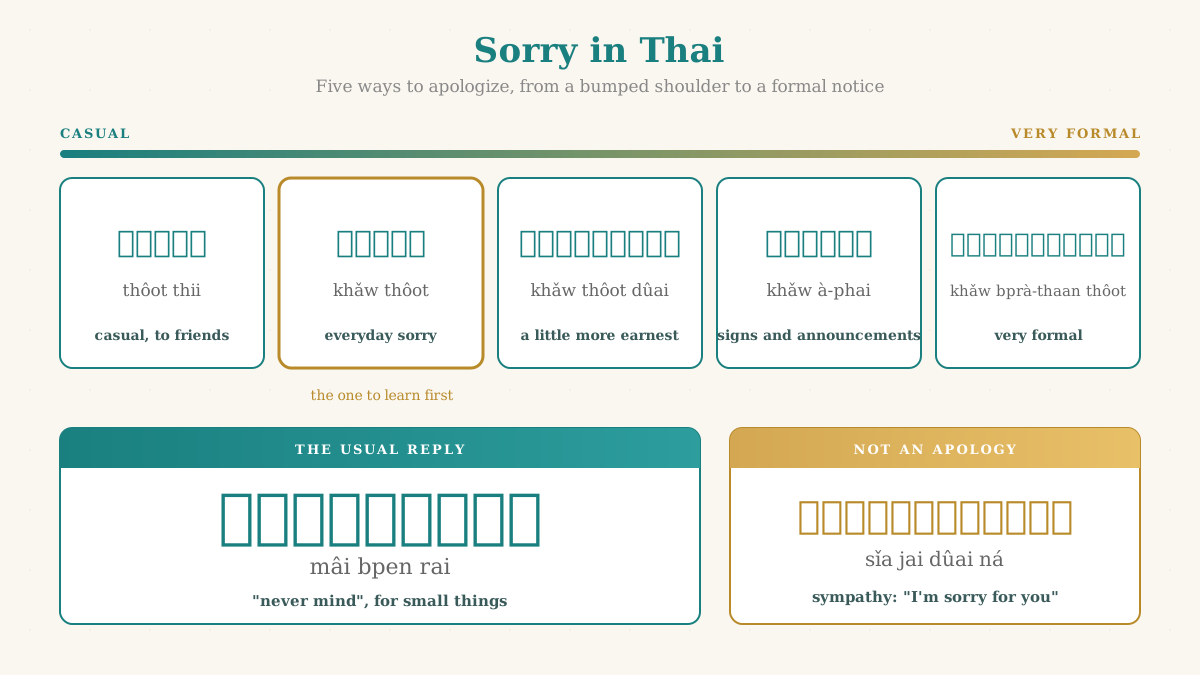
You’ve stepped on someone’s foot on the Skytrain, or you’re ten minutes late to dinner. What’s the Thai for “sorry”? The short answer is ขอโทษ(khǎw thôot). The longer answer is where it gets useful: sorry in Thai has levels, it doubles as “excuse me,” and for everyday slips the culture around apologizing is gentler and quieter than in English. This guide covers how to say sorry in Thai by weight and situation, how to say “excuse me” in Thai when you need to get past or get attention, how to answer when someone apologizes to you, and the one tone trap hiding in the word thôot.
The Default: Khǎw Thôot
khǎw thôot khrápขอโทษครับSorry (male speaker) khǎw thôot khâขอโทษค่ะSorry (female speaker)Literally, ขอ(khǎw) + โทษ(thôot) — “I ask for (your forgiveness of) the fault.” It’s the workhorse apology: you bump into someone, you give a wrong answer, you interrupt a conversation. Add the polite particle that matches your gender (the rule is explained in our guide to what ka and krub mean) and you’ve said something perfectly polite to anyone.
The same phrase is also “excuse me.” Say it to get a waiter’s attention, to interrupt, or before asking a stranger a question. English splits “sorry” and “excuse me” into two phrases; Thai uses one, and context tells the listener which you mean. Softening it with นะ(ná) — ขอโทษนะคะ(khǎw thôot ná khá) — is the version you’ll hear most from Thais addressing strangers.
The other variant you’ll hear all day is ขอโทษด้วย(khǎw thôot dûai), usually finished with นะครับ(ná khráp) or นะคะ(ná khá). The added ด้วย(dûai) makes the apology a touch warmer; shop staff use it when they’ve kept you waiting.
The Tone Trap in Thôot
Learners often say thôot with a flat or rising pitch. The word โทษ(thôot) has a falling tone, and the th is the plain English “t” of “top,” with its puff of air. It is never the “th” of “think.” The first word, ขอ(khǎw), has a rising tone, so the phrase runs rise-then-fall: khǎw thôot. If it comes out flat, it still gets understood in context, but the rise-fall is what makes it sound like Thai.
Sorry in Thai: by weight
| Thai | Romanization | Use |
|---|---|---|
| โทษที | thôot thii | Casual “my bad” with friends |
| ขอโทษ | khǎw thôot | Standard sorry / excuse me |
| ขอโทษนะ | khǎw thôot ná | Softened, friendly |
| ขอโทษด้วย | khǎw thôot dûai | ”Sorry about that,” a touch warmer |
| ขอโทษจริงๆ | khǎw thôot jing-jing | Really sorry |
| ขออภัย | khǎw à-phai | Formal: “I beg your pardon” |
Casual, Emphatic, and Formal Apologies
Between friends: โทษที(thôot thii). Dropping the “ask for” and adding ที(thii) gives you a quick, light “my bad.” It works for small slips — showing up five minutes late, grabbing the wrong drink. Use it with friends your own age or younger, not with a boss, a monk, or your partner’s grandmother. With them, stay with khǎw thôot plus the particle.
When you mean it: ขอโทษจริงๆ(khǎw thôot jing-jing). Adding จริงๆ(jing-jing) raises the sincerity without raising the drama. To say what you’re sorry for, add ที่(thîi) plus the thing:
khǎw thôot thîi maa sǎai khrápขอโทษที่มาสายครับSorry I'm late (male speaker) khǎw thôot thîi tham-hâi raw khâขอโทษที่ทำให้รอค่ะSorry to keep you waiting (female speaker)You’ll also hear ขอโทษที่มาช้า(khǎw thôot thîi maa cháa). Both are natural; สาย(sǎai) is the more usual word for missing a set time.
In formal settings: ขออภัย(khǎw à-phai). อภัย(à-phai) is a Pali-Sanskrit loan that sits in the formal register, the same ladder we map out in Thai Politeness: Why ‘Eat’ Has 5 Different Words. You’ll hear it from airline staff and announcers, and you’ll read it constantly on signs. The one every visitor meets is ขออภัยในความไม่สะดวก(khǎw à-phai nai khwaam mâi sà-dùak) — posted at construction sites, closed escalators, and out-of-order ATMs. Learn to recognize it and you can read half the “sorry” in Bangkok.
You’ll rarely say khǎw à-phai yourself in daily life. Recognizing it is the goal. The same goes for the very formal spoken ขอประทานโทษ(khǎw bprà-thaan thôot), which belongs to speeches and careful customer service.
Excuse Me in Thai: Getting Past, Getting Attention, Leaving
“Excuse me” in Thai depends on what you want to happen next:
- To get someone’s attention: ขอโทษครับ/ค่ะ(khǎw thôot khráp/khâ), the same default phrase. Food-ordering variants are in our food-ordering guide.
- To squeeze past someone: ขอทางหน่อยครับ/ค่ะ(khǎw thaang nàwi khráp/khâ), often straight after a quick khǎw thôot. ทาง(thaang) is the path you’re asking for and หน่อย(nàwi) shrinks the request. This is the BTS and market-aisle phrase. Keep the particle on it — the bare phrase is curt to a stranger — and pair it with a slight dip of the shoulders and a smile.
- To excuse yourself from a table or a group: ขอตัวก่อนครับ/ค่ะ(khǎw dtua gàwn khráp/khâ). Literally “I ask for myself first.” Thais use it when leaving a gathering before everyone else.
Notice the pattern: ขอ(khǎw) (“ask for”) starts all three. Once you know it, you can build polite requests of your own — ขอน้ำหน่อย(khǎw náam nàwi), for example. That’s the single most reusable word in this article.
Sorry, I Don’t Understand
The “sorry” a visitor needs most often is the one for not catching what was said. Lead with the apology, then say what went wrong:
khǎw thôot khráp, mâi khâo jaiขอโทษครับ ไม่เข้าใจSorry, I don't understand (male speaker) phûut ìik thii dâai mǎi kháพูดอีกทีได้ไหมคะCould you say that again? (female speaker)Men end the second one with ครับ(khráp). Among friends you’ll hear the bare อะไรนะ(à-rai ná). Add your particle (อะไรนะครับ / อะไรนะคะ) and it is polite enough for strangers too.
Owning a Mistake
When the fault really is yours, two short phrases do the work after khǎw thôot:
- ไม่ได้ตั้งใจ(mâi dâai dtâng jai) — for the spilled drink or the elbow in the ribs.
- ผมผิดเอง(phǒm phìt eeng) or ฉันผิดเอง(chǎn phìt eeng) — taking the blame outright.
A ไหว้(wâi) usually joins the words when the mistake is a real one or the other person is older or senior to you: palms together, head dipped, as you say khǎw thôot. Brushing a shoulder on the BTS doesn’t call for one; a nod and the phrase are enough.
Receiving an Apology: Mai Pen Rai
When someone apologizes to you for something small, the reply is ไม่เป็นไร(mâi bpen rai). English speakers usually write it “mai pen rai.” The middle syllable starts with ป, an unaspirated sound between “b” and “p,” and the first syllable falls.
It’s a version of “no worries,” but it’s also much more than a phrase — it’s a stance. Thais use it to close small incidents quickly, without keeping score. A waiter spills a little water: mai pen rai. You apologize for being late: mai pen rai.
A second layer of meaning matters here. Because it’s so reflexive, mai pen rai from a Thai person isn’t always “I’m not bothered.” Sometimes it’s a gracious way to move on from something that did bother them. Reading the rest of the face and tone matters. And the phrase belongs to the person who was wronged. If you missed the appointment or broke the item, don’t say it about your own mistake; offer a sincere second ขอโทษจริงๆ(khǎw thôot jing-jing) instead.
For a lighter reply to a small apology, you can add the softener: ไม่เป็นไรนะ(mâi bpen rai ná).
The phrase has two more everyday jobs:
- Replying to thanks. Someone says ขอบคุณ(khàwp-khun); you answer ไม่เป็นไรครับ/ค่ะ(mâi bpen rai khráp/khâ).
- Turning something down politely. Offered a plastic bag or a second helping you don’t want, the same words mean “no thanks, I’m fine.”
Sorry Is Not Always Khǎw Thôot: Sǐa Jai
English uses “sorry” for two things: I apologize and I’m sad for you. Thai separates them. If a friend’s grandmother has passed away, ขอโทษ(khǎw thôot) is wrong — it says “forgive my fault,” as if you caused it. The right phrase is เสียใจด้วยนะ(sǐa jai dûai ná). To anyone but a close friend, add your particle: เสียใจด้วยนะครับ / นะคะ. เสียใจ(sǐa jai) is sympathy, and the word ด้วย(dûai) turns it into “sorry along with you.” If you want the backstory on why so many Thai emotions are built on ใจ(jai), we cover it in Thai heart words.
The Culture Layer: Why Quiet Beats Loud
For small, everyday slips, apologizing in Thai is smaller than in English, and that’s on purpose. Two ideas help:
- Face. Thai social life values smooth surfaces. A long, emotional apology for a minor thing can make the other person uncomfortable, because now they have to manage your feelings as well as the original problem. A brief khǎw thôot with a small smile lets everyone move on.
- เกรงใจ(greeng jai). This word describes the sensitivity to not burdening others. It’s the reason Thais often say khǎw thôot before a request (“sorry to trouble you, but…”) rather than after a mistake. As a learner, adopting that habit — a soft khǎw thôot ná khá/khráp before you ask for anything — sounds natural and respectful.
The practical rule for minor incidents: apologize fast, keep it short, finish with the polite particle, and then stop talking about it. Over-apologizing for something small doesn’t read as sincerity in Thai; it reads as drama. A real fault is different. There, Thais apologize fully and formally — khǎw thôot jing-jing, an explanation, a wai — and so should you.
Common Mistakes
- Dropping the particle. Bare khǎw thôot is understandable but abrupt with strangers. Add khráp or khâ.
- Using thôot thii with elders or strangers. It’s casual, friends-only language.
- Using khǎw thôot for condolences. Use sǐa jai dûai ná.
- Flattening the tones. Rise on khǎw, fall on thôot.
- Saying mai pen rai about your own mistake. The wronged person says it to you. From the person at fault it sounds dismissive, and as a reply it fits small things only.
Frequently Asked Questions
How do you say sorry in Thai?
The standard way is ขอโทษ (khǎw thôot) with the polite particle: ขอโทษครับ (khǎw thôot khráp) for men and ขอโทษค่ะ (khǎw thôot khâ) for women. For friends, โทษที (thôot thii) means “my bad,” and for formal settings ขออภัย (khǎw à-phai) is used.
How do you say excuse me in Thai?
To get attention or interrupt, say ขอโทษครับ/ค่ะ (khǎw thôot khráp/khâ). To pass someone in a crowded space, say ขอทางหน่อยครับ/ค่ะ (khǎw thaang nàwi khráp/khâ). To step away from a group, say ขอตัวก่อนครับ/ค่ะ (khǎw dtua gàwn khráp/khâ).
What does mai pen rai mean?
ไม่เป็นไร (mâi bpen rai) means “it’s nothing,” “never mind,” or “no worries.” It’s the standard reply when someone apologizes for something small, and it also reflects a Thai attitude of not dwelling on minor problems. Thais also say it to answer “thank you” and to turn down an offer politely.
How do you say sorry in Thai if you’re a woman?
Women say ขอโทษค่ะ (khǎw thôot khâ). Use คะ (khá, high tone) in questions and after นะ, as in ขอโทษนะคะ (khǎw thôot ná khá) to politely get someone’s attention.
Is khǎw thôot the same as “I’m sorry for your loss”?
No. ขอโทษ asks forgiveness for something you did. For condolences or sympathy, say เสียใจด้วยนะ (sǐa jai dûai ná), which means “I’m sorry for you.”
Small Words, Big Goodwill
You’ll spend more time saying “sorry” and “excuse me” in Thailand than almost any other phrase, and a quick, well-toned khǎw thôot with the right particle makes every awkward moment shorter. Learn the rise-fall, keep it brief, and answer other people’s small apologies with mai pen rai.
Related reading: What Does ‘Ka’ Mean in Thai? Krub, Ka, and Na Ka Explained | Thai Politeness: Why ‘Eat’ Has 5 Different Words | Thai Phrases for Greetings
See how Thai reading actually works
Sound out your first Thai word →No account, no card — just the alphabet.
Start reading Thai today
Start the reading course →First 3 modules free — no card, and they don't expire.