
What Does 'Ka' Mean in Thai? Krub, Ka, and Na Ka Explained
What ka (ค่ะ) means in Thai, how krub differs, and what na ka, krub pom and a drawn-out khâa add. The polite particles, with pronunciation.
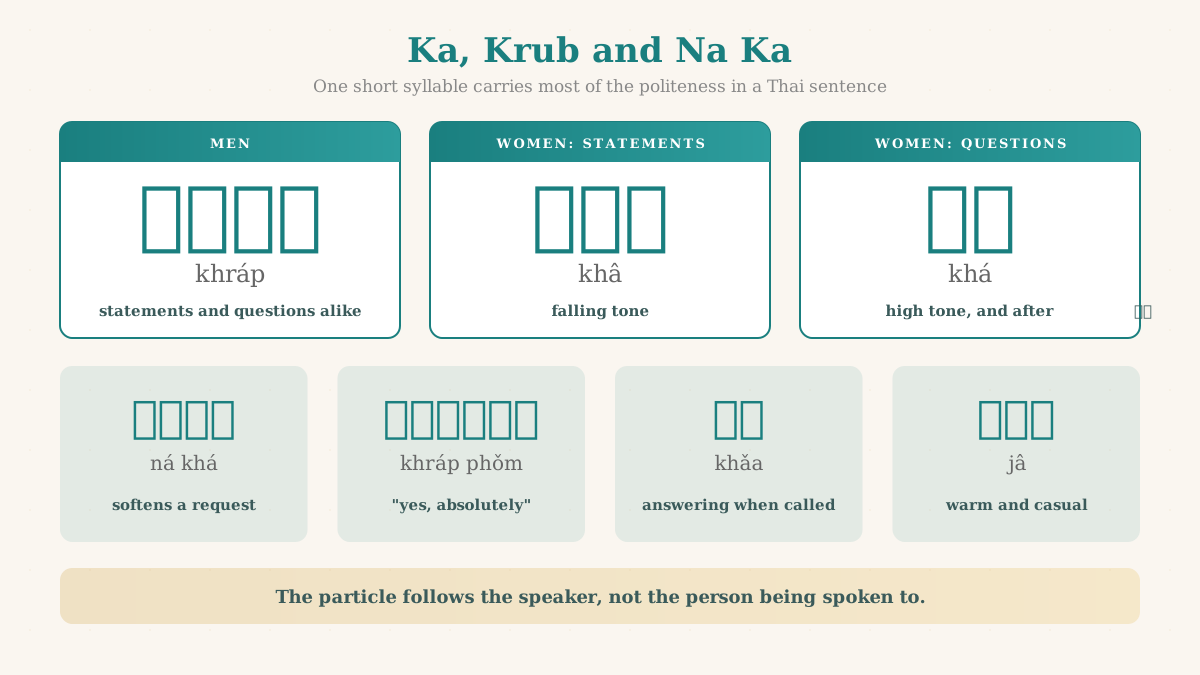
Spend one day in Thailand and you hear it hundreds of times: sawadee ka, khop khun ka, and then just ka, ka, ka down a phone line. So what does ka mean in Thai? Nothing you can translate. Ka is a polite particle: one syllable added to the end of a sentence to make it courteous. Women say ค่ะ(khâ), men say ครับ(khráp), usually written “krub” or “krap” in English.
This guide covers what the particle does on its own, how to pronounce krub, where it goes in a question, and the longer forms you will hear within an hour of landing: na ka, krub pom, a drawn-out khâa, and the warm จ้ะ(jâ) of a market vendor.
What Ka and Krub Actually Do
English marks politeness with extra words: please, would you mind, sir. Thai puts one particle at the end of the sentence and lets it do all of that work.
khàwp-khun khrápขอบคุณครับThank you (male speaker) khàwp-khun khâขอบคุณค่ะThank you (female speaker)Take the particle off and ขอบคุณ(khàwp-khun) still means “thank you”, but it lands flat, the way a one-word “Thanks.” can read as curt in an email. Thais call speech with the particle สุภาพ(sù-phâap). The particle adds manner, not meaning.
Because it carries no content, the particle can stand alone, and that is where most of the ka, ka, ka you overhear comes from. Alone, it does three jobs:
- Yes. Answer a yes/no question with ค่ะ(khâ) or ครับ(khráp) and you have said a polite “yes” or “certainly”.
- I’m listening. On the phone, Thais drop in a particle every few seconds to show they are following. It means “go on”, not “I agree”. A string of khráp, khráp, khráp from a hotel clerk confirms he heard your request, not that he has granted it.
- Here you go / understood. Hand over money, receive your change, get an instruction from a guard: a bare particle and a nod is a complete reply.
“No” works differently. A bare ไม่(mâi) is blunt, so Thais negate the verb and add the particle: ไม่เอาครับ(mâi ao khráp) to the tout offering a boat tour, ไม่เผ็ดค่ะ(mâi phèt khâ) to the friend asking about your curry.
Who Says Which: The Short Version
The particle belongs to the speaker, not the listener. Men say ครับ(khráp) whoever they are talking to; women say ค่ะ(khâ) or คะ(khá) whoever they are talking to. A man thanking a woman still says khàwp-khun khráp.
A classic mistake among foreign learners follows from learning by imitation: you repeat sawadee ka exactly as the woman who greeted you said it, and if you are a man you have borrowed her particle. People will understand you and rarely correct you.
The choice generally follows how a speaker presents their gender, and it says nothing about who they are attracted to. Trans women generally use ค่ะ(khâ), trans men generally use ครับ(khráp), and some speakers switch with the setting.
Our guide to Khop Khun Kha: What It Means and Who Says It covers this rule in full, with the thank-you and hello forms side by side.
Khâ and Khá: Two Tones in One “Ka”
English spelling flattens two different female particles into one “ka”:
The female particles
| Thai | Romanization | Tone | Used for | Example |
|---|---|---|---|---|
| ค่ะ | khâ | Falling | Statements, answers, “yes” | สวัสดีค่ะ (sà-wàt-dii khâ) |
| คะ | khá | High | Questions, after นะ, after a name or title | อะไรคะ (à-rai khá), “What?” |
| ขา | khǎa | Rising | Answering when called, calling sweetly | แม่ขา (mâe khǎa), “Mum!” |
In a statement the particle falls: khâ, short and settling, like a full stop. In a question it sits high: khá. Men have one form for both: ครับ(khráp) keeps its high tone in statements and questions alike.
The Khop Khun Kha guide has the full treatment of ค่ะ versus คะ, and the guide to Thai Tones: 5 Pitches English Can’t Teach You explains how falling, high and rising tones sound. The third row, ขา, gets its own section below.
How to Pronounce Krub (and Why It’s Spelled That Way)
khrápครับpolite particle (male speakers)“Krub”, “krap”, “khrap” and “khráp” are four English spellings of one Thai word. Each letter of the romanization is a compromise, and knowing why tells you how to say it:
- kh is the “k” of “kite”, with a puff of air. It is never the throaty “ch” of “loch”.
- r is a quick tap of the tongue, and in everyday speech most speakers drop it altogether. That gives kháp, the form you will hear most.
- a is short, close to the vowel in the English word “cup”. That is where the “u” in “krub” comes from. It does not rhyme with “crab”.
- p is the sound of the final letter บ, which is why some spellings end in “b”. Close your lips and stop there: no burst of air, no “puh”.
- The tone is high. Start above your normal speaking pitch and keep it short.
Put together: a clipped, high “krup” with your mouth closed at the end. If you say “krahb” with a long vowel and a released “b”, people will still understand you, but it marks you as a beginner straight away.
Ka is easier. The “kh” is the same aspirated “k”, the vowel is a short “a” as in “father” cut off early, and the only work is the tone: falling for ค่ะ(khâ), high for คะ(khá).
Ka and Krub in Questions
In a question, the polite particle is still the last syllable. It goes after the question word, not before it.
Thai yes/no questions end in ไหม(mǎi), so the particle follows it:
phèt mǎi kháเผ็ดไหมคะIs it spicy? (female speaker) phèt mǎi khrápเผ็ดไหมครับIs it spicy? (male speaker)Thai has no all-purpose word for “yes”. ใช่(châi) only confirms “is that right?” questions, so for most questions you answer by repeating the verb or adjective with your particle: เผ็ดค่ะ(phèt khâ), or ไม่เผ็ดครับ(mâi phèt khráp). Notice the woman’s particle switch from high คะ in the question to falling ค่ะ in the answer.
Questions built on “what”, “where” and “how much” work the same way:
an-níi à-rai khrápอันนี้อะไรครับWhat is this? (male speaker) hâwng náam yùu thîi nǎi kháห้องน้ำอยู่ที่ไหนคะWhere is the toilet? (female speaker)Krub? and Ka? on their own: “pardon?”
Said alone with a questioning lift, the particle means “sorry?” or “yes?”. A man says ครับ(khráp) with the pitch pushed up at the end; a woman says คะ(khá). You will hear it when a cashier misses what you said, and when someone answers a knock at the door. The fuller version is อะไรนะคะ(à-rai ná khá) or อะไรนะครับ(à-rai ná khráp).
So if a shop assistant answers your carefully prepared sentence with one high, questioning syllable, she has not agreed to anything. She is asking you to say it again.
Calling Someone: พี่คะ, คุณครับ, and ขา
To get someone’s attention politely, say their title or name and add your particle. Women use the high-tone คะ(khá) here, even though it is not a question:
phîi kháพี่คะExcuse me (to someone a little older; female speaker) khun khrápคุณครับExcuse me, sir / madam (male speaker)พี่(phîi) is how you address anyone somewhat older than you, including a waiter or a taxi driver. น้อง(náwng) is for someone clearly younger, and คุณ(khun) is the neutral choice for a stranger. In a restaurant, phîi khá or náwng khráp is how you call staff over.
The third female particle answers the call. ขา(khǎa) has a rising tone and a long vowel, and a woman or girl says it when someone calls her name: a mother calls up the stairs, the daughter answers khǎa. Added after a name or family word it turns a call into an affectionate one, as in แม่ขา(mâe khǎa). It sounds sweet, affectionate and markedly feminine, so as a learner you only need to recognise it. A man answers a call with plain ครับ(khráp). If you look ขา up in a dictionary, the first entry is the unrelated word for “leg”.
What Does Na Ka Mean?
Service staff rarely stop at one particle. You will hear na ka (นะคะ(ná khá)) from women and na krub (นะครับ(ná khráp)) from men.
นะ(ná) is a softener. It turns an instruction into a request and a reminder into a friendly nudge, a little like ending an English sentence with “okay?”. Add the polite particle and you get politeness plus warmth:
raw sàk khrûu ná kháรอสักครู่นะคะJust a moment, please (female speaker, softened) khǎw-thôot ná khrápขอโทษนะครับSorry about that / excuse me (male speaker, softened)Compare รอสักครู่ค่ะ(raw sàk khrûu khâ): correct and polite, but brisk. With นะ it says “bear with me”. That is why na ka fills customer service announcements, voice messages between friends, and English texts from Thai women (“see you tomorrow na ka”).
One spelling point: after นะ, women use the high-tone คะ(khá), so it is ná khá and never ná khâ. The spelling นะค่ะ is a common slip, including among Thai writers.
Sawadee Ka and Khop Khun Ka
The two phrases that carry ka around the world are a greeting and a thank-you:
sà-wàt-dii khâสวัสดีค่ะHello / goodbye (female speaker) sà-wàt-dii khrápสวัสดีครับHello / goodbye (male speaker)Sawadee (สวัสดี) is the greeting. It works at any time of day, and for goodbye as well as hello. The particle is the politeness attached to it, so “sawadee ka” is “hello”, said politely by a woman, and “sawadee krub” is the same from a man. Khop khun ka (ขอบคุณค่ะ) and khop khun krub (ขอบคุณครับ) are one phrase, “thank you”, with two particles. You will also see these written “kha”, “krap” and “kap”; they are spellings of the same words.
For the thank-you phrase, see Khop Khun Kha: What It Means and Who Says It. For greetings and the wai that goes with them, see our Thai phrases for greetings guide.
Fast Speech: Kháp, Khâa, and Khráp Phǒm
Real Thai moves quickly, and the particles change shape:
- ครับ(khráp) loses its r and becomes kháp, spelled คับ(kháp) in chat messages. Most Thai men say it this way most of the time.
- ค่ะ(khâ) stretches into a long ค่า(khâa). It is friendly and informal: a shopkeeper’s khàwp-khun khâaa as you leave, or “kaaa” in a text.
- Men have an emphatic option: ครับผม(khráp phǒm). It is krub plus ผม(phǒm), and it works like a crisp “yes, sir” or “will do”. Staff say it to customers, and friends say it with a grin. In English letters it appears as krub pom or kap pom.
Two notes save confusion. First, คับ and ค่า are also ordinary words (“tight” and “fee” or “value”), so a dictionary lookup of the chat spellings will mislead you. Second, there is no “ka pom”. ผม is a male pronoun, so only men say khráp phǒm, and what sounds like “ka pom” is kháp phǒm at speed.
None of these replace the standard forms. They are what the standard forms turn into at conversational speed.
Warmer Particles: จ้ะ and จ๊ะ, and When Thais Drop Them All
Krub and ka mark polite distance. With people they are close to, Thais use warmer particles or none at all.
The most common warm pair mirrors ค่ะ and คะ exactly:
jâจ้ะwarm particle for statements jáจ๊ะwarm particle for questions and after นะจ้ะ(jâ) falls and ends statements; จ๊ะ(já) is high and ends questions, as in ไปไหนจ๊ะ(bpai nǎi já). A drawn-out จ้า(jâa) is the cheerful version. You hear the pair from adults to children, between friends and couples, and from market vendors to customers. Women use it more than men. If a vendor says jâ to you, she is being friendly, not rude; reply with your usual krub or ka. Men also have a relaxed variant of krub: ฮะ(há).
Between close friends and siblings, particles mostly disappear. Thais also do not attach one to every sentence, even with strangers: the first sentence, the last one, and any short answer are where they matter most.
As a learner the rule is simple: when in doubt, keep the particle. Use krub or ka with strangers, staff, anyone older, and anyone you have just met. Too much politeness costs nothing. Our guide to Thai Politeness: Why ‘Eat’ Has 5 Different Words explains when formality relaxes and what replaces it.
Frequently Asked Questions
What does ka mean in Thai?
Ka (ค่ะ, khâ) has no translatable meaning. It is a polite particle that female speakers add to the end of a sentence to show respect. Male speakers use krub (ครับ, khráp) the same way. Said on its own, ka is a polite yes or a signal that the speaker is listening.
What does na ka mean in Thai?
Na ka (นะคะ, ná khá) combines the softening particle na (นะ) with the polite particle ka. It makes a sentence gentler and friendlier as well as polite, so a request sounds warm instead of brisk. Male speakers say na krub (นะครับ, ná khráp).
What does sawadee ka mean in Thai?
Sawadee ka (สวัสดีค่ะ, sà-wàt-dii khâ) means hello, said politely by a female speaker. Sawadee is the greeting, used at any time of day and for goodbye too, and ka is the polite particle. A man says sawadee krub (สวัสดีครับ, sà-wàt-dii khráp) instead.
How do you write sawadee ka in Thai?
สวัสดีค่ะ. That is สวัสดี (sà-wàt-dii, the greeting) followed by ค่ะ (khâ, the female polite particle). The male version, sawadee krub, is written สวัสดีครับ.
What does krub pom (kap pom) mean?
Krub pom (ครับผม, khráp phǒm) is an emphatic polite yes used by male speakers, close to yes, sir or will do. It combines the polite particle krub with pom (ผม), the male word for I. It is often written kap pom because the r drops out in fast speech. There is no ka pom: pom is a male pronoun, so women do not use this phrase.
How do you pronounce krub in Thai?
Krub (ครับ, khráp) has a high tone and a short vowel close to the one in the English word cup. The final sound is a p with the lips closed and no burst of air. Most speakers drop the r in everyday speech, which gives kháp.
Why do Thais say ka or krub on its own?
On its own, ค่ะ (khâ) or ครับ (khráp) is a polite yes, or a signal that the speaker is listening. With a questioning pitch, คะ (khá) or ครับ means pardon. Women also answer with ขา (khǎa) when someone calls their name.
One Syllable, Most of the Politeness
You can miss tones, forget vocabulary and point your way through half a conversation, and still come across as respectful in Thai if krub or ka lands at the end of your sentences.
The spelling tells you more than “ka” ever can. ค่ะ, คะ and ขา are three different words on the page, and the letters and tone marks show which tone each one takes. Read Thai, Jam Kham’s script course, teaches the consonant classes and tone rules behind that, and you read a real Thai word by the third card. The first modules are free.
Related reading: Khop Khun Kha: What It Means and Who Says It | Thai Politeness: Why ‘Eat’ Has 5 Different Words | Thai Tones: 5 Pitches English Can’t Teach You | Thai Phrases for Greetings
See how Thai reading actually works
Sound out your first Thai word →No account, no card — just the alphabet.
Start reading Thai today
Start the reading course →First 3 modules free — no card, and they don't expire.