
Khop Khun Kha: What It Means and Who Says It
Khop khun kha means thank you — but only if you're the right speaker. What it means, why kha and khrap aren't interchangeable, and how to answer.
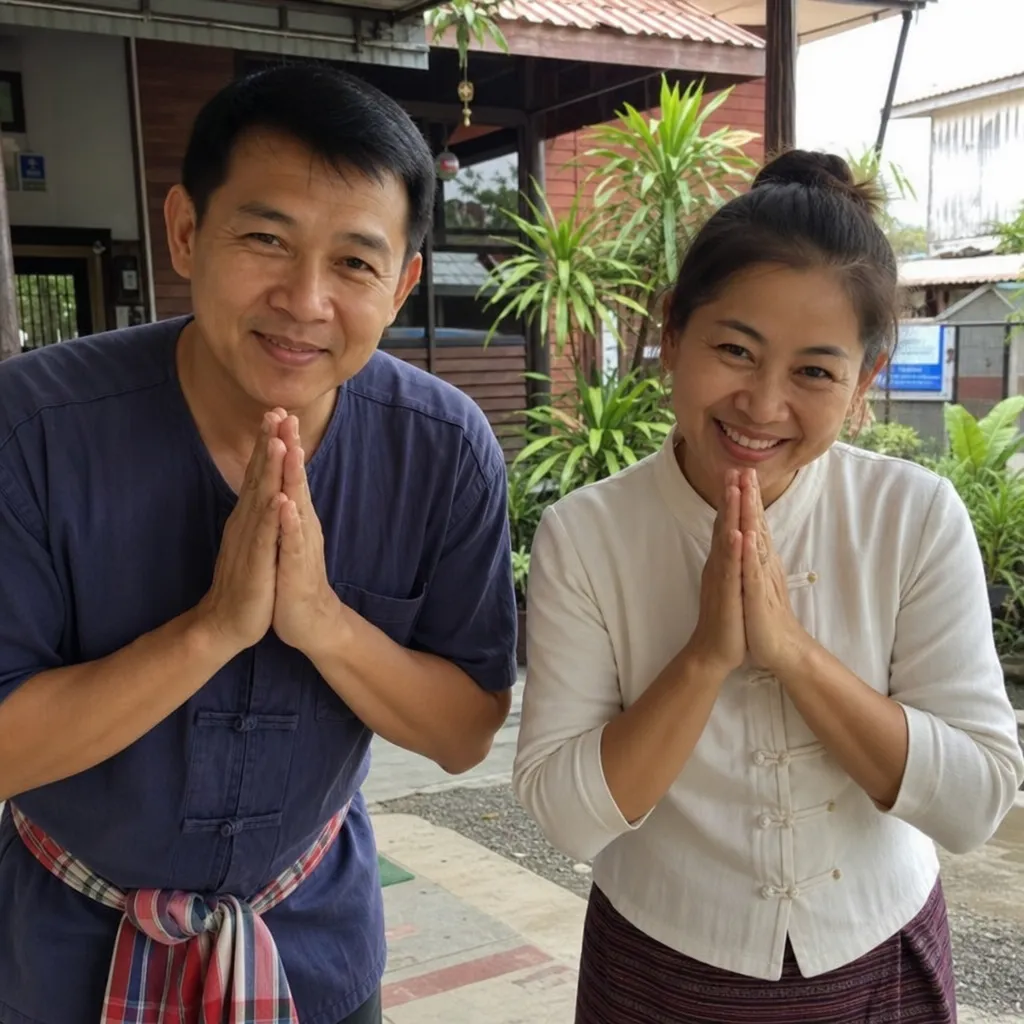
You hear it dozens of times a day in Thailand — at the 7-Eleven counter, from the driver, at the end of every phone call. ขอบคุณค่ะ(khàwp-khun khâ). It is one of the first Thai phrases a visitor picks up, and it is also the first one visitors get subtly wrong, because the part everyone repeats — the “kha” — is the part that is not supposed to be repeated.
This guide covers what the phrase actually means, who says which version, why it appears in four different spellings online, and how to answer when someone says it to you.
What “Khop Khun Kha” Means
The phrase has two parts doing two different jobs.
khàwp-khunขอบคุณthank you khâค่ะpolite particle (female speaker)ขอบคุณ(khàwp-khun) is the thank you. It works on its own, and it is what you would find in a dictionary. ค่ะ(khâ) is a politeness particle — a small word tacked onto the end of a sentence to make it polite. It has no translation of its own. It is closer to tone of voice than to vocabulary.
The second half of ขอบคุณ(khàwp-khun) is a word you have probably already met: คุณ(khun), the polite “you” that also works as a title in front of someone’s name. Its older and more basic sense is “goodness”, “merit”, or “kindness done to you” — a Pali borrowing — and that is the sense at work here. The ขอบ(khàwp) in front of it is a verb meaning to acknowledge or accept, not the identically spelled ขอบ(khàwp) that means edge. So the compound reads roughly as acknowledging someone’s goodness — a considerably warmer construction than the transactional English “thanks”.
To scale it up, add มาก(mâak):
khàwp-khun mâak khâขอบคุณมากค่ะthank you very muchThai speakers often double it in speech — ขอบคุณมาก ๆ(khàwp-khun mâak mâak) — which lands somewhere near “thanks so much”.
Kha or Khrap: It Depends on You, Not Them
This is the one rule worth getting right on day one.
| Speaker | Thank you | Hello |
|---|---|---|
| Female | ขอบคุณค่ะ (khàwp-khun khâ) | สวัสดีค่ะ (sà-wàt-dii khâ) |
| Male | ขอบคุณครับ (khàwp-khun khráp) | สวัสดีครับ (sà-wàt-dii khráp) |
The particle is attached to the person speaking. It does not change based on who you are talking to. A woman thanking a man still says ค่ะ(khâ); a man thanking a woman still says ครับ(khráp). As a visitor, you pick the one that goes with you and stay consistent with it.
Visitors get this wrong constantly, and the reason is understandable: most people first hear the phrase from a woman at a hotel desk or a shop counter, repeat it exactly as heard, and end up with a man saying ค่ะ(khâ). You will be understood and nobody will correct you, which is precisely why the mistake survives entire two-week trips.
The Tone Trap: ค่ะ Versus คะ
Written Thai distinguishes two particles that romanization flattens into one “ka”.
khâFallingค่ะstatement particle kháHighคะquestion particleSame consonant, same vowel, different tone, different job. ค่ะ(khâ) falls, and it ends statements: ขอบคุณค่ะ(khàwp-khun khâ). คะ(khá) sits high, and it ends questions, calls for someone’s attention, or softens a request: เท่าไหร่คะ(thâo-rài khá).
The one exception worth knowing: if the sentence ends in นะ(ná), the particle stays high — นะคะ(ná khá), not นะค่ะ, even in a statement. This is the most misspelled particle in Thai, including by native writers.
A learner working only from English spelling has no way to know this exists. “Kha” is one syllable on the page, so they use one tone everywhere — and every question they ask comes out sounding like a flat statement. Thai women switch between the two constantly without ever thinking about it.
Men have it fractionally easier: ครับ(khráp) covers both statements and questions. In fast speech it usually loses its ร(r) and comes out closer to “kháp”, which is why you will see both “krap” and “kap” written online. Both are the same word.
Why It’s Spelled Four Different Ways
Search for this phrase and you get khop khun kha, kap kun ka, kob kun ka, korp koon kah. They are not variants of the phrase. They are four people’s attempts to write one Thai phrase — ขอบคุณค่ะ(khàwp-khun khâ) — with an alphabet that cannot hold it.
Look at what English spelling has to throw away:
- ข is not a plain k. It is aspirated, with a puff of air, closer to the k in “kite” than the k in “skate”. Writing it as “k” loses that; writing it as “kh” makes some readers reach for the throaty ch in “loch”, which is further off than a plain k.
- The vowel is not an “o”. ขอบ(khàwp) uses a long “aw” — think of “corp” without the r. “Khop” points at the wrong vowel entirely.
- The final บ is a b that is pronounced as a p. And it is unreleased: your lips close and stop, with no puff at the end. English has no comfortable way to spell that.
- None of the spellings show tone. ขอบ(khàwp) is low, คุณ(khun) is mid, ค่ะ(khâ) is falling. Tone is not decoration in Thai — it is part of the word, the same way a vowel is.
The Thai spelling has none of these problems, because it was designed for this language. ขอบคุณค่ะ(khàwp-khun khâ) carries the tones, the vowel length, and the final consonant that every romanization has to throw away.
That is the practical case for learning the script rather than collecting romanized phrases: not scholarship, but accuracy. It is the same problem described in the romanization trap, and this phrase is its clearest example, because “khop khun kha” is famous in English precisely as a misspelling.
See how Thai reading actually works
Read the phrase the way it's actually written — try the free alphabet demo and read a real Thai word in about three minutes.
Sound out your first Thai word →No account, no card — just the alphabet.
When Thais Actually Say Thank You
ขอบคุณ(khàwp-khun) is standard in service situations: shops, restaurants, taxis, hotels, offices. Use it there and you are on safe ground.
Thai tends to use it less freely than English does inside close relationships. In many families and long friendships, explicit thanks is simply less frequent than an American visitor would expect, and thanking an intimate constantly can read as putting distance between you rather than showing warmth. This is not coldness — it is a different default about where politeness gets marked, and it varies a lot between families.
Two other forms are worth recognising even if you never use them:
khàwp-jaiขอบใจthanks (to someone younger, junior, or close) khàwp-phrá-khunขอบพระคุณthank you (formal, respectful)ขอบใจ(khàwp-jai) is what an adult says to a child or a senior person says to a junior one, and it is also warm between close friends and same-age peers. It is friendly downward, and distinctly wrong upward — a visitor using it with an older stranger sounds condescending. ขอบพระคุณ(khàwp-phrá-khun) runs the other way: it is the deferential form, used with people you owe real gratitude to — parents, grandparents, teachers. With monks the customary form adds กราบ(gràap) in front (กราบขอบพระคุณ(gràap khàwp-phrá-khun)), part of a separate register laypeople use when speaking to the Sangha.
As a visitor you never need either one. ขอบคุณ(khàwp-khun) plus your particle is correct in every situation you will encounter, and reaching for a fancier form you have not calibrated is a bigger risk than using the standard one.
How to Respond
When someone thanks you, the workhorse reply is:
mâi bpen raiไม่เป็นไรno worries, it's nothing, you're welcomeAdd your particle — ไม่เป็นไรค่ะ(mâi bpen rai khâ) or ไม่เป็นไรครับ(mâi bpen rai khráp) — and you have covered “you’re welcome”, “no problem”, and “don’t mention it” in one phrase. It is also what you say when someone apologises, or when something minor goes wrong, which makes it one of the highest-value phrases in the language.
More formally, you may hear:
dûai khwaam yin diiด้วยความยินดีwith pleasureAnd in casual settings, a bare ครับ(khráp) or ค่ะ(khâ) with a nod is a complete, natural response. Silence plus a smile is also fine. Thai does not require a verbal acknowledgement the way English tends to.
The Four Phrases That Pair With It
You do not need a long list to be polite in Thailand. These four plus ขอบคุณ(khàwp-khun) cover the overwhelming majority of visitor interactions:
| Thai | Romanization | Meaning |
|---|---|---|
| สวัสดี | sà-wàt-dii | hello / goodbye |
| ขอโทษ | khǎw-thôot | sorry / excuse me |
| ไม่เป็นไร | mâi bpen rai | no worries / you’re welcome |
| เท่าไหร่ | thâo-rài | how much? |
Attach your particle to each one and you have a working set of polite Thai. When you want the fuller version, 30 Thai phrases every tourist needs covers the practical vocabulary for food, transport, and shopping, and our Thai greetings guide has the complete greeting set with audio.
From Phrase to Language
Memorising ขอบคุณค่ะ(khàwp-khun khâ) as a sound gets you through a transaction. It does not get you any closer to the next phrase, because a romanized phrase is a dead end — it teaches you nothing reusable.
Reading it changes that. ค่ะ(khâ) and คะ(khá) stop being one confusing syllable and become two clearly different words. คุณ(khun) shows up again in ขอบพระคุณ(khàwp-phrá-khun) and you recognise it. The tones stop being something you have to be told and become something you can see.
Read Thai is built for exactly that transition. Letters arrive in the order you actually meet them in real Thai text, each one carries its class and tone behaviour rather than existing as an isolated shape, and you read a real Thai word by the third card — before any tone theory. Most learners get there in about three minutes.
Q&A
Question: What does “khop khun kha” mean?
Short answer: It means “thank you”, spoken by a female speaker. In Thai script it is ขอบคุณค่ะ (khàwp-khun khâ). ขอบคุณ is the actual “thank you”; ค่ะ is a politeness particle that women add to the end of statements. A male speaker says ขอบคุณครับ (khàwp-khun khráp) instead. The particle marks the speaker, not the person being thanked.
Question: Is it “khop khun kha” or “khop khun khrap”?
Short answer: Both are correct — for different speakers. Women say ค่ะ (khâ) and men say ครับ (khráp). A man who says “khop khun kha” because he heard a woman say it will be understood, and will also sound noticeably odd. The particle goes with the speaker, not the listener, so it stays the same whether you are thanking a man, a woman, or a room full of people.
Question: Is it “sawadee ka” or “sawadee kap”?
Short answer: Same rule. Women say สวัสดีค่ะ (sà-wàt-dii khâ) and men say สวัสดีครับ (sà-wàt-dii khráp). The greeting สวัสดี does not change — only the particle does. In everyday speech men often shorten ครับ to something closer to “kháp”, which is why both “krap” and “kap” spellings circulate.
Question: Why is “khop khun kha” spelled so many different ways?
Short answer: Because none of the spellings are Thai. “Khop khun kha”, “kap kun ka”, and “kob kun ka” are all attempts to write ขอบคุณค่ะ in English letters. The ข is an aspirated k, the vowel is closer to “aw” than “o”, the final บ is written as a b but pronounced as an unreleased p, and no spelling shows the tones. Every romanization is a different compromise.
Question: What is the difference between ค่ะ and คะ?
Short answer: Tone, and it changes what the sentence does. ค่ะ (khâ) has a falling tone and ends statements — ขอบคุณค่ะ. คะ (khá) has a high tone and ends questions, calls for attention, or softens a request — เท่าไหร่คะ, “how much?”. Learners who memorise only “kha” use the falling tone everywhere, which makes questions land like flat statements.
Question: How do you respond when someone says khop khun kha?
Short answer: ไม่เป็นไร (mâi bpen rai) covers “no worries”, “it’s nothing”, and “you’re welcome” all at once — add your particle: ไม่เป็นไรค่ะ or ไม่เป็นไรครับ. More formally you might hear ด้วยความยินดี (dûai khwaam yin dii). In casual settings a smile, a nod, or a bare ครับ / ค่ะ is a complete reply.
Question: Do you need to wai when you say thank you in Thai?
Short answer: Not always. A wai adds respect and suits thanking someone older, senior, or genuinely helpful. It is not expected for routine service, and you do not need to return a wai from shop staff, servers, or children — a smile and a nod is correct there. A nod plus a spoken thank you is the natural default in most everyday situations.
See how Thai reading actually works
Stop guessing at spellings — learn to read ขอบคุณค่ะ the way it's actually written. Free alphabet demo, no account needed.
Sound out your first Thai word →No account, no card — just the alphabet.