
Understanding Thai Vowels: A Comprehensive Guide
Thai vowels attach before, after, above, below, or around consonants — and short vs. long length changes a word's meaning. Here's how to read the chart.
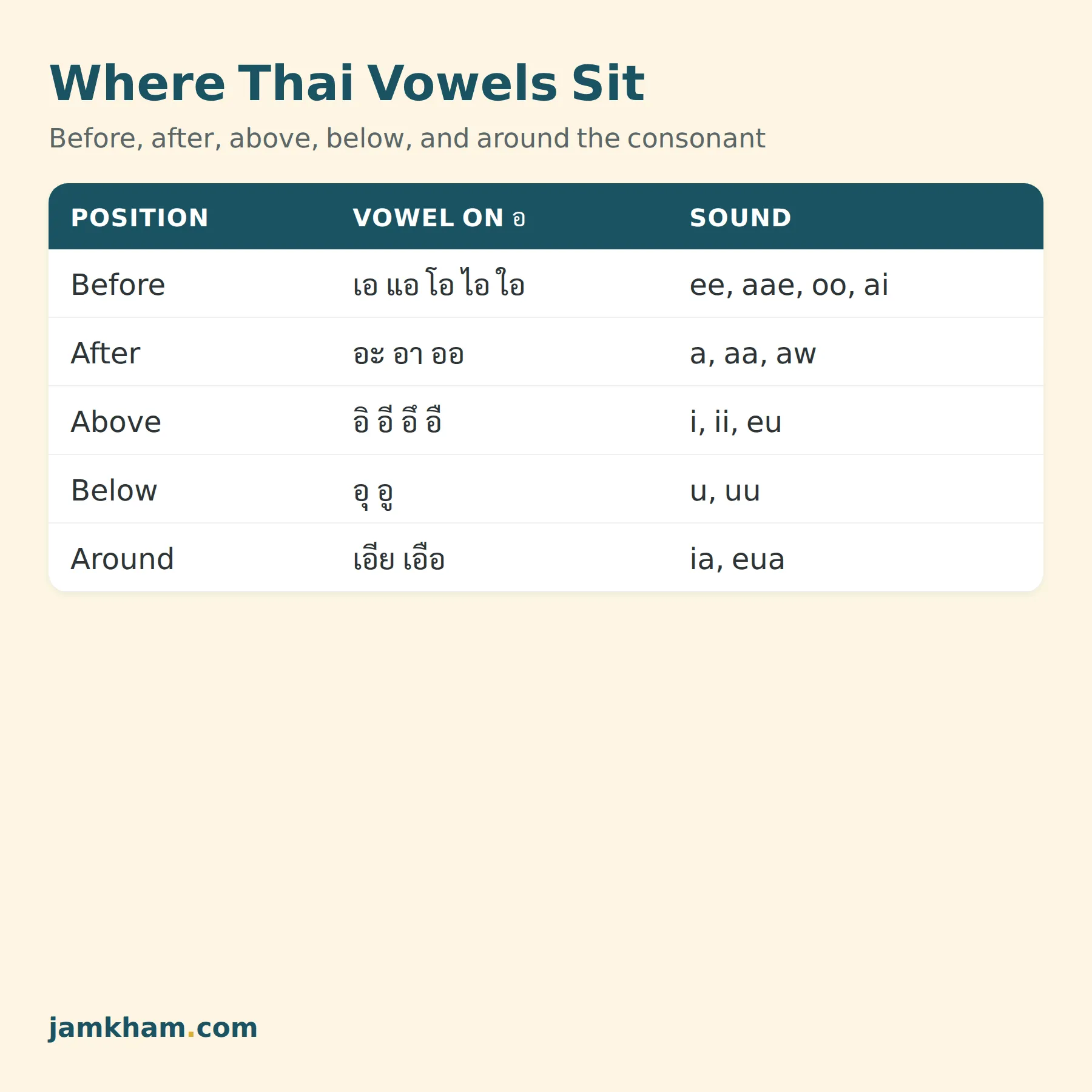
The first time you look at written Thai, the consonants are the part that looks learnable. They sit in a row, left to right, the way letters are supposed to. It is the Thai language vowels that break the pattern — floating above the line, tucked underneath, and in one case written to the left of the consonant you say first.
Consonants form the structural backbone of a word, but the vowels are what give it exact meaning. Hold one a beat too short and you have said a different word.
Unlike the Latin alphabet, where vowels and consonants follow one another in a straight line, the Thai writing system runs on different spatial and phonetic rules. This guide covers all of them: how to read a Thai vowels chart, where each symbol sits, why length changes meaning, how vowels feed into tone, and which study methods actually make them stick.
What Makes Thai Vowels So Unique?
The Thai writing system is classified as an abugida. In an abugida, consonant-vowel sequences are written as a unit. The consonant acts as the main base or anchor, while the vowel is a secondary notation that modifies it.
When you first look at Thai alphabet vowels, you will notice they are not independent, standalone letters the way they are in English. They attach themselves to consonants. That relationship is the first real hurdle for learners, and the point at which reading starts to click.
There are 21 physical vowel symbols in Thai, but through various combinations, they produce 32 distinct vowel sounds (though only 28 are actively used in modern, daily Thai). Because of that, a well-organized Thai vowel chart is the most efficient way to map the sounds visually.
The Spatial Puzzle: Thai Vowel Placement Around Consonants
One of the most common questions from new learners is whether Thai vowels are written before or after consonants.
The answer is both — and also above, below, and completely surrounding them.
Unlike English, where letters read strictly from left to right, Thai vowel placement around consonants behaves more like a solar system: the consonant is the sun at the centre and the vowels orbit it. Here is how the Thai writing system vowel marks are distributed:
- After the consonant: The most familiar position for English speakers. For example, Sara Aa (า) follows the consonant. In the word มา (maa - to come), the vowel sits neatly to the right.
- Before the consonant: Some vowels are written before the consonant they are pronounced after. Sara Ai (ไ-) is a great example. In ไป (bpai - to go), the vowel symbol comes first visually, but you pronounce the ป (bp) first.
- Above the consonant: Symbols like Sara I (-ิ) sit on top of the consonant, like a small hat. Example: กิน (gin - to eat).
- Below the consonant: Symbols like Sara U (-ุ) tuck underneath the consonant. Example: ดุ (dù - fierce).
- Surrounding the consonant: Some complex vowels are written in multiple parts, sandwiching the consonant. For instance, Sara Ao (เ-า) places one piece before and one piece after the consonant, as seen in เมา (mao - drunk).
One consequence of all this: a Thai vowel can never stand on its own. When a syllable begins with a vowel sound, Thai writes the silent carrier letter อ to give the vowel something to attach to — which is why every symbol on a vowel chart is shown sitting on อ. And because a bare consonant string carries an unwritten vowel of its own (นก reads nók, not “nk”), some of the vowels you pronounce are never written at all.

Decoding the Anatomy of a Thai Vowels Chart
A standard Thai vowels chart is arranged to highlight the systematic relationships between sounds. If you are looking at Thai alphabet vowels for beginners, you will notice the chart is usually divided into pairs. This pairs a short vowel with its corresponding long vowel counterpart.
Using a chart helps you see the logical patterns of the language. Instead of viewing 32 random sounds, you begin to see a highly structured grid. Most charts also include phonetic symbols for Thai vowels, which matter because the English alphabet lacks letters for some Thai sounds (like the unrounded back vowel written ‘eu’).

Short vs Long Thai Vowels Differences
Understanding the short vs long Thai vowels differences is not about sounding natural; it is what makes you understood at all. In Thai, vowel length changes the entire meaning of a word.
- Short vowels are pronounced quickly and sharply, abruptly cutting off the airflow.
- Long vowels are drawn out, lasting about twice as long as a short vowel.
Let’s look at a classic example, holding the tone constant so that length is the only variable:
- เข้า (khâo, short vowel) means “to enter.”
- ข้าว (khâao, long vowel) means “rice.”
Both are falling tone. The only thing separating them is how long you hold the vowel — so ask for ข้าว with a short vowel and you have asked someone to eat “enter.” Any Thai vowel pronunciation guide worth using will emphasize length as heavily as the sound itself, which is exactly why romanization alone will not get you there.
Length is also the one thing a chart genuinely cannot teach you. You can see that อะ is short and อา is long; you cannot see how long “long” is. That only arrives through hearing the pair back to back.
See how Thai reading actually works
Hear a short and long vowel side by side and the difference stops being theoretical. Two minutes, no account, no card.
Sound out your first Thai word →No account, no card — just the alphabet.
Understanding Thai Diphthongs and Triphthongs
As you move further down your chart, you will encounter combinations. Understanding Thai diphthongs and triphthongs is easier than it looks, because Thai has far fewer of them than English does.
A diphthong is a gliding vowel — one that starts in one mouth position and slides to another inside a single syllable. Thai has exactly three:
- เ-ีย (ia) — as in เสีย (sǐa, to be spoiled)
- เ-ือ (eua) — as in เรือ (reua, boat)
- -ัว (ua) — as in ตัว (dtua, body)
That is the whole set. Learn those three and you have learned every gliding vowel in the language.
Be careful not to confuse a diphthong with a vowel that simply ends in a glide consonant. แมว (maeo, cat) sounds like it glides, but it is the long vowel แ followed by a final ว — a vowel plus a consonant, not a diphthong. The distinction matters because the final ว is what makes the syllable live, which decides its tone.
You will also see เ-ือย, เ-ียว and -วย described as triphthongs, as in เหนื่อย (nèuay, tired). Thai textbooks generally call them that; most linguists analyse them as one of the three diphthongs above plus a final ย or ว. Either way, you read them the same.
A Practical Thai Vowel Pronunciation Guide
Most of the trouble with vowels in Thai language learning comes from leaning on English approximations, and it will eventually hold you back. A written Thai phonetic transcription of vowels helps — but only one that marks both tone and vowel length. Be careful which system you pick up: RTGS, the official Thai transliteration you see on road signs, deliberately discards tone and length, which are the two things you most need recorded. Time spent matching Thai sounds to exact English equivalents is time you do not get back.
Here is how to avoid common mistakes in Thai vowel pronunciation:
- Do not rely on your native tongue’s shape: English speakers tend to relax their mouths. Thai vowels require much more active lip rounding, spreading, and jaw dropping. For example, Sara Uu (อู) requires your lips to be tightly puckered, much more so than the English “oo” in “moon.”
- Watch the unrounded back vowel: The sound eu (อือ) is notoriously difficult for Westerners, and it is widely mistaught as a “smile” vowel. Do not spread your lips. Keep them relaxed and unrounded while holding your tongue back where it sits for “oo” — spreading into a smile pulls the tongue forward and turns it into “ee.”
- Respect the glottal stop: A short vowel at the end of a syllable with no final consonant is naturally followed by a glottal stop (a sudden closure of the throat). Failing to execute this makes short vowels sound lazy and muddy. The exceptions are ไ-, ใ-, เ-า and -ำ, which end in a glide or nasal instead.
One naming note that trips people up on charts: the short -ุ and the long อู are both commonly read aloud as “Sara U.” Throughout this guide the long one is written Sara Uu, so the pair stays distinguishable — which, in a post about vowel length, matters.
See how Thai reading actually works
Read Thai drills every vowel with clear audio, so you hear the length and mouth shape instead of guessing from a chart.
Sound out your first Thai word →No account, no card — just the alphabet.
Thai Vowel Classification Rules and Tones
You cannot discuss Thai vowels without talking about tones. A syllable’s tone comes from four inputs: the consonant class, whether the syllable is live or dead, the vowel length, and any tone mark. Vowels drive two of the four, which is where Thai vowel classification rules come into play — and the consonant class supplies the rest.
In Thai phonotactics, syllables are divided into two categories: “Live” syllables and “Dead” syllables.
- Live syllables end in a long vowel, or in a sonorant — ม น ง ย ว (m, n, ng, y, w). They allow the voice to naturally trail off.
- Dead syllables end in a short vowel with no final consonant, or in a stop — ก ด บ (k, t, p). They abruptly chop the airflow.
Watch the glides. ไ-, ใ-, เ-า and -ำ are all short vowels, but they end in a glide or a nasal, so the syllables they form are live, not dead. That catches out a lot of learners: ไป, เมา, เขา and แมว all look short and all behave as live syllables.
Mastering Thai vowel tones means reading the syllable type first, not the vowel length. With a mid-class consonant, a live syllable gives Mid tone (กา gaa, กัน gan) and a dead syllable gives Low tone (กะ gà, ปาก bpàak) — and note that ปาก has a long vowel and still takes Low, because the final ก makes it dead.
Vowel length decides the tone on its own in exactly one place: a low-class consonant in a dead syllable, where a short vowel gives High (นะ ná) and a long vowel gives Falling (นาก nâak). That single row is the reason length is worth drilling.

How to Memorize Thai Script Vowels
Looking at a complete chart of 32 sounds can be intimidating. If you want to know how to memorize Thai script vowels without burning out, you need a systematic approach. Here are a few easy ways to learn Thai vowels:
- Group by Visual Shape: Start with the “stick” vowels that sit on top of consonants (-ิ, -ี, -ึ, -ื). Notice how they build upon one another visually. Then, move to the vowels that sit below the consonant.
- Learn in Short/Long Pairs: Never learn a vowel in isolation. If you learn the short Sara A (อะ), immediately learn its long partner, Sara Aa (อา).
- Use Spaced Repetition Systems (SRS): Vowels are exactly the kind of material spaced repetition is built for. Whatever tool you use, make sure the cards carry clear audio, the Thai script, and a transcription that marks tone — a card without audio cannot teach you length.
- Write Them Out: Muscle memory is powerful. Print out tracing sheets. As you write the symbol, say the sound aloud. Pay attention to where you physically start drawing the symbol (usually at the circular head of the character).
- Look for Real-World Context: Instead of just memorizing the chart, learn the vowels through highly common vocabulary words. It is easier to remember that เ-า makes the “ao” sound by associating it with the number nine (เก้า - gâo) or the word for mountain (เขา - khǎo).
Building your own deck vs. using a ready-made course
Anki is a good place to start, and plenty of Thai learners get real results from it. It is free, the scheduling algorithm is proven, and if you want total control over your cards, nothing beats it.
The catch is that Anki gives you an engine, not a syllabus. You supply everything else — and for Thai vowels specifically, that means three jobs most learners underestimate: sourcing a deck whose romanization is internally consistent (many public Thai decks are not, and mixed schemes actively teach the wrong length), sourcing audio you trust for every short/long pair, and building your own tone drilling, because a generic flashcard app has no concept of consonant class or live/dead syllables.
That is the gap Read Thai closes. The vowels arrive in the order you actually meet them in written Thai, every card carries clear audio so length is something you hear rather than infer, and the tone rules are drilled as their own card type instead of being left for you to work out from a chart. You are practising the same way — spaced repetition — without spending your first fortnight building the deck instead of reading.
Start reading Thai today
Every vowel in order, with clear Thai audio on each short/long pair and the tone rule attached. First three modules free — no card.
Start the reading course →First 3 modules free — no card, and they don't expire.
Summary: Your Path to Reading Fluency
Learning the Thai writing system changes how you interact with the language, permanently. Working through a Thai vowels chart lays down the groundwork for reading, writing, and accurate pronunciation, and shows you how Thai alphabet vowels map to sound.
Three things to carry away. Respect the geography of the script — symbols fall above, below, before, after, and around the consonant, and the visual order is not the spoken order. Pay close attention to length, because it is the most common trap for beginners and the one that changes meaning. And read the syllable type before you read the vowel length, because that is what actually decides the tone.
With consistent Thai script reading practice for vowels, the swirls and lines turn into clear, meaningful sounds. Take it one vowel pair at a time.
Q&A
Question: Are Thai vowels written before or after consonants?
Short answer: Both—and also above, below, and even around them.
In Thai, the consonant is the “anchor” and vowels are placed relative to it: after (มา maa “to come” with Sara Aa, า), before (ไป bpai “to go” with Sara Ai, ไ-, which is written first but pronounced after the consonant), above (กิน gin “to eat” with Sara I, -ิ), below (ดุ dù “fierce” with Sara U, -ุ), and surrounding (เมา mao “drunk” with Sara Ao, เ-า).
Visual order doesn’t always match the spoken order, so train yourself to look around the consonant for all vowel parts.
Question: How should I use a Thai vowels chart effectively?
Short answer: Read it as a system, not a list.
A standard chart pairs each short vowel with its long counterpart. Traditional Thai grammar counts 21 written vowel symbols and 32 vowel forms; four of those (ฤ ฤๅ ฦ ฦๅ) are archaic and not really vowels, which is why you will usually see 28 quoted for modern Thai.
Use a transcription that marks tone and vowel length rather than English spellings—Thai has sounds English doesn’t, like the unrounded back vowel “eu”—but treat transcription as a crutch, not the destination: only the Thai script records tone and length without ambiguity.
Good charts also group complex vowels, helping you see how simple vowels combine and where each part is written around the consonant. Note that every vowel on a chart is shown on อ, the silent carrier letter, because Thai vowels cannot stand alone.
Question: What’s the difference between short and long vowels, and why does it matter?
Short answer: Duration changes meaning. Short vowels are quick and clipped; long vowels last about twice as long.
Many Thai word pairs differ only by vowel length. For example, เข้า khâo (short) means “to enter” while ข้าว khâao (long) means “rice”—same falling tone, so only the length tells them apart.
Two key pronunciation tips: a short vowel with no final consonant takes a natural glottal stop (ไ-, ใ-, เ-า and -ำ are the exceptions); and mouth shapes matter—pucker firmly for Sara Uu (อู), and keep your lips relaxed and unrounded, not smiling, for the back vowel eu (อือ).
Question: How do Thai vowels affect tones (live vs. dead syllables)?
Short answer: Vowel length helps classify syllables, which in turn determines tone rules.
Live syllables end in a long vowel or in a sonorant—ม น ง ย ว (m, n, ng, y, w). Dead syllables end in a short vowel with no final consonant, or in a stop—ก ด บ (k, t, p). Watch for ไ-, ใ-, เ-า and -ำ: they are short vowels but still make live syllables, because they end in a glide or a nasal.
Tone then follows from the syllable type together with the consonant class. With a mid-class consonant, a live syllable gives Mid tone (กา gaa, กัน gan) and a dead syllable gives Low tone (กะ gà, ปาก bpàak)—regardless of vowel length. Vowel length decides the tone by itself in only one place: a low-class consonant in a dead syllable, where short gives High (นะ ná) and long gives Falling (นาก nâak).
Question: What are practical ways to memorize and practice Thai vowels?
Short answer: Use a structured routine.
Group symbols by visual shape (e.g., the “stick” vowels above the line: -ิ, -ี, -ึ, -ื), always learn short/long pairs together (อะ vs. อา), and drill with spaced repetition that includes clear audio, Thai script, and a transcription that marks tone.
Handwrite symbols while saying the sound to build muscle memory, and anchor each vowel to common words—e.g., remember เ-า (“ao”) via เก้า gâo “nine” or เขา khǎo “he/she, mountain.” Consistent, context-rich reps turn the chart into readable sound.
Start reading Thai today
Every Read Thai card shows the vowel, its length, and the tone it produces — so you're not just staring at a chart. First three modules free, no card.
Start the reading course →First 3 modules free — no card, and they don't expire.