
Common Thai Writing Mistakes (and How to Fix Each One)
Writing Thai exposes gaps reading lets you skip: head loops, pre-posed vowels, tone marks on the wrong letter, and letters you can't pick by ear.
You can read a menu. You recognise ข้าว(khâao) on sight, you know your consonant classes, and the tone rules are starting to feel automatic. Then someone hands you a pen and asks you to write your address, and the whole thing collapses.
That is not a gap in your studying. Reading and writing Thai are genuinely different skills, and reading lets you skip three things writing will not. It lets you skip stroke order, because the letter is already on the page. It lets you skip vowel placement, because you can see where the vowel already sits. Above all, it lets you skip spelling choices — reading ส and ศ both give you an “s” and you move on, but writing forces you to pick one.
This guide covers the mistakes that only show up on the production side: handwriting, spelling, and typing. If you are still building the underlying model of the script, start with the basics of Thai writing first, and if your errors are on the reading side, the seven reading mistakes covers those separately.
Why Writing Thai Is Harder Than Reading It
The Thai writing system is an abugida: consonants are the frame of every syllable, and vowels attach around them as marks. Forty-four consonant letters carry only 21 distinct initial sounds, and vowels can land in five different positions relative to their consonant.
For a reader, that redundancy is free. You see ษ, you say “s”, the extra letters cost you nothing.
For a writer, the same redundancy is the entire problem. Every sound you want to write is a fork in the road, and the script gives you no way to work out which branch is correct from the sound alone. Add handwriting mechanics and a keyboard layout that expects a specific input order, and you get a set of errors that a reading-only learner never encounters.
Here are the seven that show up most.
Mistake 1: Starting Letters Anywhere but the Head
Almost every Thai letter begins with a small circle called the หัว(hǔa), and the head is where your pen starts. From there you follow the letter’s natural curve in one continuous motion. Only two consonants — ก and ธ — have no head at all.
Beginners who learned the shapes visually tend to draw them like pictures: start at the top, sketch the outline, add the loop last. The result is legible on the page and unrecognisable at speed, because the loop ends up the wrong size, facing the wrong way, or in the wrong corner — and loop position is exactly what separates several pairs of letters.
The fix: find the head first, start there every single time, and draw the letter without lifting the pen. Write slowly for the first week; speed comes from the motor pattern being right, not from rushing it.
Mistake 2: Writing Pre-Posed Vowels After the Consonant
Five Thai vowels are written to the left of the consonant they are pronounced after: เ แ โ ใ ไ.
bpaiไปto goYou say “bp” then “ai”, so the instinct is to write ป then ไ. That is wrong, and it stays wrong even though the finished word looks almost the same to a beginner’s eye — because the vowel and consonant have swapped places, you have written a different sequence of characters, and a Thai reader, a search box, and a spellchecker will all treat it as gibberish.
The rule is that writing order follows the page, not the mouth. Pre-posed vowel first, then the consonant, then anything that follows.

The same discipline applies to the wrap-around vowels. เสีย(sǐa) is written เ, then ส, then ี, then ย — the vowel’s two halves are separated by the consonant, and you write them in the order they appear on the line.
The fix: when you learn a vowel, learn it as a shape with a slot, not as a sound. Practise ไ–, เ–, and โ– as gaps waiting for a consonant. If you have already been through Thai vowel placement as a reader, this is the same knowledge run in reverse.
Mistake 3: Putting the Tone Mark Over the Wrong Letter
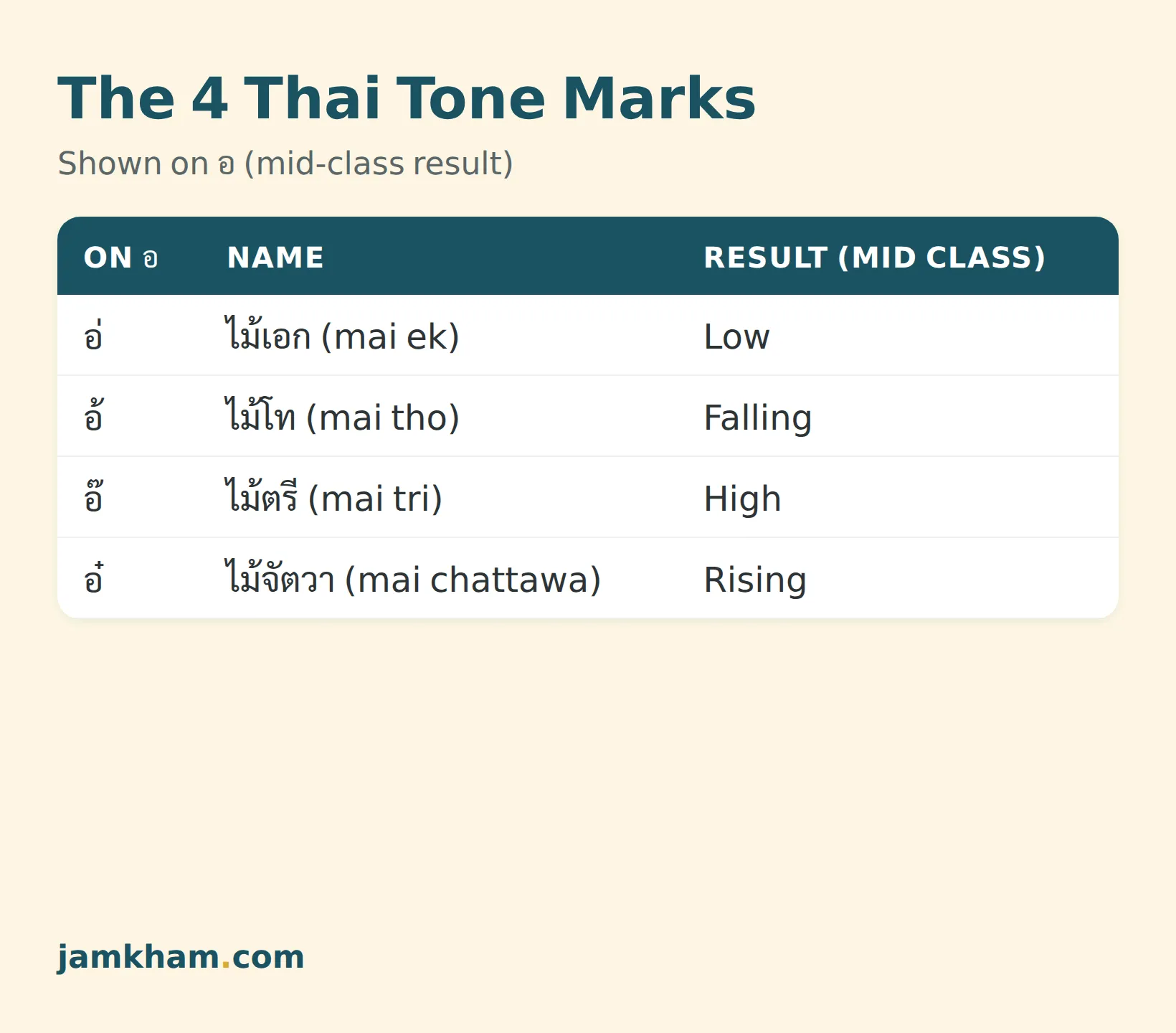
The default is simple: the tone mark goes above the syllable’s initial consonant. Two situations break that default, and both are common.
A vowel already sits above the consonant. Then the tone mark stacks on top of the vowel, not beside it.
nîiนี่this, hereWritten order: น, then ี, then ่. Three characters, bottom to top.
The syllable starts with a cluster or a leading ห. Then the mark moves to the second consonant.
bplàwyปล่อยto release, let go nàwyหน่อยa little, a bitIn ปล่อย(bplàwy) the mark sits over ล, not ป. In หน่อย(nàwy) it sits over น, not ห. Learners who put it over the first letter produce something that still reads as the same word to a patient human and as an error to everything else.
One thing the mark never does is move onto a pre-posed vowel. In เก่ง(gèng) the mark belongs to ก even though เ is physically further left.

The fix: identify the syllable’s initial consonant before you write anything above the line. The mark’s home is that letter — everything else is an adjustment on top of it. This gets much easier once consonant classes are automatic, because finding the initial consonant is the same operation as working out the tone.
See how Thai reading actually works
Read Thai drills the letter, its class, and its tone behaviour together — try it on your first Thai syllable, no account needed.
Sound out your first Thai word →No account, no card — just the alphabet.
Mistake 4: Spelling by Ear When Thai Spells by Etymology
This is the mistake that separates writing from reading completely.
Thai has 44 consonant letters and 21 initial consonant sounds. Several letters are homophones:
| Sound | Letters | Example |
|---|---|---|
| s | ส ศ ษ ซ | สาม (sǎam, three) · ศาล (sǎan, court) |
| th | ท ธ ฑ ฒ ถ ฐ | ทำ (tham, to do) · ธรรม (tham, dharma) |
| kh | ข ค ฆ | คน (khon, person) · ระฆัง (rá-khang, bell) |
| n | น ณ | นาน (naan, long) · คุณ (khun, you) |
(ฑ is the awkward one: in a small set of words it spells a d instead, as in บัณฑิต(ban-dìt).)
Hearing “sǎam” tells you nothing about whether to write ส, ศ, or ษ. The answer is set by where the word came from: native Thai words and Pali or Sanskrit loans use different letters for the same sound, and the spelling preserved that history long after the pronunciation merged.
It goes further than single letters. การ(gaan), กาล(gaan), and กาฬ(gaan) are all pronounced identically and spelled with three different final letters. Words also carry silent letters, killed by the mark ทัณฑฆาต(than-thá-khâat) — the letter sitting under it is a การันต์(gaa-ran). In จันทร์(jan), ทร is written and not said.
The fix: accept that Thai spelling is vocabulary, not a rule you are missing. Learn words as whole written shapes from the beginning rather than as sounds you will spell later. This is also the strongest practical argument against leaning on romanization — a learner who stores สาม(sǎam) as “saam” has stored nothing that helps them write it.
Mistake 5: Confusing Thai Letters That Differ by One Stroke
Several Thai letters are near-identical twins separated by a single tail, hump, stem, or loop position. Reading gives you context to disambiguate them. Writing does not — you either produce the distinguishing feature or you write the wrong letter.
| Pair | Sounds | What separates them |
|---|---|---|
| ผ / ฝ | ph / f | ฝ adds a small flick to the tall stem |
| พ / ฟ | ph / f | ฟ adds the same flick to the tall stem |
| บ / ป | b / bp | ป’s right stem rises above the letter body |
| ด / ต | d / dt | ต’s top-right corner is pointed; ด’s is rounded |
| ฎ / ฏ | d / dt | the same d/dt pair again, in the rarer letters |
| ก / ถ / ภ | g / th / ph | ก has no head; ถ’s loop is bottom-left, ภ’s is top-left |
| น / ม | n / m | same skeleton — ม’s lower loop sits bottom-left, น’s bottom-right |
Notice the pattern in the first two rows: the added flick means “f” in both cases. Several of these differences are systematic rather than arbitrary, which makes them much easier to hold onto than a flat list of 44 shapes.

The fix: practise the confusable letters in pairs, not in alphabetical order. Writing ผ and ฝ ten times each, alternating, builds the contrast far faster than writing the whole alphabet through in sequence.
Mistake 6: Writing a Vowel Where Thai Writes None
Thai does not write every vowel it pronounces. When two consonants sit together with no vowel between them, the vowel is implied. This does not apply to true clusters (ปล, กร, กล) or to a leading ห — there the two consonants are one sound unit and no vowel is inserted.
nókนกbirdThere is no vowel character in that word at all — the “o” is inherent to the structure. Same with คน(khon) and ลม(lom).
The unwritten vowel can also be a short “a” in the first syllable of a longer word:
thà-nǒnถนนroad sà-baaiสบายcomfortable, fineA learner writing from sound hears two syllables’ worth of vowels and supplies them both, producing ถะโหนน or สะบาย. Both are wrong, and both are the direct result of trusting your ears over the written form.
The fix: this is the one mistake on the list that fixes itself, provided you learn words from Thai script rather than from romanization. You will never write a vowel into นก(nók) if the shape you memorised was นก.
Mistake 7: Putting Spaces Between Words
Thai text runs continuously. ฉันกินข้าว(chǎn gin khâao) is three words and no spaces.
Spaces do exist in Thai, but they work like English punctuation rather than like word boundaries. They separate clauses and sentences, set off numerals and foreign words, and follow names. There is also no full stop at the end of a Thai sentence — the space is the full stop.
Learners add spaces because it feels helpful. It is not: Thai readers parse word boundaries from word shapes they already know, and unexpected spaces break that pattern-matching rather than assisting it. The effect is roughly like reading English with a space dropped into the middle of ev ery other word.
The fix: write continuously from the start, even when it feels uncomfortable. And use the space deliberately where Thai does — at a clause break — so your writing has the rhythm a Thai reader expects.
Getting These Right Faster Than Drilling Alone
The mistakes that survive practice — 4, 5, and 6 — come from the same root cause: the letters were learned as visual facts rather than as language. A learner who memorised “ส = s” has stored a fact. A learner who has met ส hundreds of times inside real words has stored a piece of language, and that is the version that tells you when to write ส instead of ศ.
That distinction is what Read Thai is built around. Letters arrive in the order you actually encounter them in written Thai, each one shows up with its class and tone behaviour rather than as an isolated shape, and the review schedule brings it back at the point you are about to forget it. You read a real Thai word by the third card, before any tone theory, because concrete beats abstract when you are building recognition.
How to actually use a Thai alphabet chart
A chart is a reference, not a curriculum. Reading down all 44 letters in order gives you a strong sense of the first six and nothing after that, and it teaches the alphabet as a list — which is exactly the fact-memory failure above.
Use one to look up a letter you have just met, to check a class, or to compare two letters you keep confusing. Our Thai alphabet chart groups the letters by class and links each one into a practice card, so a lookup turns into a rep instead of a glance. For a sensible learning order, which Thai letters to learn first covers the twenty that carry most real text.
Typing Thai versus writing it by hand
Typing skips stroke order entirely, which makes it the faster way to practise spelling and the slower way to learn letter shapes. Do both, for different reasons.
To set up a Thai keyboard: on Windows, Settings → Time & Language → Language & region; on macOS, System Settings → Keyboard → Input Sources; on iOS and Android, add Thai in your keyboard settings. The standard layout is called Kedmanee, and virtually every physical keyboard sold in Thailand uses it.
Two things trip people up. First, you type in written order, not spoken order — ไป is ไ then ป, exactly as you would write it. Second, within a syllable the order is base consonant, then above or below vowel, then tone mark. Type the mark before the vowel and it may render in a visibly wrong position even though the characters are technically all present.
Avoid transliteration input tools that let you type “sawatdee” and convert to Thai. They keep you anchored to romanization at precisely the moment you are trying to break away from it.
The Short Version
Thai writing mistakes cluster into three groups. Mechanical ones — head loops, stroke order, pre-posed vowels, tone-mark placement — are fixed by practice, and they are fixed permanently once the motor pattern is right. Spelling ones are fixed by vocabulary, because the correct letter is a property of the word rather than of the sound. Habit ones, like spacing and vowel insertion, are fixed by learning from Thai script instead of from romanization.
None of them are signs that you started too late or that the script is beyond you. They are the specific, finite set of things English does not prepare you for, and every one of them has a concrete fix.
Q&A
Question: How do you write “Thai” in Thai?
Short answer: The word is ไทย(thai). The language is ภาษาไทย(phaa-sǎa thai) and the country is ประเทศไทย(bprà-thêet thai). Note that ไทย ends in a ย that is not pronounced — it reflects a Pali-influenced spelling convention rather than a sound. Spelling it by ear as ไท gives you a real but different word.
Question: How many letters are in the Thai alphabet?
Short answer: 44 consonant letters, two of which (ฃ and ฅ) are obsolete and appear only in historical texts, leaving 42 in active use. Those 44 letters produce only 21 distinct initial consonant sounds, which is why spelling Thai by ear does not work. On top of the consonants there are roughly 32 vowel forms, four tone marks, and a handful of diacritics such as the silent marker ์.
Question: Do you write Thai vowels before or after the consonant?
Short answer: It depends on the vowel, and written order is not spoken order. Five vowels — เ แ โ ใ ไ — are written to the left of the consonant even though they are pronounced after it, so ไป (bpai) is written ไ first, then ป. Others sit after the consonant (า), above it (ิ ี ึ ื), below it (ุ ู), or wrap around it (เ–ีย).
Question: Where does the tone mark go in a Thai word?
Short answer: Above the syllable’s initial consonant, with two adjustments. If a vowel already sits above the consonant, the mark stacks above that vowel — นี่ is น, then ี, then ่. If the syllable starts with a cluster or a leading ห, the mark goes over the second consonant: ปล่อย takes its mark over ล, and หน่อย over น. The mark never moves onto a pre-posed vowel like เ.
Question: Does Thai use spaces between words?
Short answer: No. Thai runs words together and uses spaces the way English uses commas and full stops — to separate clauses and sentences, around numerals and foreign words, and after names. Adding a space between every word makes text harder for Thai readers, not easier, because they parse boundaries by word shape.
Question: What is the hardest part of writing Thai compared to reading it?
Short answer: Choosing the right letter. Reading only asks you to turn a symbol into a sound, and homophone letters cost you nothing. Writing runs it backwards: you hear “sǎam” and must know that three is สาม with ส rather than ศ or ษ. That choice comes from the word’s etymology, not from any rule you can derive from the sound, so Thai spelling is learned word by word.
Question: How do you type Thai on a computer or phone?
Short answer: Add the Thai keyboard in your system settings — Windows: Settings → Time & Language → Language & region; macOS: System Settings → Keyboard → Input Sources; iOS and Android: add Thai under keyboards. The standard layout is Kedmanee. You type in written order, so ไป is ไ then ป, and within a syllable you type the base consonant, then any above or below vowel, then the tone mark.
See how Thai reading actually works
Learn the letters as language, not as a list — read your first real Thai word in about three minutes. No account needed.
Sound out your first Thai word →No account, no card — just the alphabet.