
Anuban, Prathom, Mathayom: Thai School Levels Explained
Anuban, prathom, mathayom — what each Thai school level means, the ages in each year, and how to read a class label like ม.4/2 on sight.
Second week of term. Someone hands you a laminated timetable. Tuesday, period 3: ม.4/2. Period 5: ป.6/1. Thursday you have อ.3 for something called “conversation.”
You have no idea whether you’re about to face eleven-year-olds or seventeen-year-olds. The head of department has already moved on to the photocopier code. Everyone else reads these labels the way you read “Year 9” — instantly, without thinking — so nobody thinks to explain them.
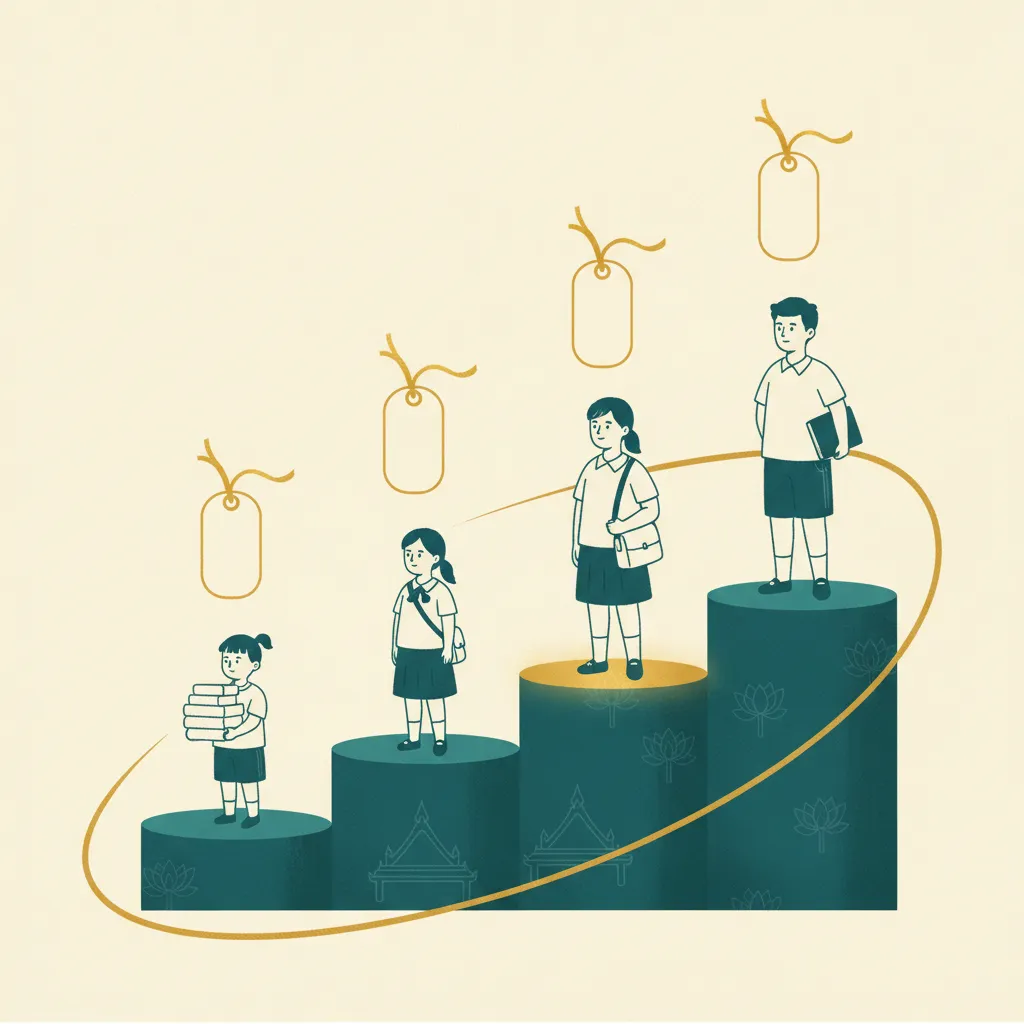
Anuban, prathom, mathayom: four stages, fifteen year labels, one convention for the room number. That’s the whole system, in the form you actually meet it.
The Four Stages: Anuban, Prathom, and Mathayom
Thai basic education is built in four blocks. Each has a formal name in Thai, a one-letter abbreviation you’ll see far more often than the full word, and a numbered range of years.
อนุบาล — anuban, ages 3 to 5
à-nú-baanอนุบาลkindergarten / pre-primaryAbbreviated อ. — so อ.1, อ.2, อ.3. These are the three kindergarten years, roughly ages 3, 4 and 5. Anuban is not compulsory, but it’s state-funded and most Thai children do it, which is why most government primary schools have an anuban wing attached.
If you’re timetabled for anuban, expect songs, colors, and a class of thirty who are still learning to read Thai themselves.
ประถมศึกษา — prathom, ages 6 to 11
bprà-thǒm-sèuk-sǎaประถมศึกษาprimary educationSix years, ป.1 through ป.6, and everyone shortens the name to just ประถม(bprà-thǒm). This is where compulsory schooling begins: under the Compulsory Education Act B.E. 2545 (2002), a child must be enrolled from the year they turn seven, which in practice means starting ป.1 at six going on seven (Act text, Thai).
ป.6 ends with the move into secondary school, which in many towns means an entrance exam for a better-regarded ม.1 place.
มัธยมศึกษาตอนต้น — lower secondary, ages 12 to 14
mát-thá-yom-sèuk-sǎa dtawn-dtônมัธยมศึกษาตอนต้นlower secondary educationThree years, ม.1 to ม.3, universally shortened to ม.ต้น(maw dtôn). This is the second half of compulsory education, and ม.3 is where the legal obligation ends. Some of the students you teach in ม.3 will not be in the building the following year. ม.4 is a choice, and a large share of every year group takes the vocational route to a separate college instead.
มัธยมศึกษาตอนปลาย — upper secondary, ages 15 to 17
mát-thá-yom-sèuk-sǎa dtawn-bplaaiมัธยมศึกษาตอนปลายupper secondary educationThree years, ม.4 to ม.6, shortened to ม.ปลาย(maw bplaai). Optional, competitive, and streamed: at ม.4 students pick a track, most commonly science-math (วิทย์-คณิต(wít-khá-nít)) or one of the arts tracks. The alternative is a vocational certificate at a separate college.
ม.6 is the exit year. Much of it — the mock exams, the days out for entrance tests and interviews, the stress — runs on the university admission calendar.
How to Read a Thai Class Label
The part that makes a timetable readable is this: a label has three pieces.
ม.4/2 = ม. (mathayom) + 4 (the year) + /2 (the room)
The slash is read aloud as ทับ(tháp), the same word used in Thai house numbers. So ม.4/2 is spoken “maw sìi tháp sǎwng,” and it means Mathayom 4, room 2 — ห้อง(hâwng) is the class section, not a period or a study group. It’s the second homeroom of that year, with its own roll, its own homeroom teacher, and usually its own room.
Read the letter, read the year, and you know the age. That’s the whole trick.
Thai class labels at a glance
| Label | Said aloud | Stage | Typical age |
|---|---|---|---|
| อ.1 – อ.3 | aw nèung – aw sǎam | Anuban (kindergarten) | 3–5 |
| ป.1 – ป.6 | bpaw nèung – bpaw hòk | Prathom (primary) | 6–11 |
| ม.1 – ม.3 | maw nèung – maw sǎam | Mathayom, lower secondary | 12–14 |
| ม.4 – ม.6 | maw sìi – maw hòk | Mathayom, upper secondary | 15–17 |
Once the labels stop being noise, the rest of the paperwork opens up too — the class list and the report card use the same script. If you have never read a Thai word, try the first characters free, no account and watch the letters on that timetable stop being shapes and start being sounds. That’s the first step the Read Thai course builds on, in the order you meet the letters.
Nine Years Compulsory, Fifteen Years Free
These two numbers get quoted interchangeably and they mean different things.
Nine years are compulsory. The Compulsory Education Act B.E. 2545 covers ป.1 through ม.3, from the year a child turns seven until sixteen. That’s the block a parent can be penalized for skipping.
Fifteen years are free. A 2016 order re-established state-funded basic education at fifteen years, from anuban through ม.6 or an equivalent vocational certificate, covering five categories of cost: tuition, textbooks, learning materials, uniforms, and student development activities (ThaiPublica’s breakdown of the policy).
The gap between the two explains a lot of staffroom conversations. Attendance stops being legally required at ม.3, but the money keeps flowing to ม.6, so schools push hard on retention through the transition.
Grades: The 0–4 Scale and GPAX
Thai school grades are numbers, not letters, on a scale running from 4 down to 0 in half-point steps: 4, 3.5, 3, 2.5, 2, 1.5, 1, 0. A 1 is the minimum pass, usually around 50 percent, and 0 is a fail; schools set the exact percentage cut-offs within the national criteria set out in the Ministry’s assessment guidance for the 2551 core curriculum. That’s the scale on every mathayom report card. Prathom has more latitude, and the lower years are moving to a four-band descriptive scale under the new 2568 primary curriculum, piloted from the 2025 school year.
The trap for a Western teacher is reading a 3 as a C. It isn’t. On an eight-step scale where 1 is the pass line, a 3 sits well up the range — closer to how you would read a B.
Two other marks turn up on Thai report cards and neither is a grade. ร(raw) means the result is on hold because work or data is missing. มส(maw sǎw) means the student fell below the required share of class hours — commonly 80 percent — and lost the right to sit the end-of-semester assessment (OBEC assessment guidelines, Thai PDF). If a student in your register has one of these, it is an attendance problem, not a marking problem.
GPAX is the cumulative version — the average that follows a student out of ม.6 into the university admission system. It normally covers all six semesters of ม.ปลาย, though some admission rounds use five. GPA is one term; GPAX is the whole run.
The School Year Starts in May
If you arrived expecting a September start, the calendar will keep surprising you. Under the Ministry of Education’s regulation on the academic year, the Thai school year runs 16 May to 15 May, split into two semesters:
- First semester — ภาคเรียนที่ 1(phâak-rian thîi nèung) — opens 16 May, closes 11 October
- Second semester — ภาคเรียนที่ 2(phâak-rian thîi sǎwng) — opens 1 November, closes 1 April
Schools can shift these dates with approval, and many do by a week or two, so treat them as the frame rather than the promise. The shape holds everywhere: about three weeks off in October, and the long ปิดเทอม(bpìt thoem) running through April — the hottest month, and the one Songkran falls in.
For a teacher this is the most practical fact in the post. Hiring peaks ahead of the May opening, with a smaller wave before November, and a contract signed in July drops you into a semester with classes already formed. An April flight home is not a favor your school is doing you; it is when the building is empty.
Why This Is a Reading Problem
Notice what every item in this post has in common. The timetable is in Thai script. So is the class list, the report-card header, the permission slip you countersign, and the message that lands in the school LINE group at 9pm about tomorrow’s assembly.
A foreign teacher who can’t tell ม. from ป. on sight is, in a narrow but real sense, illiterate at work. Not incapable — you will muddle through with photos sent to a colleague and an app that mangles field labels. But you stay a step behind information everyone else got instantly. The same holds for what everyone calls you: ajarn and khru are not interchangeable, and the one on your door plate was a choice somebody already made for you.
The fix is smaller than it sounds. You need the letters and a few dozen recurring words, not fluency — the same narrow goal that makes reading Thai forms and letters a job of weeks. Start with the script: how to read Thai walks through the logic, the Thai alphabet chart lays out all 44 consonants with their classes, and the complete guide to Thai script explains why vowels sit above, below and around the consonant. Add Thai numerals — the same ones on your payslip and your lease — and the dates on a permission slip stop being guesswork.
Then read what is in front of you. A class list is ideal early practice material: short, repetitive, and you already know what it says. Thai forms and official paperwork is the next step up, and the learning roadmap sets out the order.
Frequently Asked Questions
What does ม.4/2 mean in a Thai school?
It is a class label. ม. stands for มัธยมศึกษา(mát-thá-yom-sèuk-sǎa), the 4 is the year (upper secondary year one, typically age 15), and the /2 is the homeroom number within that year. The slash is read aloud as ทับ(tháp), so ม.4/2 is the second class of Mathayom 4.
How old is a mathayom 1 student?
Around 12 at the start of the year. Mathayom 1 (ม.1) follows straight on from ป.6. Lower secondary runs ม.1 to ม.3, roughly ages 12 to 14; upper secondary runs ม.4 to ม.6, roughly ages 15 to 17.
Is mathayom compulsory in Thailand?
Only the lower half. Compulsory education covers nine years — ป.1 to ม.3 — under the Compulsory Education Act B.E. 2545, so ม.4 to ม.6 are not required. Upper secondary is still free: state-funded basic education runs fifteen years, from anuban through ม.6 or an equivalent vocational certificate.
What is GPAX and how is it different from GPA?
GPA is the average for a single semester. GPAX is the cumulative average across semesters — for a school leaver, normally all six semesters of ม.4 to ม.6, though some admission rounds use five. Both sit on the same 0–4 scale, where 1 is the minimum pass.
When does the Thai school year start?
Mid-May. Under the Ministry of Education’s regulation, the academic year runs from 16 May to 15 May, with the first semester from 16 May to 11 October and the second from 1 November to 1 April. Individual schools can adjust the dates slightly with approval. The long holiday is April, not summer.
Read the Board Instead of Guessing at It
Class labels are the easiest Thai you will ever have to read: three letters, six numbers, one slash. But they are written in a script, and until you can read that script they stay a code someone else has to read out for you.
Read your first Thai letters right now, no account needed — two minutes is enough to find out whether Thai script clicks for you. From there, the structured alphabet course teaches every consonant and vowel in the order you meet it, with the tone rule behind each one; the first three modules are free, no card. A Thai school is the best possible place to learn it — you’re surrounded by the same few hundred written words every day.
Start reading Thai today
The timetable, the class list, the report card — all in a script you can learn in a few weeks. Read Thai teaches every consonant and vowel in the order you meet it, with the tone rule behind each one. First three modules free — no card.
Start the reading course →First 3 modules free — no card, and they don't expire.