
Wai Kru: What Happens at Thailand's Teacher Ceremony
Wai kru explained: the June school ceremony, the four plants on the tray, why it falls on a Thursday, and what a teacher is actually meant to do.
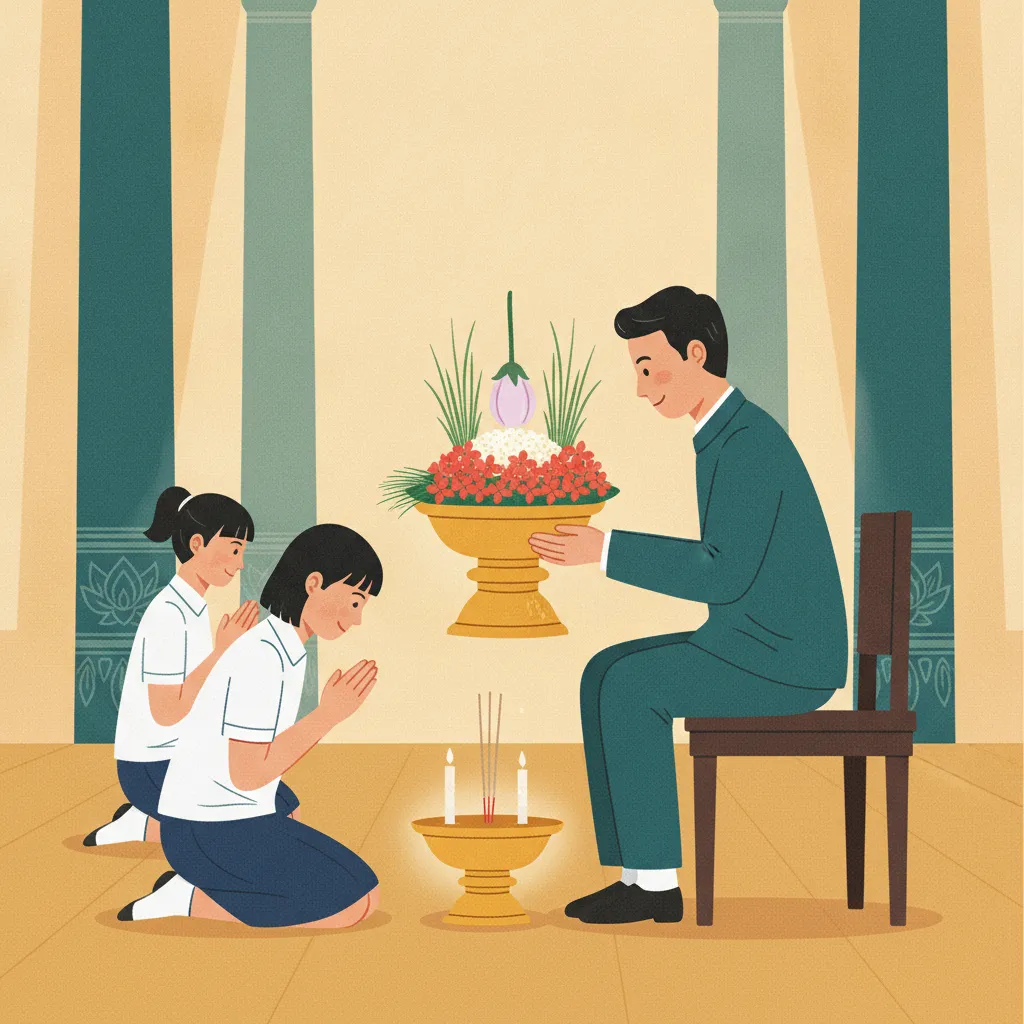
Your first June in a Thai school, someone tells you to wear the formal jacket and be in the hall by eight. You end up in a chair on a stage. Below you, several hundred students are sitting on the floor in rows, and at a cue they bow forward together, hands pressed together and set on the tiles in front of them. A student at the microphone leads a chant that isn’t Thai and isn’t English. Everyone answers it from memory. Then the class representatives come forward on their knees, each carrying a flower arrangement built on a pedestal tray, and one of them holds it up to you.
Nobody briefed you. You have a tray in your hands, the whole school is watching, and you don’t know whether to bow back.
This is wai kru — ไหว้ครู(wâi khruu), paying respect to the teacher — and every part of it means something specific, spelled out below.
Three different things called wai kru
The phrase is two words stacked: ไหว้(wâi) and ครู(khruu), the latter borrowed into Thai from Sanskrit guru. Paying respect to the teacher. Three different occasions carry the name, and they’re easy to mix up.
วันไหว้ครู — the school ceremony
This is the one you’re sitting in. Schools hold it early in the first semester — which in the Thai school system opens in May — usually on the second Thursday of June, though each institution picks its own Thursday and some run it on the first Thursday of term instead, which can put it in late May. Ask your school; don’t assume.
The Office of the Royal Society’s definition explains the timing: ไหว้ครู is the ceremony by which a person becomes a student before beginning to learn. It sits at the start of the year because it’s the formal act of entering the relationship, not a thank-you at the end of one. The word for a student, ลูกศิษย์(lûuk sìt), stacks “child” on “disciple” — ลูก(lûuk) plus ศิษย์(sìt). A family framing, and the ceremony is where it opens.
The running order barely varies: the presiding teacher lights incense and candles, a student representative leads the homage, everyone chants together, the student leaders read an oath committing to study seriously, and the trays come up class by class.
วันครู — National Teachers’ Day, 16 January
A separate observance, and a national one. On the proposal of then prime minister Plaek Phibunsongkhram, the Thai cabinet resolved on 21 November 1956 to make 16 January Teachers’ Day — the date the Teachers Act was published in the Royal Gazette in 1945. The first national ceremony followed on 16 January 1957 at Suphachalasai Stadium in Bangkok. Its symbol is the orchid, ดอกกล้วยไม้(dàwk glûay-máai), chosen because an orchid takes long, patient attention before it flowers.
One practical note, because it’s the question every foreign teacher actually has: 16 January is not a national public holiday. Banks and government offices run normally. Most schools do close teaching so staff can attend the official ceremonies, but it varies — check yours rather than assuming a day off.
ไหว้ครูรำมวย — before the fight
Same root idea, different setting. A fighter circling the ring and kneeling to each corner before a bout is performing ไหว้ครูรำมวย(wâi khruu ram muay) — honoring trainers, gym, and lineage. The vocabulary is almost the same as the school version, because the relationship is. Our guide to Muay Thai vocabulary for the gym covers that ritual and the words a trainer uses on the pads.
What’s on the tray
The arrangement is built on a พาน(phaan), a footed tray used for presenting things respectfully. Most classes bring a pair — พานดอกไม้(phaan dàwk-máai) and พานธูปเทียน(phaan thûup thian) — and the four traditional plants go on the flower one. Classes usually compete to build the best tray, and one can take a week of evenings.
Under the decoration are four traditional elements, and none of them are there for color.
The four plants and what they stand for
| Thai | Romanization | Literally | Meaning on the tray |
|---|---|---|---|
| หญ้าแพรก | yâa phrâek | Bermuda grass | Learning that takes hold fast and survives being walked on |
| ดอกมะเขือ | dàwk má-khěua | Eggplant flower | Humility — the flower always hangs face-down toward the ground |
| ข้าวตอก | khâao dtàwk | Popped rice | Discipline — the grain opens only under controlled heat |
| ดอกเข็ม | dàwk khěm | Ixora flower | A keen mind — เข็ม also means “needle” |
Thai PBS records the wishes plainly: may you learn as fast as หญ้าแพรก grows, a grass that spreads quickly and withstands heat, drought, and feet; may you have a keen intellect, สติปัญญาเฉียบแหลม(sà-dtì bpan-yaa chìap lǎem), like the ixora’s name. The popped rice stands for discipline: a grain doesn’t burst open on its own, but under controlled heat every grain opens white.
The species are specific: the Royal Park Rajapruek collection lists หญ้าแพรก as Cynodon dactylon and ดอกเข็ม as Ixora spp. with the same symbolism attached.
That argument isn’t only about ceremonies — it’s the program sheet on your chair, the banner over the stage, and the label on the tray your students spent Wednesday night building. If you want to find out whether Thai letters click for you, read your first Thai word right now, no account needed. The Read Thai course takes the characters in the order you’ll meet them; the Thai alphabet chart is the free version to keep open on your phone.
Why Thursday
Because Thursday is Jupiter’s day, and Jupiter teaches.
The Thai name for the day, วันพฤหัสบดี(wan phá-réu-hàt-sà-baw-dii) — shortened to วันพฤหัส(wan phá-réu-hàt) in ordinary speech — comes from Brihaspati, who in Brahmanic-Hindu tradition is the guru of the devas, the teacher of the gods, and who gives his name to the planet Jupiter. The convention long predates the school assembly: the Office of the Royal Society records that parents once took their children to be entrusted as a teacher’s students on a Thursday, bringing incense, candles and flowers with them. So the ceremony that formally begins a student’s year sits on the weekday that already belonged to teaching.
That also explains a structural difference between the two dates. วันไหว้ครู(wan wâi khruu) is fixed to a weekday and drifts across the calendar. วันครู(wan khruu) is fixed to a date, 16 January, and drifts across the week. One follows tradition; the other follows a cabinet resolution.
What you’re supposed to do
The practical part, in the order it happens.
Receive the tray with both hands. Take it, hold it briefly, set it down where the school has indicated — usually a table beside you. Don’t wave it off, and don’t take it one-handed.
Acknowledge the wai; don’t mirror it. The gesture is directed at you in your role as ครู(khruu). Thai has a word for the response — รับไหว้(ráp wâi) — and it is hands together at chest height with a slight nod, or, since yours will be full of tray, just the nod, a smile and a word. What you don’t do is raise your hands to nose or forehead height, the way you would wai someone senior to you. That’s standard Thai practice rather than a school rule: the wai moves upward, and the person receiving it acknowledges rather than mirrors it. Our guide to Thai politeness levels covers the wider pattern.
Say something. Even one sentence. ขอบคุณครับ(khàwp khun khráp) or ขอบคุณค่ะ(khàwp khun khâ) — “thank you” — is enough, and it will be remembered longer than you expect. If you’re unsure which particle is yours, khop khun kha vs khrap sorts it out in a minute.
Dress the way you’re told. Thai schools are specific about this, and the answer is almost always more formal than a normal teaching day. Ask a colleague rather than guessing.
Frequently Asked Questions
What does “wai kru” mean?
ไหว้ครู(wâi khruu) combines ไหว้(wâi) — the palms-together gesture of respect — with ครู(khruu), teacher, a word Thai borrowed from Sanskrit guru. It means paying respect to the teacher, and it names both the school ceremony and the ritual a Muay Thai fighter performs before a bout.
When is Wai Kru Day in Thailand?
The school ceremony is held early in the first semester, most commonly on the second Thursday of June, though each school sets its own Thursday and some hold it on the first Thursday of term. It’s a weekday tradition rather than a fixed date, so it moves each year.
What do the four flowers on the wai kru tray mean?
หญ้าแพรก (Bermuda grass) stands for learning that takes root fast and endures hardship; ดอกมะเขือ (eggplant flower) for humility, because the flower always hangs face-down toward the ground; ข้าวตอก (popped rice) for discipline, the grain opening only under controlled heat; and ดอกเข็ม (ixora) for a keen mind, since เข็ม also means “needle.”
Is Wai Kru Day the same as Teachers’ Day in Thailand?
No. วันไหว้ครู is the school ceremony in June. วันครู, National Teachers’ Day, falls on 16 January and was established by cabinet resolution in 1956 to mark the publication of the Teachers Act on 16 January 1945. Teachers’ Day is not a national public holiday, though most schools suspend classes for it.
What should a foreign teacher do at a wai kru ceremony?
Attend, dress as formally as your school specifies, receive each tray with both hands, and acknowledge the students’ wai with a nod, a smile, and a short thank-you rather than returning a full wai. Avoid stepping over trays placed on the floor.
After the ceremony
The ceremony rewards attention. Once you know the eggplant flower is about humility and the ixora is a play on the word for needle, the arrangement in front of you stops being decoration and becomes a sentence your students wrote to you. The same is true of the banner, the program, and half the signage in the building.
The alphabet is the whole barrier there, and it’s smaller than it looks. Try the first Thai characters free, no account needed and see whether the letters click — two minutes is enough to find out. Or read the plain-language explanation of how Thai reading works first. When you want the structured version, the Read Thai course teaches every character with the tone rule behind it. Not starting today? Take the one-page Thai script cheatsheet and keep it in your desk drawer for next June.
Related reading: Muay Thai Vocabulary for the Gym | The Thai School System Explained | Thai Pronouns: How “I” and “You” Actually Work
Start reading Thai today
The tray label, the program sheet, the banner over the stage — all written in a script you can learn in a few weeks. Read Thai teaches every character with the tone rule behind it. First three modules free — no card.
Start the reading course →First 3 modules free — no card, and they don't expire.